
How Monumental taught robots to think like masons
Bricklaying hasn't changed in 2,000 years. Monumental is betting robots can finally change that.
Published on August 24, 2026
© Monumental

Mauro swapped Sardinia for Eindhoven and has been an IO+ editor for 3 years. As a GREEN+ expert, he covers the energy transition with data-driven stories.
“If you were to pull a construction worker from the Roman age to our days, they would probably grab a trowel and get to work. Mortar, bricks, and scaffolding: things have barely changed in thousands of years,” says Salar al Khafaji. He says it half-jokingly. But the joke points at exactly the problem Monumental is trying to solve: an industry that has hardly innovated, even as it faces labor shortages and rising costs.
Monumental is a robotics startup automating bricklaying. Its robots, guided by proprietary software, are capable of laying brick and mortar on active construction sites, minimizing human intervention. With a fleet of over 150 robots, the company has now built over 100 homes across the Netherlands and the United Kingdom.
The company was founded in 2021 by Al Khafaji and Sebastiaan Visser. The two had already built and sold one company together — Silk, a data-visualization startup acquired by Palantir in 2016. In July, the Amsterdam-based startup announced the closure of a $32 million funding round. This funding will help grow the team, strengthen its presence where it is already active, and set foot in the United States.
.png&w=2048&q=75)
Investment of the month
Each month, we interview a startup or company that has recently received an investment.
Robots taking over the construction site
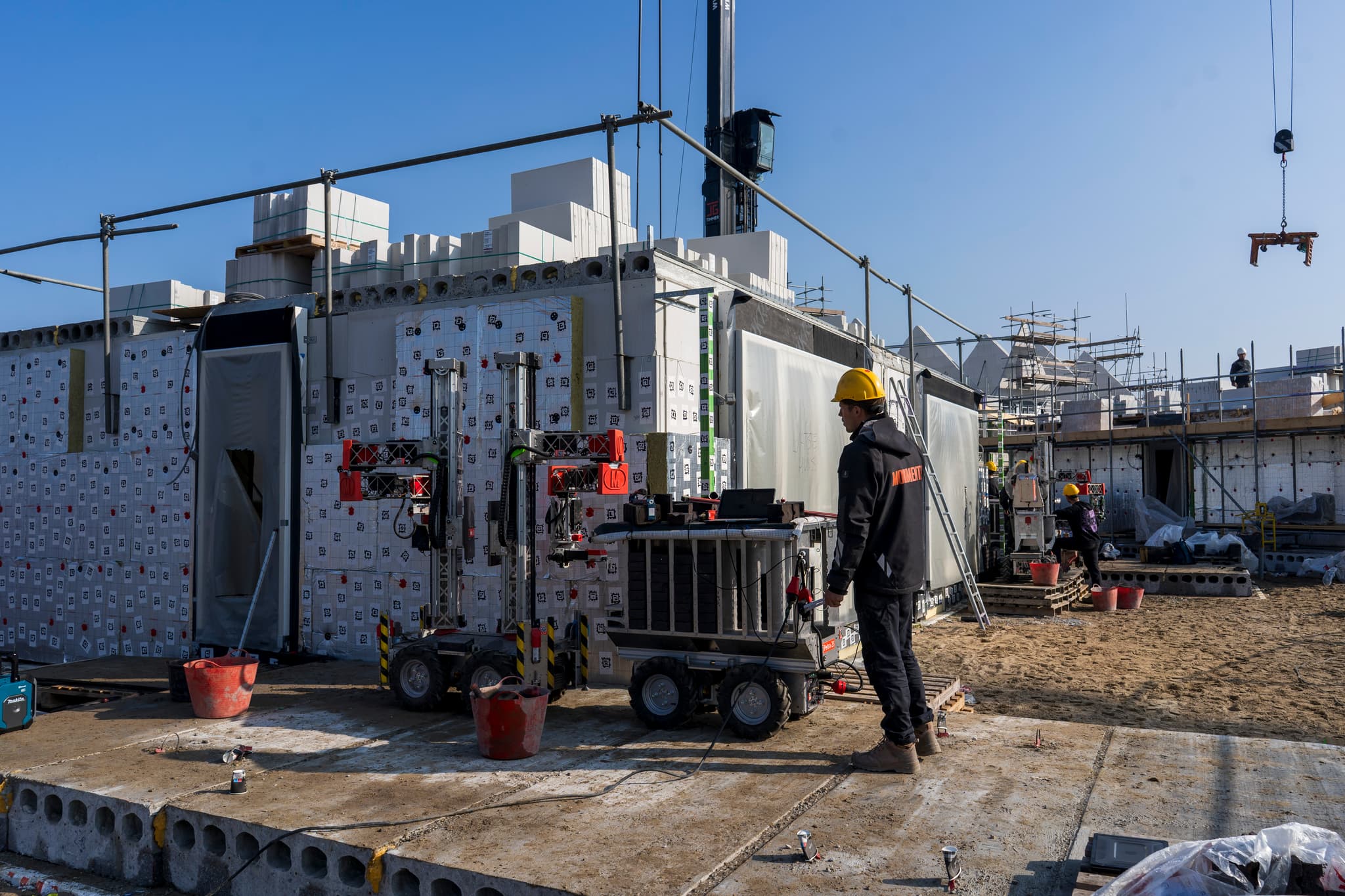
A Monumental crew on a construction site works in small teams of three robots: one lays brick and mortar, the other two resupply it with materials. Fixed sensor units mounted around the site — Al Khafaji calls them mushrooms — track the robots’ positions in real time.
The bricklaying robot is equipped with an arm to pick up bricks and another to extrude mortar. Developing this dedicated extruder proved a significant engineering feat due to the inconsistency of mortar, which sometimes behaves as a solid and sometimes as a liquid. The team came up with a custom nozzle that dynamically adjusts the vibration and extrusion rates in real time, ensuring the mortar is always ready to adhere to bricks.
What makes execution smooth on the construction site is the proprietary software engine behind it: Atrium. “It contains architects’ drawings, live 3D models, and real-time telemetry straight from the site,” Al Khafaji says. “Atrium is the core of the company. Despite technically being a robotics company, our engineering team skews roughly three-to-one software to hardware.”
External Content
This content is from youtube. To protect your privacy, it'ts not loaded until you accept.
Operating robots out in the open
Unlike other use cases, construction robots need to localize themselves in an open, unstructured space. In a factory, a robot repeats the same task over and over at the same location — picking up an item and putting it on a conveyor belt, for instance.
“In construction, I can give a brick and ask you where it goes, and even an experienced human doesn’t know off the top of their head. A skilled mason uses a total station, sets out string lines, and even then, determining where to place the first brick is hard,” stresses the founder. If laying bricks is hard for humans, then teaching robots to interact in an open space and lay bricks correctly took years of research and development.
Once a wall section is built, the company conducts visual inspections to verify what has been built and confirm it meets the specifications, adding further information to continue improving performance.
Acting as a full-fledged subcontractor
Monumental doesn’t sell its robots; rather, it sells completed walls. The CEO explains that, given industry dynamics, this was the go-to option. Contractors don’t have the money to invest in expensive robots, and if they did, the product would have to be perfect from the start.
“When we started, our robots couldn’t do corners. Contractors wouldn’t have tolerated that if we had sold them the robots. So, initially our robots only did the bricklaying, and we paid masons to handle the corners, absorbing the costs ourselves to prove our solutions. As long as the wall was built, contractors were fine with it,” he recalls.
This strategy helped Monumental get the ball rolling and iterate faster. Now, not only do its robots build corners, but they also can follow patterns, recognize when a gap has to be left for a window frame, and know when to stop because a mason has to step in and install a lintel. "We never thought we were going to be amazing at it," he says. "We thought just learning by doing is the best way to learn."
%2520%2526%2520Sebas%2520(left)__1.JPG&w=2048&q=75)
Monumental's founders. On the left, Sebastiaan Visser and on the right, Salar al Khafaji. - © Monumental
Scaling
The funding round, led by Khosla Ventures, pushes the total raised amount past $60 million. Monumental employs 130 people, including robotics engineers, software developers, and on-site operators. Robots are assembled in-house, and Al Khafaji wants to keep it that way.
For him, scaling is the real challenge: taking on larger projects, increasing the fleet, and improving performance. “We are trying to do all of that at the same time across different countries. There are many engineering challenges we have to tackle, but they feel more like an exciting roadmap than a source of dread,” he states.
When is autonomous homebuilding going to happen?
Al Khafaji is candid that fully autonomous homebuilding — robots framing an entire structure, not just its walls — is likely "a matter of decades" away. The nearer-term ambition is more personal: he believes automation doesn't have to make buildings uglier.
"I think robots can bring back aesthetics to the world," he says. "We've been building ugly things for decades... our robots can build beautiful things without being more expensive." Even standard social housing, he argues, doesn't have to be visually forgettable.
The process is in full swing, and having proved itself on the construction site, Monumental is enjoying its growth. The same Roman mason, dropped onto a Monumental site today, would have a lot more trouble recognizing his trade.