
How Fizyr’s vision AI is automating the edge cases of logistics
At NCAS26, Ken Fleming demonstrated how artificial intelligence is giving robots the vital ability to "see" and reason.
Published on April 23, 2026
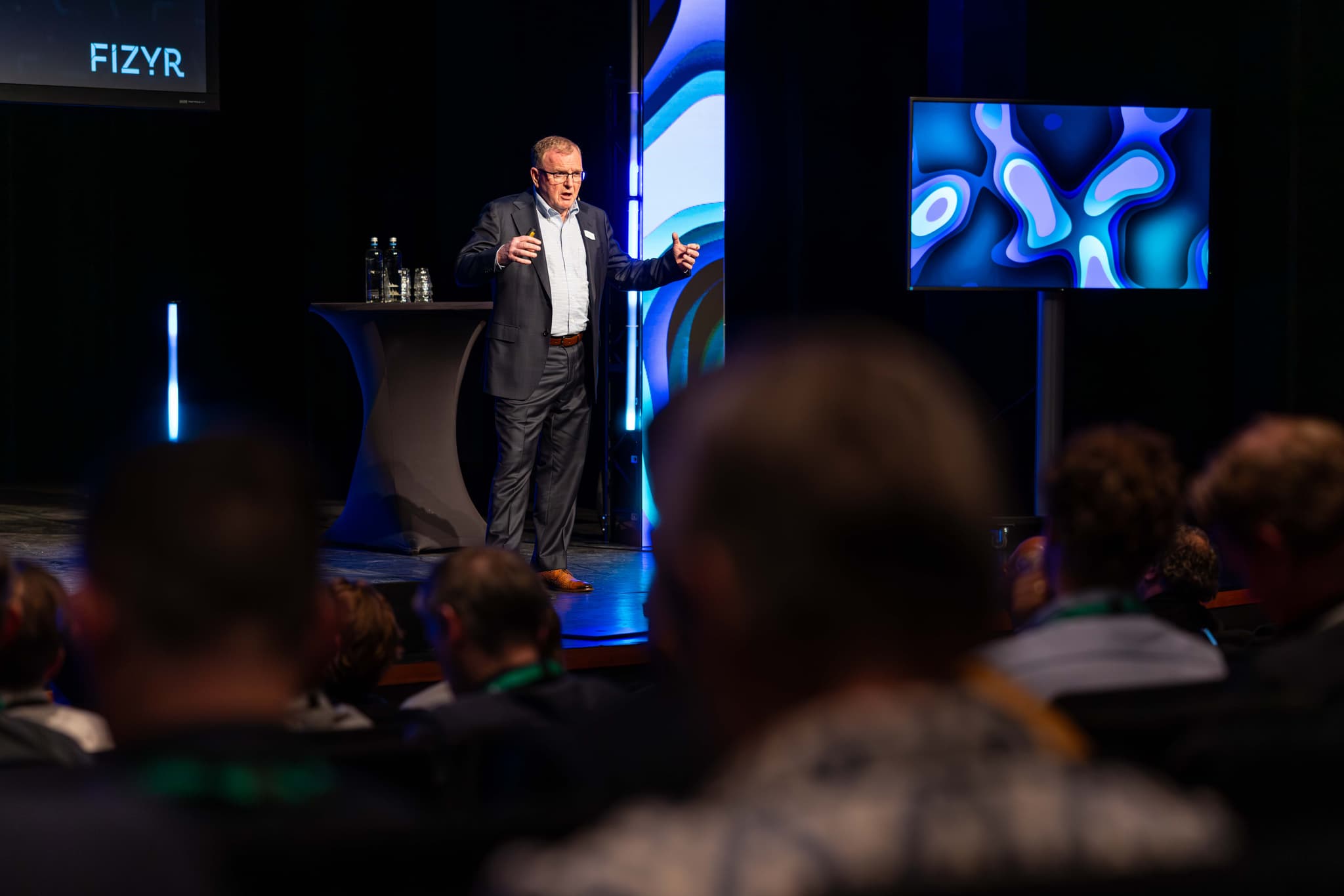
Ken Fleming, CEO of Fizyr, NCAS 2026 © NCAS

Bart, co-founder of Media52 and Professor of Journalism oversees IO+, events, and Laio. A journalist at heart, he keeps writing as many stories as possible.
Fyzir’s journey began as a TU Delft incubator project that successfully won the Amazon picking challenge for both identifying and placing items. However, the team quickly learned a crucial business lesson: building and maintaining physical robot fleets is vastly different from developing algorithms. To scale, they pivoted to focus exclusively on what they did best - computer vision software - leaving the hardware to integrator partners.
Today, Fizyr provides the "thinking piece" that translates raw camera sensor data into actionable instructions for inherently "dumb" robots. At the Nationaal Congres Autonomous Systems (NCAS’26), Ken Fleming, CEO of Fizyr, demonstrated how artificial intelligence is giving robots the vital ability to "see" and reason.
Mastering the chaos and quality control
While many automated warehouses rely on robots moving neatly stacked boxes, Fizyr specializes in the messy "edge cases". Whether dealing with chaotic piles of parcels where people have walked on the packages, or unpredictably oriented items, Fizyr’s Vision AI thrives in environments where strict, classical programming fails.
Fleming also emphasized a vital, often-overlooked dual purpose of Vision AI: it is not just about telling a robot where to pick an item, but also performing rigorous quality control. For example, in food processing, Fizyr’s AI doesn't just locate a pepper; it analyzes the skin for bruises, calculates the severity of the damage, and applies the specific quality-acceptance rules of individual retailers before deciding if the robot should pack it.
The Heerenveen success story: Sorting the unsortable
The highlight of Fleming’s presentation was a highly successful, local collaboration with Pallet Sorting Systems based in Heerenveen. Sorting wooden pallets is a notoriously difficult, manual job characterized by heavy lifting, splinters, and extreme monotony. Because the work is so repetitive and physically taxing, warehouse staff typically leave for other jobs within six months, forcing companies into a constant cycle of rehiring and retraining.
While automating this process seemed obvious, it proved incredibly complex. The global supply chain relies on an insane variety of pallets, different sizes, custom dimensions, varying weights, and different moisture levels.
Initially, Fizyr’s brilliant academic engineers tried to train the AI using strict industry specifications and a 2% tolerance margin. It failed completely. The system was unable to intuitively handle the massive real-world variations that a human worker processes instantly.
The missing link: "Arie" the human expert
To solve this, Fizyr realized they were missing domain expertise. They brought in a human pallet-sorting expert named Arie, who possessed an intuitive, mid-air understanding of what constituted a good or bad pallet based on years of manual labor. By having Arie stand next to the software engineers and tell them whether the AI's assessments were accurate, they successfully translated human cognitive reasoning into the neural network.
The resulting system is a fully automated sorting tunnel equipped with seven cameras. The pallets enter the tunnel, the cameras feed data to Fizyr's AI "brain," and the system instantly calculates what the pallet is and where it should be sorted.
Agnostic hardware and the road ahead
To make these systems highly adaptable, Fizyr remains strictly camera- and robot-agnostic, allowing integrators to choose the best hardware for their specific use case. They are also actively partnering with NVIDIA, using advanced Jetson platforms to reduce the heavy compute footprint previously required by massive GPU servers, which is crucial for battery-powered mobile robots.
Looking ahead, the Pallet Sorting Systems collaboration is already expanding. While the AI currently sorts by type and detects heat-treated wood, by early next year, the system will feature full inspection capabilities to autonomously detect broken boards and rogue nails.
For Fleming, the ultimate takeaway for the Autonomy Economy was clear: true innovation requires bringing together the best software engineers, the best mechanical builders, and the human end-users to build a "best of breed" solution.