
How a quiet regional aircraft could reshape Europe’s air mobility
VÆRIDION’s Microliner was designed from scratch: a nine-seat, fully electric aircraft designed for routes of up to 400 kilometers.
Published on January 2, 2026
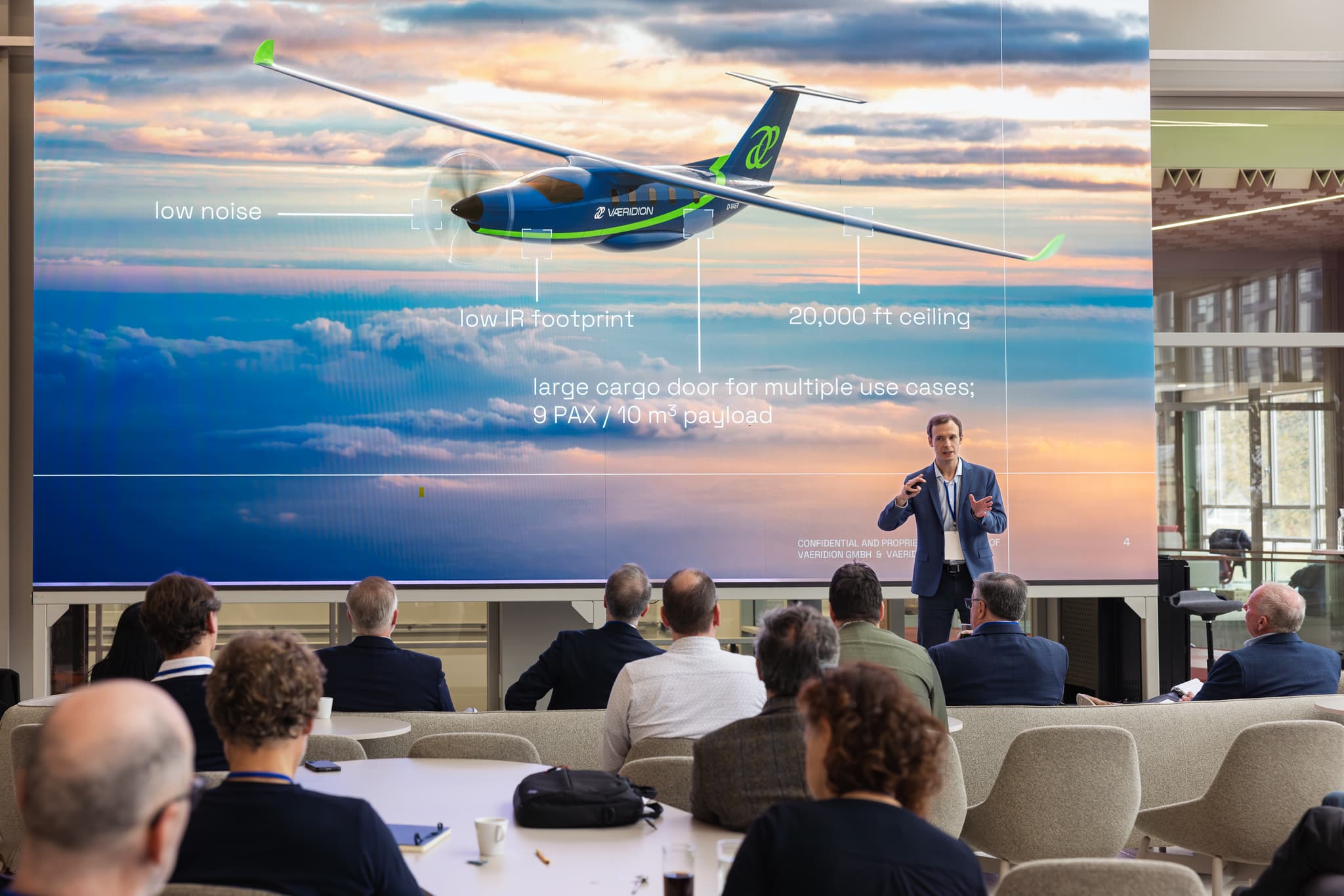
Dr. ir. Nando van Arnhem, Vaeridion's Head of Flight Physics © Nadia ten Wolde
Bart, co-founder of Media52 and Professor of Journalism oversees IO+, events, and Laio. A journalist at heart, he keeps writing as many stories as possible.
At first glance, VÆRIDION looks like yet another startup chasing the promise of electric flight. But as the Munich and Delft-based company took the stage at Blue Magic Netherlands, it quickly became clear that its ambitions extend far beyond green aviation. What VÆRIDION is building is not just an aircraft, but a platform; one that sits at the intersection of civil aviation, energy technology, and Europe’s growing need for strategic autonomy.
“Our focus is not a retrofit,” the company's Head of Flight Physics, Dr. ir. Nando van Arnhem explained on stage. “This is a clean-sheet aircraft.”
That distinction matters. Instead of electrifying an existing design, VÆRIDION started from scratch. The result is the Microliner: a nine-seat, fully electric aircraft with a 24-meter wingspan, designed for short regional routes of up to 400 kilometers. It is built to operate under IFR conditions, from existing regional airports, and to do so with a fraction of the noise and emissions of conventional aircraft.
In a world where aviation is under growing pressure to decarbonize, that alone would be noteworthy. But what makes VÆRIDION stand out is how deliberately the company designed the aircraft for multiple roles: civil and beyond.
A clean-sheet aircraft for real-world operations
The Microliner is not intended as a futuristic concept or demonstrator. It is being designed for daily operations: regional passenger flights, cargo transport, medical evacuation, and logistics.
Its configuration reflects that pragmatism. The aircraft features a long, glider-inspired wing for maximum efficiency, integrated modular battery packs in the wings, and a multi-engine, single-propeller propulsion system. The result is an aircraft optimized for low energy consumption, low noise, and high reliability.
“We’re not chasing speed,” Van Arnhem explained. “We’re optimizing for efficiency, safety, and operational flexibility.”
That philosophy explains why the aircraft’s 400-kilometer range is seen as a strength rather than a limitation. Roughly 20 percent of all commercial flights worldwide fall within that range. In Europe alone, thousands of underused regional airports already exist that could support such operations without major new infrastructure.
And crucially: the Microliner is designed for real certification pathways. VÆRIDION has already completed its preliminary design review, selected key suppliers, and is now moving into detailed design. First flight is scheduled for 2027, with commercial deliveries targeted for 2030. The company already has its first customer contracts in place.
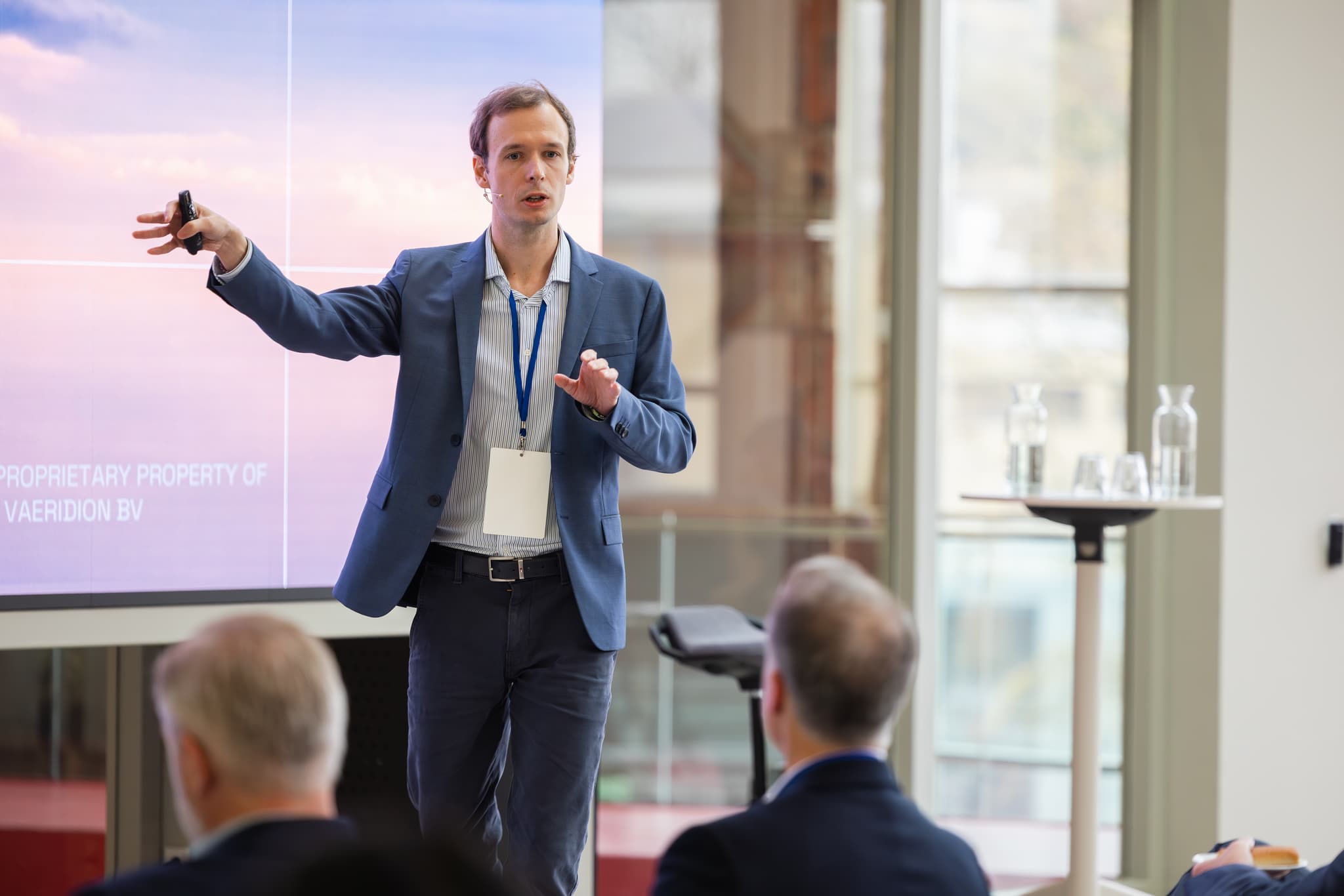
Dr. ir. Nando van Arnhem, Vaeridion's Head of Flight Physics © Nadia ten Wolde
From sustainable aviation to dual-use potential
Where the presentation took a surprising turn was in its discussion of dual-use applications.
Because the Microliner is electric, quiet, and capable of operating from relatively short runways, it also fits emerging military and security needs, particularly in Europe, where dispersed operations and infrastructure resilience are becoming strategic priorities.
“We are not building a military aircraft,” Van Arnhem emphasized. “But the technology naturally enables dual use.”
Low acoustic and infrared signatures, single-pilot operation, and low maintenance requirements make the aircraft suitable for surveillance, logistics, and support missions. With more than 3,500 airfields across Europe - including roughly 200 military airports - the Microliner could operate from locations that are currently underutilized.
This aligns closely with NATO’s evolving concept of agile combat employment: moving away from large centralized airbases toward distributed, flexible operations that are harder to disrupt.
The battery as a strategic technology
Perhaps the most striking part of VÆRIDION’s story is its battery technology.
Rather than relying on off-the-shelf solutions, the company has developed its own battery system architecture: everything above the cell level. That includes thermal management, mechanical protection, monitoring systems, and redundancy layers explicitly designed for aviation-grade safety.
“These are not automotive batteries,” Van Arnhem said. “They are designed to meet aviation safety standards.”
The company has already conducted extensive testing, including failure scenarios, and holds patents on key aspects of the system. What makes this particularly interesting is that the battery technology itself has applications beyond aviation.
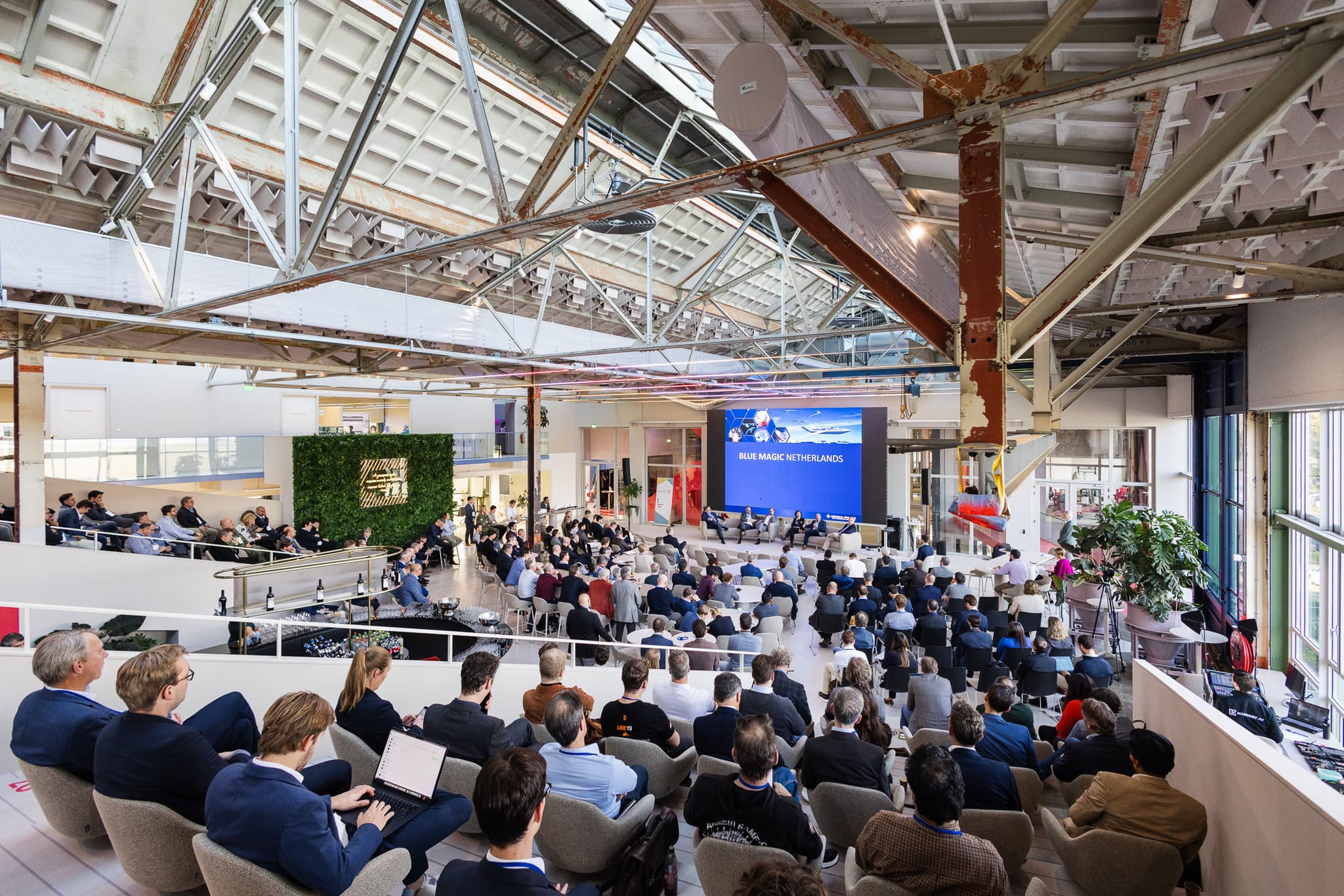
Blue Magic Netherlands
Read all our stories on the Blue Magic Netherlands event here
In one example discussed at Blue Magic Netherlands, the batteries could power high-energy laser systems for counter-drone defense. Compared to expensive missile-based solutions, battery-powered directed-energy systems offer a far more scalable and cost-effective approach.
“One battery pack could support hundreds of laser engagements,” Van Arnhem noted. “And the lifetime cost is comparable to a single interceptor missile.”
VÆRIDION is not developing weapons systems itself, but it is actively working with partners to understand how its battery technology could enable such applications. In 2026, flight tests are already planned using legacy aircraft equipped with battery pods to explore these use cases.
A pragmatic path to scale
Unlike many aerospace startups, VÆRIDION’s strategy is notably grounded. The company currently employs approximately 70 people across design, certification, testing, and supplier integration. Major partners such as GKN are already involved, and development is split between Munich and Delft.
A key milestone came with the acquisition of infrastructure formerly owned by Lilium, giving VÆRIDION access to a hangar and testing facilities without the capital burden of building from scratch. That facility will be used for propulsion testing and, eventually, flight operations.
The company is currently raising €30 million to accelerate development toward critical design review and expand its testing capabilities. Part of that funding is already secured.
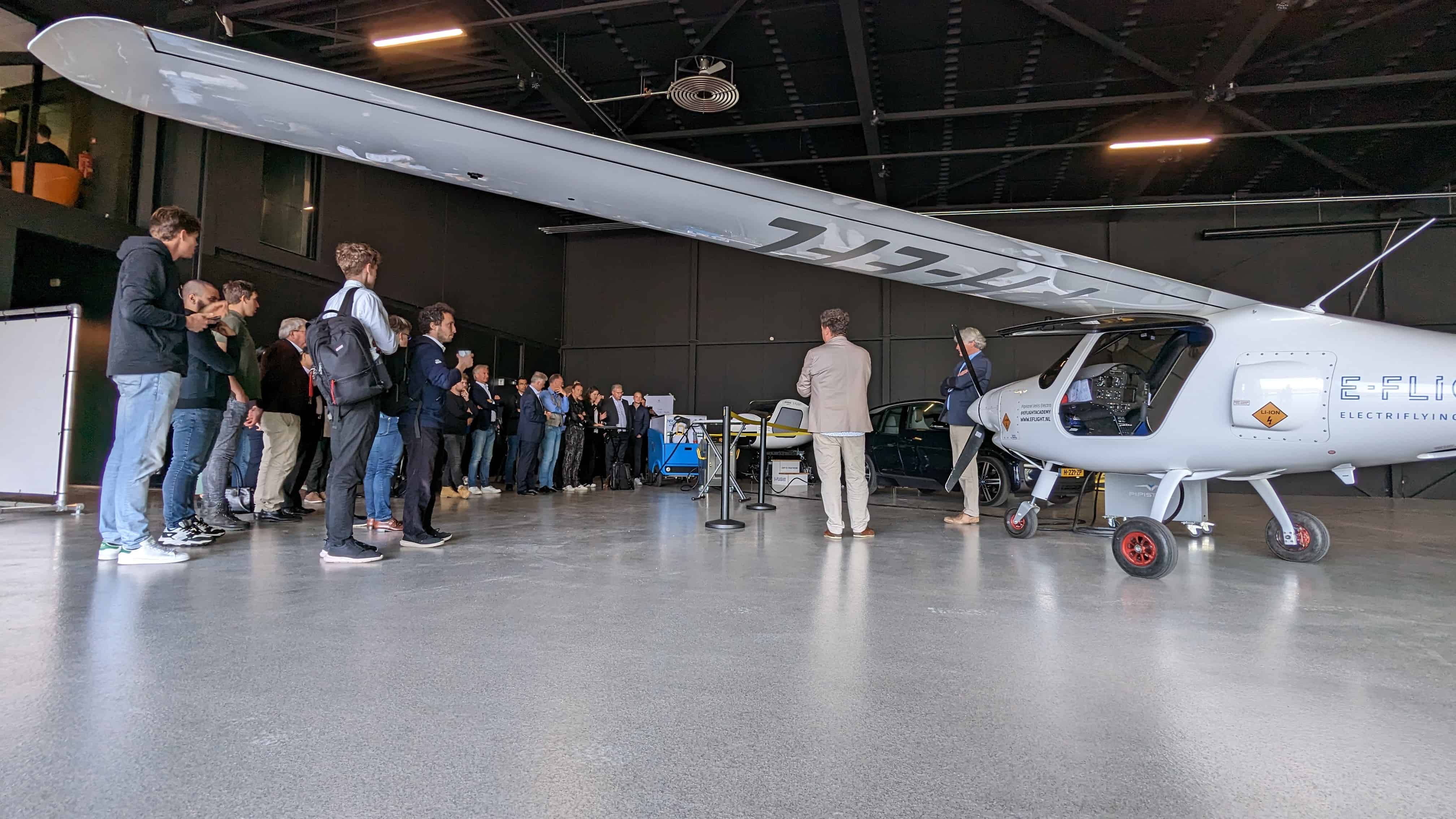
Electric flying: a sustainable solution for regional mobility within Europe
The entire sector around electric flying gathered in Teuge to discuss the next steps on the path to a successful and climate-friendly future.
Not science fiction, but engineering
What stood out most during the presentation was how deliberately unhyped the story was.
No promises of autonomous air taxis. No futuristic timelines. No reliance on unproven technology.
Instead, VÆRIDION presented itself as an engineering company solving concrete problems: how to fly cleanly, quietly, safely, and affordably - and how to design systems that remain relevant in both civilian and security contexts.
“We’re not trying to change aviation overnight,” Van Arnhem concluded. “We’re building something that works, that can be certified, and that can scale.”
In a European landscape increasingly focused on technological sovereignty, resilient infrastructure, and dual-use innovation, that may be precisely the right approach.