
How a French judge exposes your tech dependency
U.S. sanctions on ICC Judge Guillou expose Europe’s fragility: Without digital independence, we’re one click from collapse.
Published on February 25, 2026
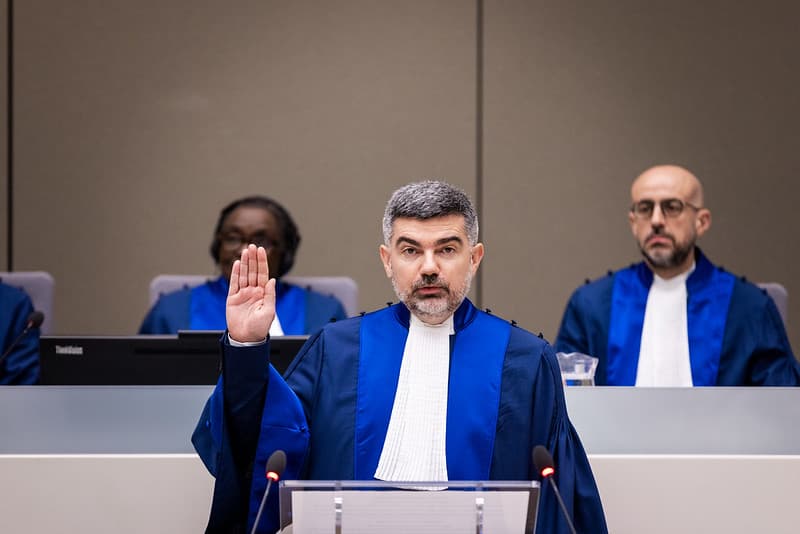
© ICC

Team IO+ selects and features the most important news stories on innovation and technology, carefully curated by our editors.
Imagine: you are a respected judge at the International Criminal Court (ICC) in The Hague. You do your job and apply international law. Suddenly, your credit card stops working. You can no longer pay for a taxi, book a flight, or even order a book. Your bank account is frozen, and your email address is shut down.
This is not dystopian fiction—it is the harsh reality for Nicolas Guillou. This French judge at the ICC is experiencing firsthand what it means when Washington turns off the digital tap. His situation is more than a personal tragedy; it is a loud wake-up call for European autonomy. It ruthlessly exposes how our dependence on American tech and payment systems poses a direct threat to our sovereignty.
A 'civil death' by algorithm
Nicolas Guillou describes his situation as a "civil death." Since the United States placed him on its sanctions list in the summer of 2025, his life has been severely restricted. The immediate trigger was his approval of an arrest warrant against Israeli Prime Minister Benjamin Netanyahu. The consequences were swift and far-reaching. His Visa credit card stopped working. Online payments for everyday things like hotels or flights became impossible. Even services like Amazon, Airbnb, and Booking.com are now off-limits to him.
This goes far beyond financial inconvenience. It strikes at the heart of functioning in a modern society. Guillou has suddenly become a "digital pariah." He cannot function like other citizens, simply because the infrastructure we all use—from payment systems to cloud storage—is controlled by American companies. In a conversation with European Commissioners Valdis Dombrovskis and Maria Luís Albuquerque in Brussels, Guillou warned that this fate could befall any European official. If a judge in The Hague can be "switched off" by a decision in Washington, who is safe?
The long arm of American law
The U.S. wields its power through the Office of Foreign Assets Control (OFAC). The legal basis for this, including Executive Order 14203, allows the U.S. government to freeze the assets of anyone involved with the ICC. But the impact extends far beyond American borders. This is due to the extraterritorial reach of these sanctions. Virtually every international transaction touches the U.S. financial system or relies on American technology at some point.
European banks and tech companies are terrified of U.S. fines. They choose the path of least resistance and strictly enforce the sanctions, even against European citizens on European soil. Guillou points out that even a single American link in a service chain can block the entire service. This mechanism turns American tech companies into de facto enforcers of U.S. foreign policy, cutting across the European rule of law. It undermines not only economic freedom but also democratic decision-making. Officials may avoid certain cases out of fear of personal sanctions.
Tech dependency as Europe's Achilles' heel
The Guillou case is not an isolated incident. It is a symptom of a much broader problem we have written about before: Europe's extreme dependence on American tech giants. Whether it is cloud storage, email services, or payment systems, the reins are held by companies like Microsoft, Google, and Visa. We previously reported on the risks posed by services like Outlook and Gmail in light of the American CLOUD Act, which gives U.S. authorities access to data, regardless of where it is stored.
The response from Brussels has so far been largely diplomatic, but the urgency is growing. Guillou is calling for the EU to activate existing legislation, such as the "Blocking Statute." This mechanism, designed in the 1990s, is meant to protect European companies from the effects of extraterritorial sanctions. In theory, it should prohibit companies from complying with U.S. sanctions when they conflict with EU interests. In practice, few companies dare to risk losing access to the U.S. market.
We need our own infrastructure
That is why more than just rules are needed. We must build. Guillou and various policymakers are pushing for the accelerated introduction of the digital euro and independent payment systems like Wero. Steps are also being taken in the field of cloud infrastructure. The recently established European Digital Infrastructure Consortium (EDIC) aims to speed up the development of sovereign digital goods. The goal is clear: to create an ecosystem in which European citizens and institutions can continue to function, regardless of who sits in the White House.
Nicolas Guillou’s experiences serve as a test case for Europe. They show that economic and digital sovereignty are not abstract policy terms but prerequisites for survival. If the EU cannot protect its own judges from foreign interference, the credibility of the entire union is at stake. The technology exists. Alternatives to American services—from secure email to independent clouds—are available. The question is no longer whether we should embrace them, but how quickly we can make the transition.
The European Alternative
The European Alternative is a series about European tech solutions that prioritize privacy, digital sovereignty, and sustainability. Instead of relying on major American platforms, we highlight the alternatives Europe itself has to offer—transparent, secure, and aligned with European values.