
‘Hope as the basis for circular and sustainable construction’
To increase the impact of research, built environment scientists are developing positive future scenarios. “The starting point for action.”
Published on December 16, 2025

As Head of Partnerships, Linda liaises with new partners. She coordinates all ongoing collaborations and connects our journalistic editorial and commercial articles. She is not only the connector behind our articles, but also all of our events.
To fight climate change, the built environment must become more sustainable. As a result, the buildings where we live and work in will look very different in the future. But how do we bring about that change? "As humans, we are generally very focused on negativity. All day long, we hear in the news about things that go wrong, dangers, and crises. But change does not come from fear; it comes from hope. We want to show what is possible to drive change," says Daan Schraven, associate professor of new economy in the built environment at Delft University of Technology.
Schraven is together with Torsten Schröder, assistant professor of sustainability in architectural design at Eindhoven University of Technology, part of 4TU.Built Environment. This is a partnership between the built environment related faculties of the four Dutch technical universities, which are working on innovation in six key areas. Each topic has its own Domain Acceleration Team (DAT). Schraven and Schröder are involved in the DAT in the field of circularity and sustainability. The team initiated and hosted in October 2025 a two-day conference. The scientists sat down for an interview about the team's direction and opportunities to make the built environment more sustainable.
Accelerating the transition to circular and sustainable construction
Schröder begins: "With the work of our DAT, we want to contribute to the transition to circular and sustainable construction. This requires radical change. Universities are conducting extensive research into improving the built environment. But more is needed; we need to scale up. That is why we are joining forces in the DAT. This involves not only scientists from various universities, but also other stakeholders, for example, from industry or municipalities." The team members have been working on a white paper recently. It covers the strategic topics that team members believe are important to the transition to circular and sustainable construction. Among them are identifying new financing opportunities, examining international developments, fostering more debate, and developing upside scenarios and visions for the future to show what is possible.
Positive scenarios
The conference focuses on the last two topics, mainly the positive future scenarios. “We wanted to set up the scenarios together with the parties involved, stimulate debate, and gain insights. We see that as our role from the 4TUs,” says Schraven. It is important to involve all ecosystem stakeholders in defining the changes to the process. “We need to show people why you want to join forces, what you want to achieve together. That shared vision is vital.”
The conference addressed both the scientific and practical implications of these outlooks. “On the first day, we focused mainly on the scientific side. We developed two scenarios. The first was based on digitization and its impact on society's sustainability. The second was based on people and how technology could support them. On the second day, we worked with other stakeholders, such as government officials and the business community, to further develop and visualize these scenarios,” explains Schraven.
Outlining a vision
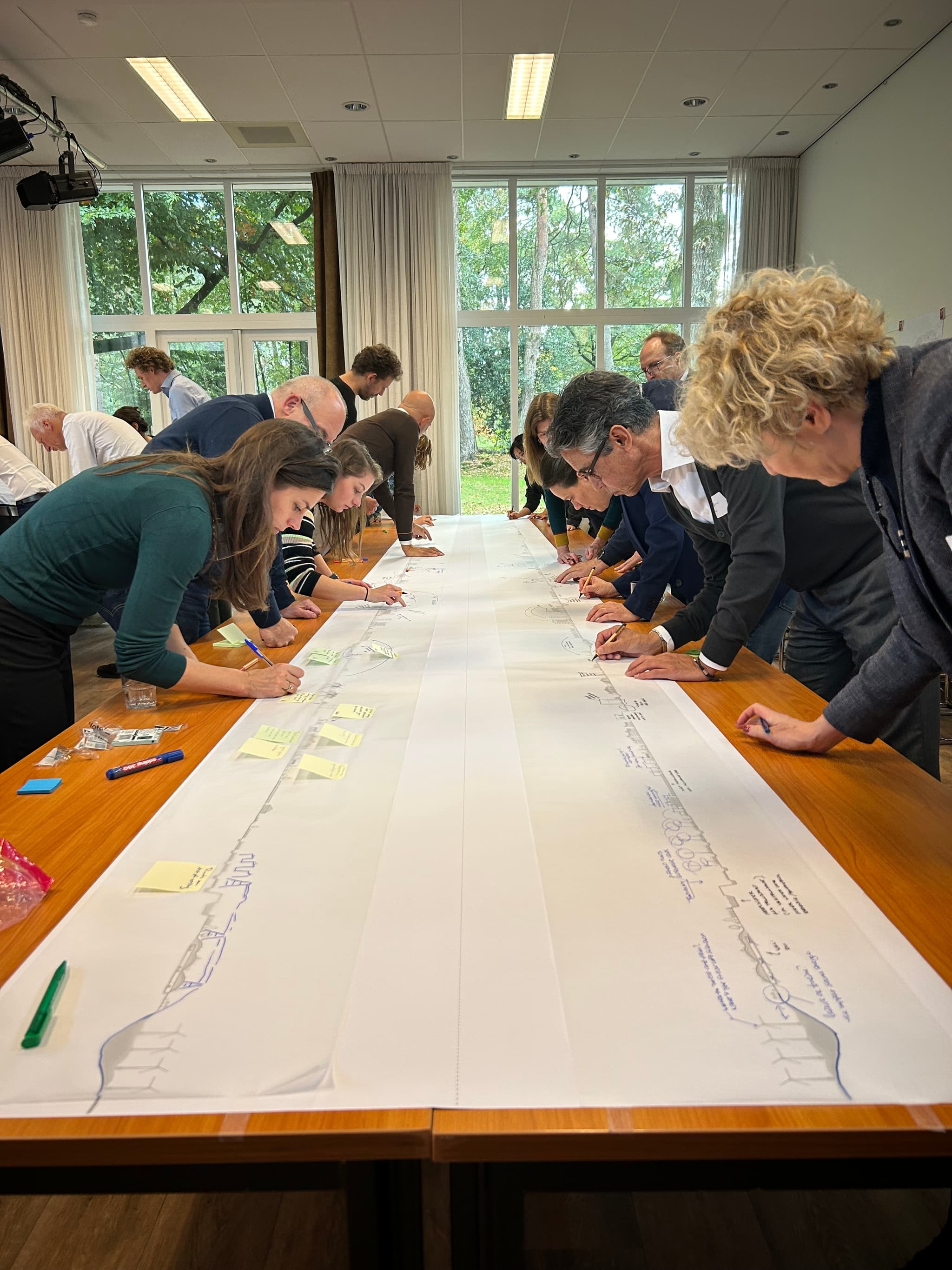
The participants were given an eight-meter-long drawing with a section of an imaginary city and its hinterland as simple visualization of today's society. Think, for instance, of residential areas, industrial estates, rivers, and other elements of the current landscape. Participants were able to make adjustments and add new elements using pens, and Post-it notes. For example, facilities to generate and store renewable energy were added, attention was paid to water management, and several ideas to solve the housing shortage were discussed, such as adding extra floors to existing homes.
Afterwards, the participants immediately evaluated the session. They exchanged ideas for new research projects and tips and tricks for improving or expanding existing research. The participants agreed that other stakeholders in the ecosystem also play an important role in the research. The technical possibilities are endless. Considering how people make use of these possibilities is relevant, too.
Schraven: “The next step is to use the insights we have gained to work on the follow-up to the scenarios. In addition to the theory, we need to set up and implement action points.” This again involves the necessary collaborations, for instance, with the TKI Bouw en Techniek. The TKI’s are implementing the Dutch mission driven innovation policies.
The power of imagination
“Designers, engineers and researchers need to collaborate more in the future,” says Schröder. “The power of imagination is essential for thinking outside the box. And that, in turn, is crucial for realizing positive future scenarios.” He therefore envisions stronger multidisciplinary collaborations within 4TU Built Environment. “After all, all the disciplines are already there. Thinking in desirable future scenarios can motivate stakeholders to get involved and align around a shared vision,” concludes Schröder.
Sponsored
This story is the result of a collaboration between 4TU.Built Environment and our editorial team. IO+ is an independent journalism platform that carefully chooses its partners and only cooperates with companies and institutions that share our mission: spreading the story of innovation. This way we can offer our readers valuable stories that are created according to journalistic guidelines.
Want to know more about how IO+ works with other companies? Click here