
Holst Centre’s next challenge is achieving industrial power
At Innovation Day, four innovation leaders agreed that Europe still lacks the industrial confidence to turn assets into global businesses.
Published on July 4, 2026
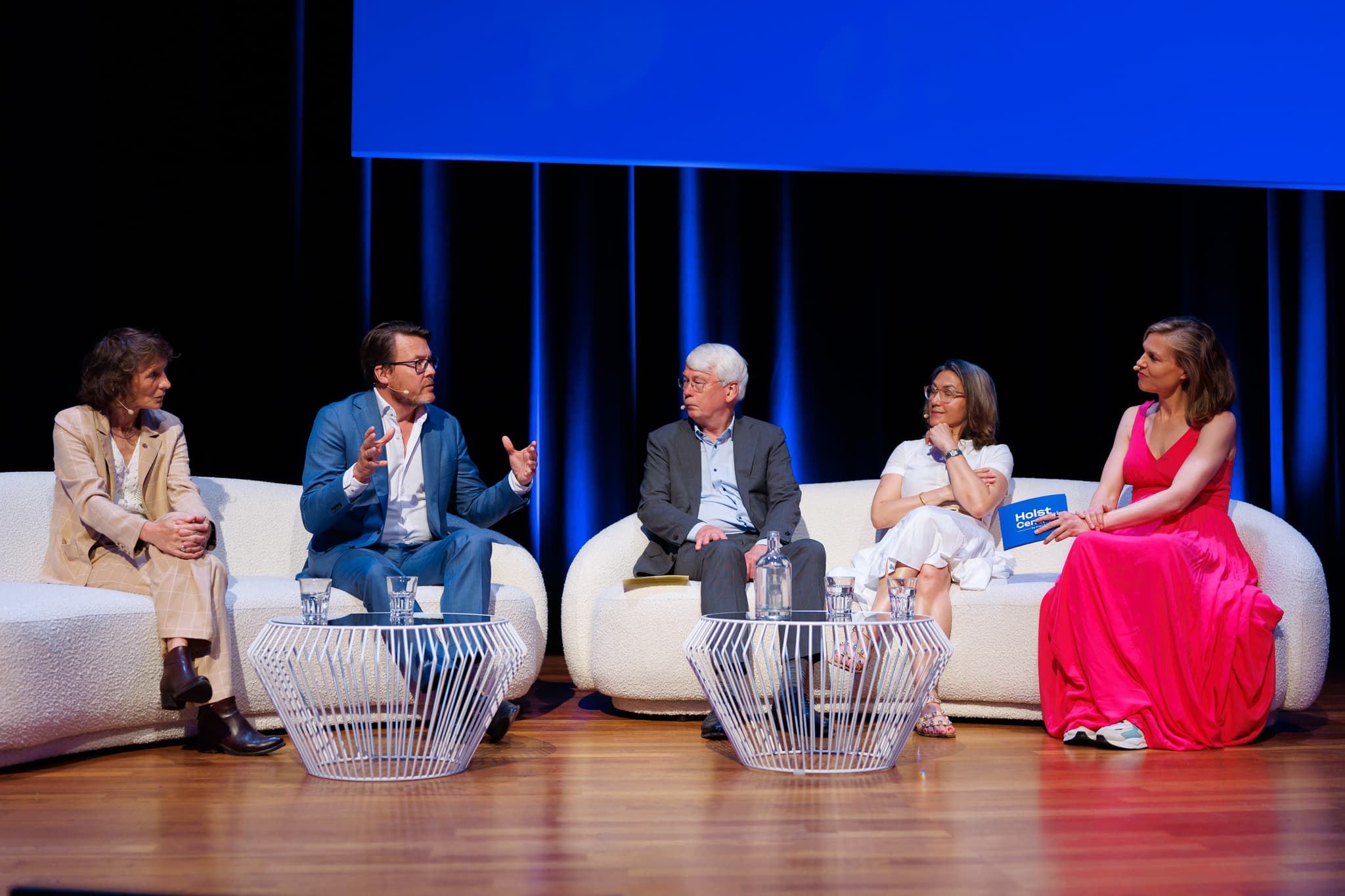
TU/e rector Silvia Lenaerts, Techleap special envoy Constantijn van Oranje, Holst Centre co-founder Henk van Houten and Brainport Development’s Chief Innovation & Technology Officer Naomie Verstraeten with host Irene Rompa - © Bram Saeys
Bart, co-founder of Media52 and Professor of Journalism oversees IO+, events, and Laio. A journalist at heart, he keeps writing as many stories as possible.
Europe is very good at producing things worth being proud of. A breakthrough in a lab. A promising prototype. A spin-off with a clever technology and an early customer. A new public-private programme with a long list of partners. But that is not the same as building an industry.
That was the underlying message in a panel discussion at Holst Centre Innovation Day, where TU/e rector Silvia Lenaerts, Techleap special envoy Constantijn van Oranje, Holst Centre co-founder Henk van Houten and Brainport Development’s Chief Innovation & Technology Officer Naomie Verstraeten looked beyond the organisation’s first twenty years.
Their conclusion was not that Brainport lacks momentum. Quite the opposite. The region has world-class research, globally relevant companies and a dense network of suppliers, engineers and knowledge institutions. But the next phase will demand a harder kind of ambition: fewer scattered efforts, fewer barriers between research and business, and a much stronger instinct to build at scale.
“The invention is a relatively small part of the actual problem,” Van Oranje said. “How do you package the thing? How do you transport it? How do you assemble it?” Those questions may sound less glamorous than a breakthrough in materials science or electronics, but they determine whether a technology becomes a company, a supply chain and eventually a market.
That distinction goes to the heart of Holst Centre’s own history.
From open innovation to industrial ambition
Twenty years ago, Holst Centre was created at a moment when Eindhoven was redefining itself. Philips Research had produced decades of breakthroughs in physics, materials and process technology, but Philips itself was no longer the natural home for every promising technology emerging from the lab.
Holst Centre became a place where ideas in areas such as flexible electronics, wearable technology and advanced materials could be developed with partners before any single company had to claim them as its own. It was an early and very practical expression of open innovation.
For Verstraeten, that openness remains one of Holst Centre’s defining strengths. She recalled visiting the centre early in her career and seeing technologies that seemed far from commercial reality at the time, including flexible displays that would later become familiar in foldable consumer devices.
The lesson, she suggested, is that an innovation ecosystem works when it does more than host interesting projects. It must create shared platforms around which companies, institutes and public partners can organise themselves.
That is what Brainport has tried to do with initiatives such as the Battery Competence Cluster NL, which brings together companies, start-ups, researchers and public partners around application-driven battery technology. The emerging Chip Competence Centre follows a similar logic: helping semiconductor companies connect to pilot lines, chip-design capabilities and European expertise.
These are not simply networks. They are attempts to decide where the region can genuinely compete. “If you focus and you make choices, bold choices, it means that you exclude things,” Verstraeten said. “But it also means that you can channel all energy towards achieving that big, very ambitious goal.”
That may sound obvious. In practice, it remains difficult in the Netherlands, where innovation policy often rewards breadth, participation and carefully balanced agendas. The panel’s argument was that such an approach can be a weakness when global markets move much faster.
Stop celebrating the first step
Van Oranje was the most direct on that point. He argued that Europe still tends to view innovation too narrowly through the lens of public funding and early-stage research. “We keep saying we have to make choices and we have to focus and focus and focus,” he said. “We don’t really.”
The problem, in his view, is not only a lack of money. It is the friction that comes with it. Every euro of public support can bring conditions, reporting requirements and delays. That may help manage risk, but it can also destroy the velocity that young technology companies need.
Van Oranje contrasted the European approach with other innovation cultures. The Netherlands, he said, is often strong at moving from scientific insight to a proof of concept. The United States is particularly good at turning that proof into a venture-backed company. China, meanwhile, is focused on what comes next: production, standardisation, automation and market capture. “China thinks about one to ten and then to one hundred,” he said. “And those are the two things we’re not good at: velocity and scale.”
That does not mean Europe should copy China. But it should learn from the underlying industrial logic. Governments cannot only act as referees, setting rules and distributing subsidies. They also have a role in creating the conditions for markets to emerge: cheaper energy, better infrastructure, public procurement, easier access to talent and faster routes from prototype to production.
In that sense, industrial policy is not merely about choosing technologies. It is about making it easier for companies to become globally competitive once the technology is there.
From start-ups to companies that matter
Lenaerts brought the discussion back to the people. For her, one of the biggest barriers remains the fragmented way Europe organises talent, education and career paths. It is still too complicated, she argued, for students and researchers to move smoothly between the Netherlands, Belgium and Germany. Universities, companies and sectors continue to work in silos, while the most valuable innovation increasingly happens between disciplines and across borders. “We need abundance in things that are really needed: talent, infrastructure and also the ecosystem,” she said.
That abundance also means changing how universities prepare researchers. Lenaerts, who moved from academia into imec earlier in her career, argued that PhD trajectories should not automatically point towards an academic future. More young researchers should gain industrial experience, work with entrepreneurs and see how technologies become products.
The goal should not be to produce ever more start-ups, she said. “We don’t need more startups. We really need unicorns.” That is not a plea for hype or valuation. It is a plea for scale: companies capable of attracting international talent, building supply chains, becoming customers for other local businesses and creating the kind of economic gravity that allows an ecosystem to renew itself.
TU/e rector Silvia Lenaerts, Techleap special envoy Constantijn van Oranje, Holst Centre co-founder Henk van Houten and Brainport Development’s Chief Innovation & Technology Officer Naomie Verstraeten with host Irene Rompa - © Bram Saeys
Brainport cannot afford complacency
Van Houten, who helped establish Holst Centre two decades ago, added an important historical perspective. Brainport exists because Eindhoven once combined excellent research with the entrepreneurial capacity to turn technologies into global businesses.
Philips did not grow by inventing one thing and stopping there. It repeatedly built new industries, from lighting to television, medical systems and semiconductors. But that model changed as technology became more specialised, supply chains became international, and companies were forced to focus more tightly on their core markets.
That is why, Van Houten argued, the region cannot expect today’s large technology companies to automatically create every next-generation industry themselves. New industries have to be built deliberately, with suppliers, scale-up expertise, production capabilities and global customers already in view.
Brainport, he warned, should also be honest about what it still lacks. Strong local demand from end customers is limited. So is direct competition between large technology players. Those missing elements matter because competition sharpens companies, while demanding customers force them to improve.
The answer may lie in thinking beyond the city or even beyond the Netherlands. The Eindhoven-Leuven-Aachen-Cologne corridor has the talent, industrial base and research strength to become far more than a collection of neighbouring ecosystems. It could become a genuine European region of production and innovation.
For that to happen, the panellists agreed, the mindset must change. Brainport should not be satisfied with being a successful regional cluster. It should measure itself against Shenzhen, Munich, Boston and other places where technology moves rapidly from engineering achievement to industrial scale.
The next twenty years of Holst Centre will therefore not be defined only by the ideas it helps create. They will be defined by what happens after those ideas leave the lab: whether they become products, factories, supply chains and companies that can compete globally.
As Lenaerts put it in the final minutes of the discussion: combine hardware with software, apply AI to real industrial problems, look for customers across Europe and the world, "and start doing things".