
Healthcare AI is ready, now the system has to change
Digital twins, AI triage, faster radiotherapy plans: the technology works. What’s missing is a healthcare system that can adopt it.
Published on November 17, 2026
© Jip Huis in 't Veld

Mauro swapped Sardinia for Eindhoven and has been an IO+ editor for 3 years. As a GREEN+ expert, he covers the energy transition with data-driven stories.
Mounting pressure on healthcare systems worldwide calls for new ways to support patients. AI is undoubtedly one of them. Experts say the technology is ready to address healthcare's challenges, but it lacks a strong ecosystem to enable such a disruptive shift.
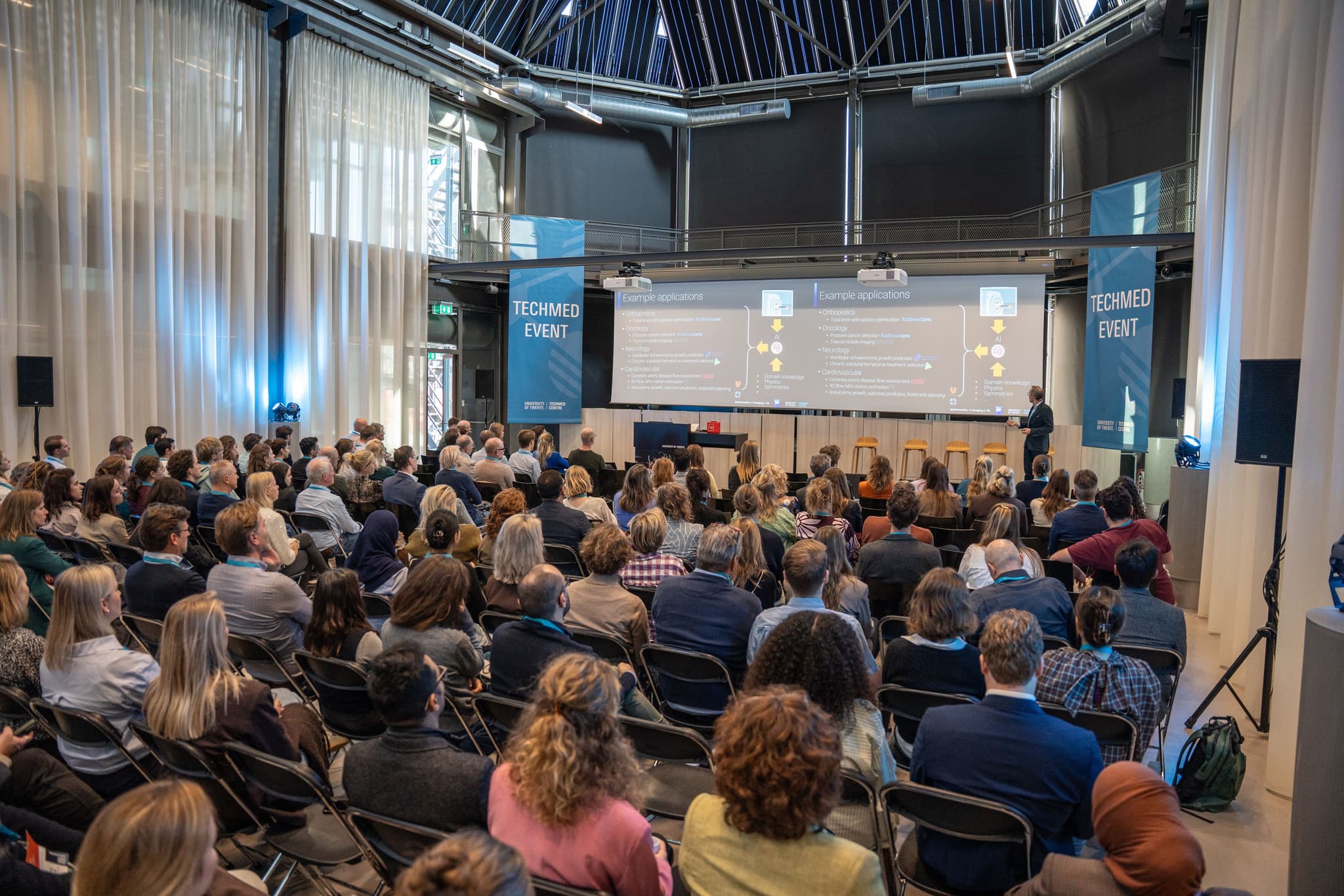
During the AI and Data-Driven Healthcare sessions held at the TechMed Event organized by MedTech Twente on November 5, experts shared examples of the difference AI can make in healthcare, as well as the challenges its application entails.
From extreme to daily care
Professor Christoph Brune laid out the University of Twente (UT) vision for AI in healthcare, describing the institution’s efforts to advance AI development. “What all these collaborations and concepts have in common is this: when we build good digital twins, we are not just fitting data with AI as input-output maps. We combine the data with what matters as domain knowledge,” he explained.
An example of his activities is the development of digital twins of blood vessels. These digital replicas allow tracking the shape, growth, and blood flow of an aortic aneurysm — a bulge in the wall of the aorta, the main artery — to help decide when to operate.
A flow simulation now takes a few minutes, providing answers. Brune underlined how this is AI “at its extreme” and far from clinical reality. Bringing such innovation into everyday care is the question.
Proof from the GP practice
Yet, AI is already stepping into family doctors' offices. Peter Dekkers is a general practitioner and also one of the founders of PraatmetdeDokter. In his view, without AI-supported triage, general practices as we know them will not survive the coming decade. A large share of them, the doctor said, are not even accepting new patients.
The platform he founded offers a solution. By downloading an app connected to their GP office, patients can describe their complaint in their own words in a WhatsApp-like chat. An AI model extracts information, judges urgency, and asks remaining questions. The practice sees a summary on a dashboard.
The platform is now being used by 110 practices in the Netherlands. Dekker highlighted that 40% of contacts go through the platform and, in over 70% of them, it saves two to five minutes per contact.
Dekkers stressed two lessons. First, AI cannot simply be bolted onto the existing phone process. "You have to redesign your process," he said: digital first, with the practice deciding who needs an appointment. Second, a human stays in charge. "The AI only prepares," he said. "The decision is human."
The barriers are in the system
On the national level, the AI for Health program intends to target the "valleys of death" between AI research and patients, in a system strained by staff shortages and stalled innovation. Ewoud Schuit (Julius Center, UMC Utrecht) and Niels Schurink (Siemens Healthineers) presented the initiative, funded with €112 million. The plan spans the full AI life cycle, with 27 use cases in fields such as vascular disease, dementia, mental health and oncology.
Schurink gave the industry view. Siemens developers, he said, used to ask whether AI could solve their problems. Now the company is aiming for autonomous scanners: "We are really thinking big." In radiotherapy, a foundation model can produce a treatment plan in about a second, work that normally takes several experts. Yet it remains research. "It's not necessarily the technology and the algorithms that are the challenge anymore," he said. "Now, it's the healthcare system that we need to change."
No AI without data
Monique Tabak, Professor of Personalised eHealth Technology at UT, brought the conversation down to a single patient. Aaron has asthma. He sees his specialist twice a year; in between, nobody knows how he is doing until an attack sends him to hospital. Care like this is planned and reactive, and it misses most of his life.
The alternative is proactive care built on three blocks: measuring in daily life, using AI to support decisions, and feeding the results back to the patient and professional. But many fine tools sit on the shelf. "If it's a good technology, it doesn't mean it's actually going to be used," Tabak warned. "AI is only as powerful as the ecosystem behind it."
As a researcher, she has felt the bottleneck herself: getting usable data, especially from several hospitals at once, is hard. Twente is building an open infrastructure for the secondary use of health data. It started small on purpose, with pilots in post-surgery recovery, heart failure monitoring and education. "We are learning by doing," she said.
Moving forward
The speakers generally agreed that it is now time to move on with validation and implementation of AI technologies. Schurink pointed to the Dutch habit of "pilotitis": proving a technology works, then piloting it again in every new setting. "We are really not utilising what we have already," he said.
The transformation can only happen as a shared effort. Brune underlined that digital transformation succeeds only “when you get the people with you on board.”
The hard questions remain: who funds the upfront investment, how to support staff whose work changes, and how to keep models fair across populations. As Dekkers put it, "the technology is already there." Healthcare now has to catch up.