
Government explores opportunities perovskite cells in Eindhoven
Minister Stientje van Veldhoven and State Secretary for Defense Derk Boswijk visited Perovion Technologies in Eindhoven.
Published on October 6, 2026
Our DATA+ expert and Editor-in-Chief, Elcke Vels, explores AI, cyber security, and Dutch innovation. Her "What if..." column imagines bold scenarios beyond the norm.
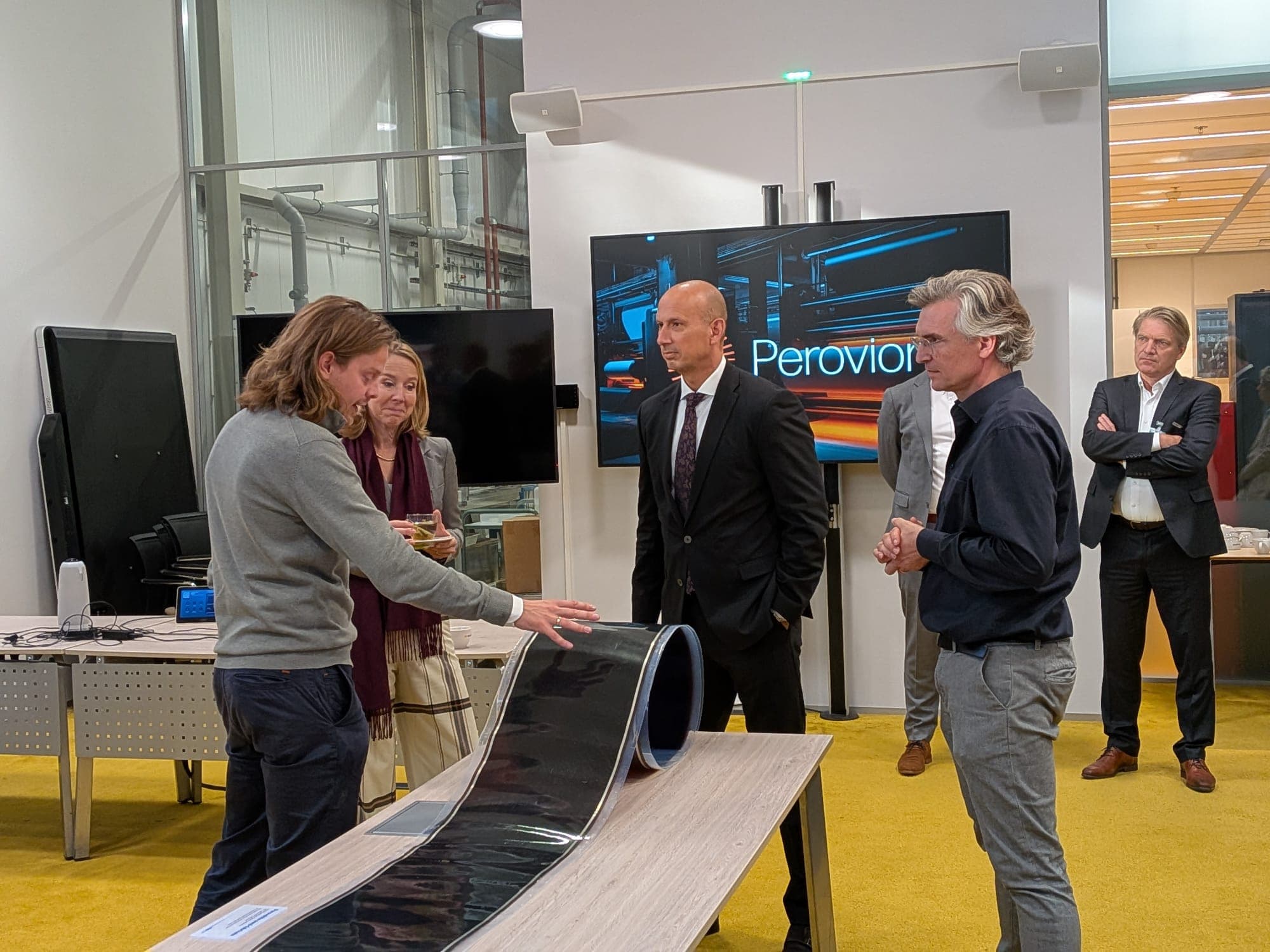
The new generation of perovskite-based solar cells is ready to make the leap from the lab to real-world applications. Minister of Climate and Green Growth Stientje van Veldhoven and State Secretary of Defense Derk Boswijk visited Perovion Technologies in Eindhoven on Monday morning. The company aims to further develop the technology and prepare it for industrial production. Applications for the Department of Defense are conceivable. “We’re going to investigate how we can use the applications we see here,” said Derk Boswijk, State Secretary of Defense.
Perovskite solar cells are light, thin, and flexible, unlike traditional silicon solar cells, which are often incorporated into glass panels. This allows them to be used in places where traditional solar panels are less suitable, such as on tents, vehicles, building facades, and drones. The active layer of the cell is only one micrometer thick. Furthermore, the materials required for their production are relatively abundant.
Perovion is working on this new generation of solar cells. The company was founded in March of this year as a spin-off from TNO and is located at the High Tech Campus Eindhoven. In addition to the minister and state secretary, TNO Chairman Tjark Tjin-A-Tsoi was also present during the visit to the High Tech Campus. It wasn’t just talk: those present were given an extensive tour of the production facility.
How it works
As the team explains during the visit, the core of Perovion’s technology lies in the way the solar cell is manufactured. A liquid solution containing perovskite is applied to a film and then dried. During this process, the materials must arrange themselves with great precision into a stable crystal structure. “That process in particular was one of the major technical challenges for a long time: making a perovskite cell is one thing, but making it efficient, stable, and scalable is much more difficult,” explains founder and CTO Sjoerd Veenstra. Perovion says that after about twelve years of development, it has developed a working and stable production method. According to the company, the production machinery can be built in Europe, making a European production chain possible.
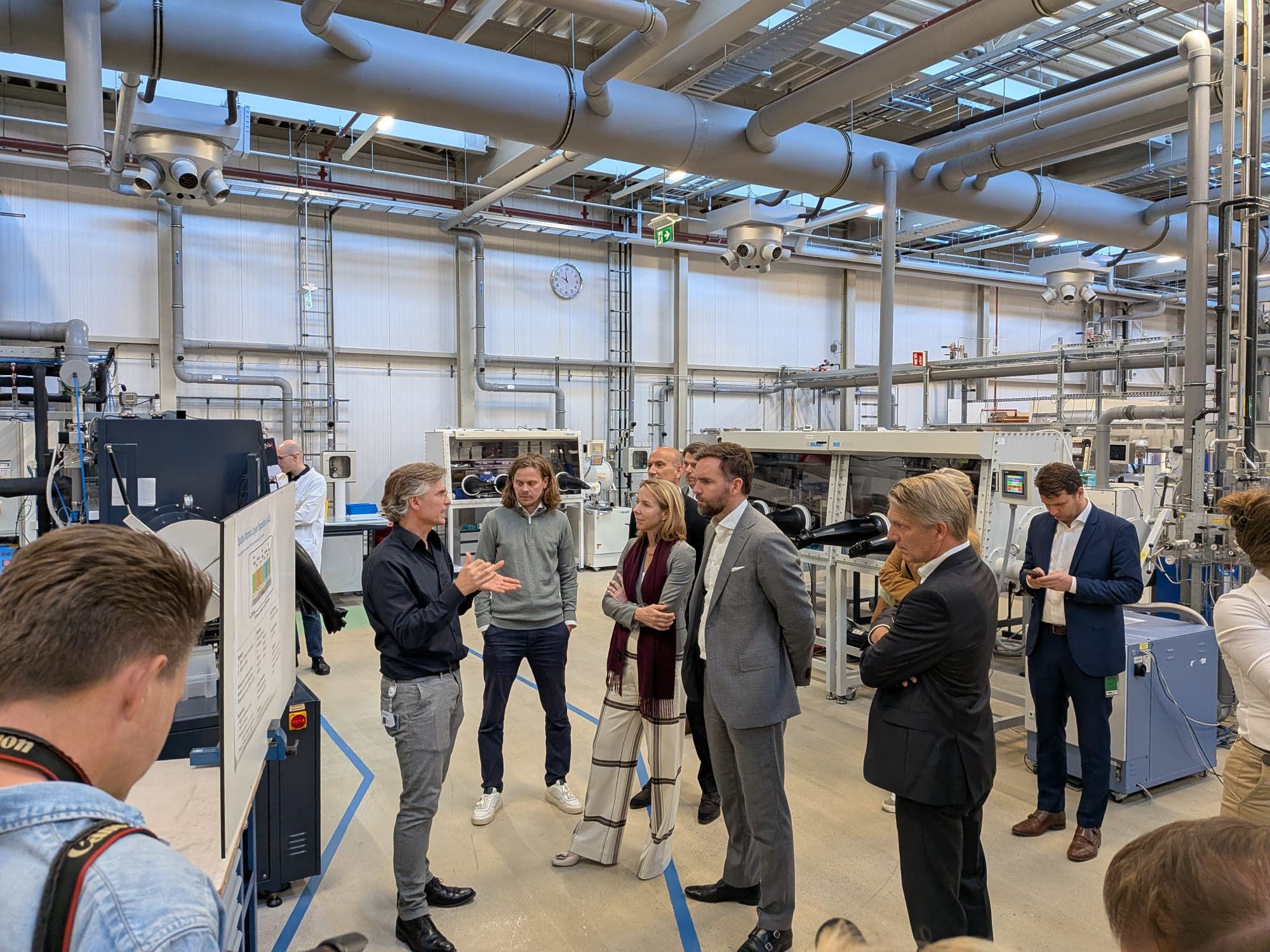
The minister and state secretary are given a tour of Perovion
Energy transition and Defense
Perovskite solar cells can logically give the energy transition a boost. Consider applications in building facades and on roofs with limited load-bearing capacity.
Various applications are also conceivable for the Department of Defense. Especially in these times of increasing geopolitical tensions, there is a great need for such technology. “It’s a typical off-grid application,” says Huib van den Heuvel, COO at Perovion.
According to Van den Heuvel, the technology can be deployed on various scales within the Department of Defense. For individual service members, this could mean they’ll need to carry fewer batteries. “They use a lot of electronics these days. If they can generate energy locally with lightweight solar cells, they won’t need to carry as many batteries.” Larger systems can also be mounted on tents and other temporary structures. Another interesting application: drones. “With these lightweight solar cells, you can potentially double the flight time of drones.”
Derk Boswijk, State Secretary of Defense, is also enthusiastic about the technology. “We’re going to investigate how we can use the applications we see here. I just looked at a roll-up solar cell that you can carry in a backpack. That might be an application for us. We’ll be exploring the possibilities in the near future.”
The first field applications will follow soon. “The plan is to produce and test full-scale demonstrators by the end of next year,” Van den Heuvel explains.
More efficient and cheaper
The technology still needs significant further development. “By the end of next year, we’ll be at an efficiency of between 15 and 20 percent, with a lifespan of, in principle, ten years. In the coming years, we’ll further increase that efficiency, extend the lifespan, and lower the cost.”
In the longer term, Perovion aims to stack multiple perovskite layers on top of each other. Each layer can utilize a different part of the light spectrum. This should allow the efficiency to increase further, possibly toward 35 percent.
The coming years will determine whether perovskite solar cells live up to their promise.