
German quantum computer breaks qubit computation record
Europe's first exascale machine has achieved what no computer has done before — fully simulating a 50-qubit quantum system
Published on May 13, 2026
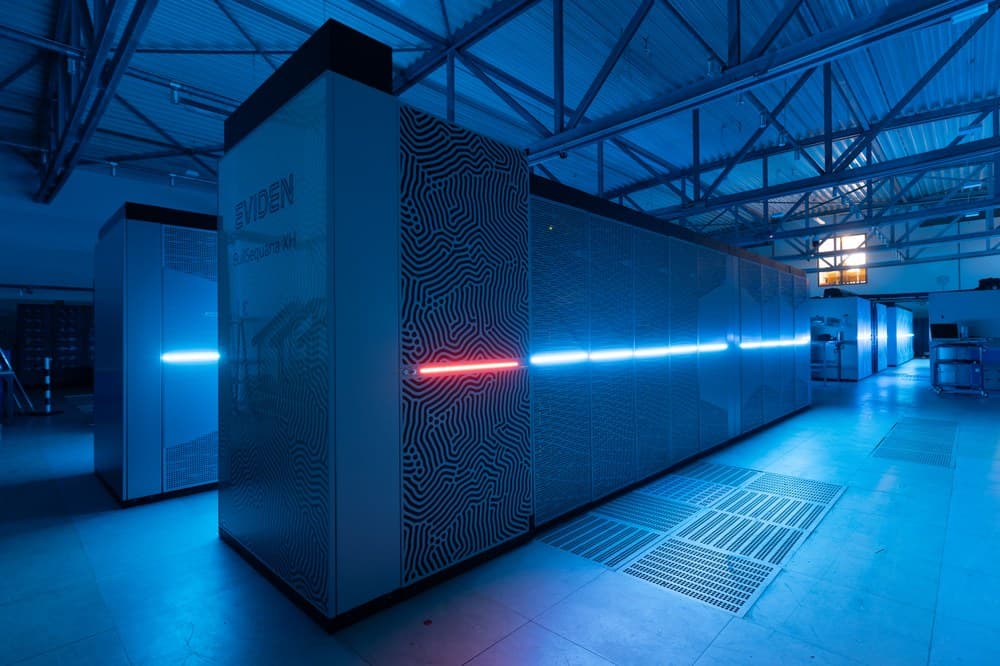
© Jülich Supercomputing Centre

Team IO+ selects and features the most important news stories on innovation and technology, carefully curated by our editors.
Researchers in Germany have set a new global benchmark in quantum computing, becoming the first team to fully simulate a 50-qubit quantum computer. The feat was accomplished using JUPITER, Europe's new exascale supercomputer housed at Forschungszentrum Jülich, and the implications for the future of quantum research could be enormous.
The breakthrough shatters the previous 48-qubit record, which was itself no small achievement. In fact, that earlier record was also set by Jülich scientists, back in 2019, using Japan's K computer. This time, the team — working in collaboration with NVIDIA — pushed even further, crossing a threshold that demands staggering amounts of computing power.
Just how demanding? Simulating 50 qubits requires around 2 petabytes of memory — roughly two million gigabytes. For context, a standard laptop can handle simulations of around 30 qubits. The exponential leap in complexity arises because each new qubit doubles both the memory and computing power required. At 50 qubits, every quantum gate operation influences more than 2 quadrillion complex numerical values, which must remain synchronized across thousands of computing nodes.
"Only the world's largest supercomputers currently offer that much," said Prof. Kristel Michielsen, Director at the Jülich Supercomputing Center, who emphasized how tightly progress in high-performance computing and quantum research are now intertwined.
A significant leap for quantum computing
The achievement was made possible by a series of technical innovations. Engineers at the NVIDIA Application Lab upgraded Jülich's quantum simulation software — known as JUQCS — to a new version, JUQCS-50, capable of performing quantum calculations even when data must be transferred to CPU memory. The team also introduced a byte-encoding compression technique that cuts memory requirements by a factor of eight, along with a dynamic optimization system that continually improves data exchange between more than 16,000 GH200 Superchips.
Beyond the record itself, the milestone carries significant practical value. Simulations of quantum computers play a critical role in advancing quantum research — scientists use them to test algorithms, validate experimental findings, and explore how future quantum systems may behave before real hardware becomes powerful enough to handle such tasks. Among the applications being explored are algorithms for studying molecules and materials, as well as optimization tools relevant to logistics, finance, and artificial intelligence.
JUQCS-50 will also be made available to outside research organizations and companies through JUNIQ, the Jülich UNified Infrastructure for Quantum Computing. Researchers expect it to serve both as a scientific tool and as a benchmark for evaluating the next generation of supercomputers — a fitting legacy for a machine that has already rewritten the record books.