
From tradition to high-tech sector: the mussel comeback
Shellfish are the future. They are healthy and reduce emissions. The government and companies are focusing on growth in the sector.
Published on February 13, 2026
© Lando Nieuwenhuize

As Head of Partnerships, Linda liaises with new partners. She coordinates all ongoing collaborations and connects our journalistic editorial and commercial articles. She is not only the connector behind our articles, but also all of our events.
Shellfish are an underappreciated but important part of more sustainable food production and a healthy diet. Mussels and oysters, for instance, are packed with nutrients such as protein and omega-3 fatty acids. Moreover, farming them is much less harmful to the environment than livestock farming. Despite the advantages, the sector's production volume has only decreased in recent decades. Are there still opportunities for the shellfish sector in the Netherlands? And if so, where are they? Three experts explain.
“The first steps towards improvement have been taken,” says Addy Risseeuw, secretary at PO Mossel, the association of mussel farmers. In 2022, the sector signed the Blue Deal, together with the Ministry of Agriculture, Fisheries, Food Security, and Nature (LVVN), RVO, the Province of Zeeland, the Zeeland development company IMPULS, and various NGOs. The goal is to increase the mussel sector turnover by 50% by 2040. The Blue Deal has accelerated innovation in the sector. Aquaculture (the farming of fish and shellfish) has now also been included in the new cabinet's plans.
“The Netherlands is a leader in innovation in shellfish farming compared to other European countries,” says Eva Hartog, researcher in aquaculture in delta regions at HZ University of Applied Sciences. She conducts research based on practical questions from entrepreneurs. To maintain this position, we need to act now, argues Arie Mol, senior expert on seafood and co-leader of the Fisheries Innovation Network (VIN) within the Netherlands Enterprise Agency (RVO), the executive agency of the Ministry of Economic Affairs and LVVN. RVO is responsible for implementing subsidy schemes and can help entrepreneurs with legislation and regulations.
Saving space and reducing emissions
Aquaculture is a promising development in a more sustainable food chain. Mussels and oysters contain more and healthier fats per kilogram than meat. “This means they can replace meat to some extent,” says Risseeuw. “But we cannot replace all meat consumption in the Netherlands.” In addition to protein, shellfish have another major advantage over livestock farming: they require much less space to grow. Not only do the animals themselves take up less space, but mussels and oysters do not need to be fed and are not given antibiotics. This is not the case with cows. Mussels and oysters consume marine food, such as algae and plankton. When you harvest mussels, you remove carbon dioxide, nitrogen, and phosphate from the water, whereas cows emit CO2 and ammonia.
Legacy sector, new opportunities
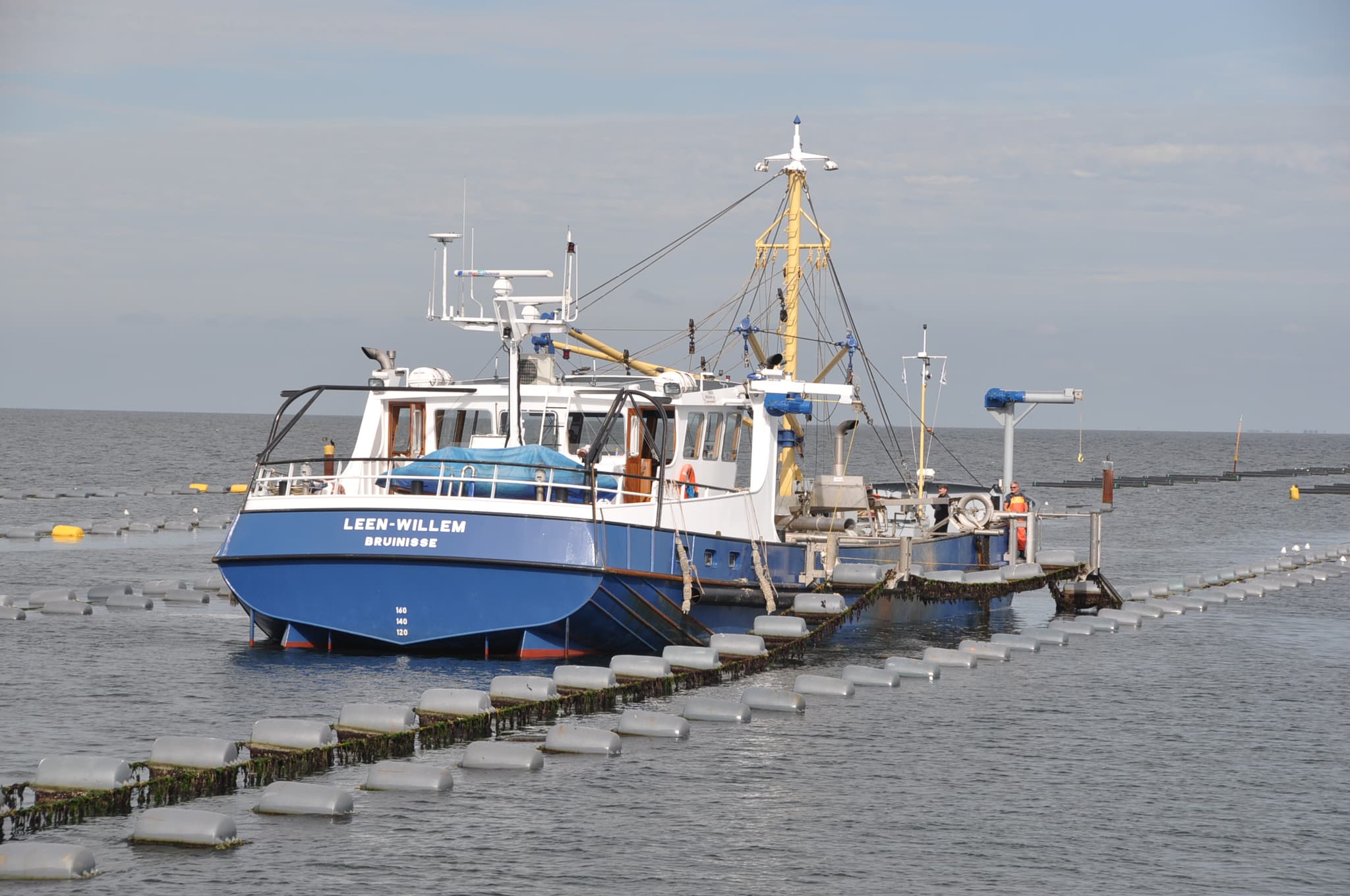
In the Netherlands, mussels and oysters are currently farmed in the Oosterschelde, the Grevelingenmeer, and the Western Wadden Sea. The sector has a rich history; people started farming shellfish as early as 1870. “The delta is suitable for bottom cultivation because the soil is fairly flat and soft. Moreover, the water is rich in nutrients,” says Risseeuw.
In other parts of the world, different types of fish and shellfish are farmed. In southern countries, where the water is warmer, this includes sea bass, while in northern countries, where the water is colder, it includes salmon. “Here, the sea temperature is somewhere in between, which, in combination with other factors, makes it a good place for shellfish,” explains Hartog. All shellfish are farmed without antibiotics, as this is unnecessary, and it is not permitted to add extra nutrients or antibiotics to the water.
Large-scale and commercial farming
The favorable conditions create opportunities to expand shellfish farming in the North Sea. In addition to the three locations where farming is currently concentrated, some areas of the North Sea coast are also suitable for farming. As part of the Blue Deal, a pilot project on commercial farming in the coastal area has been implemented. This will be followed up on in the coming years. “Ultimately, the goal is to investigate whether cultivation is possible in the coastal area. We hope that there will soon be more policy space for this, so that entrepreneurs can then really get started independently,” says Risseeuw.
Positive and negative effects
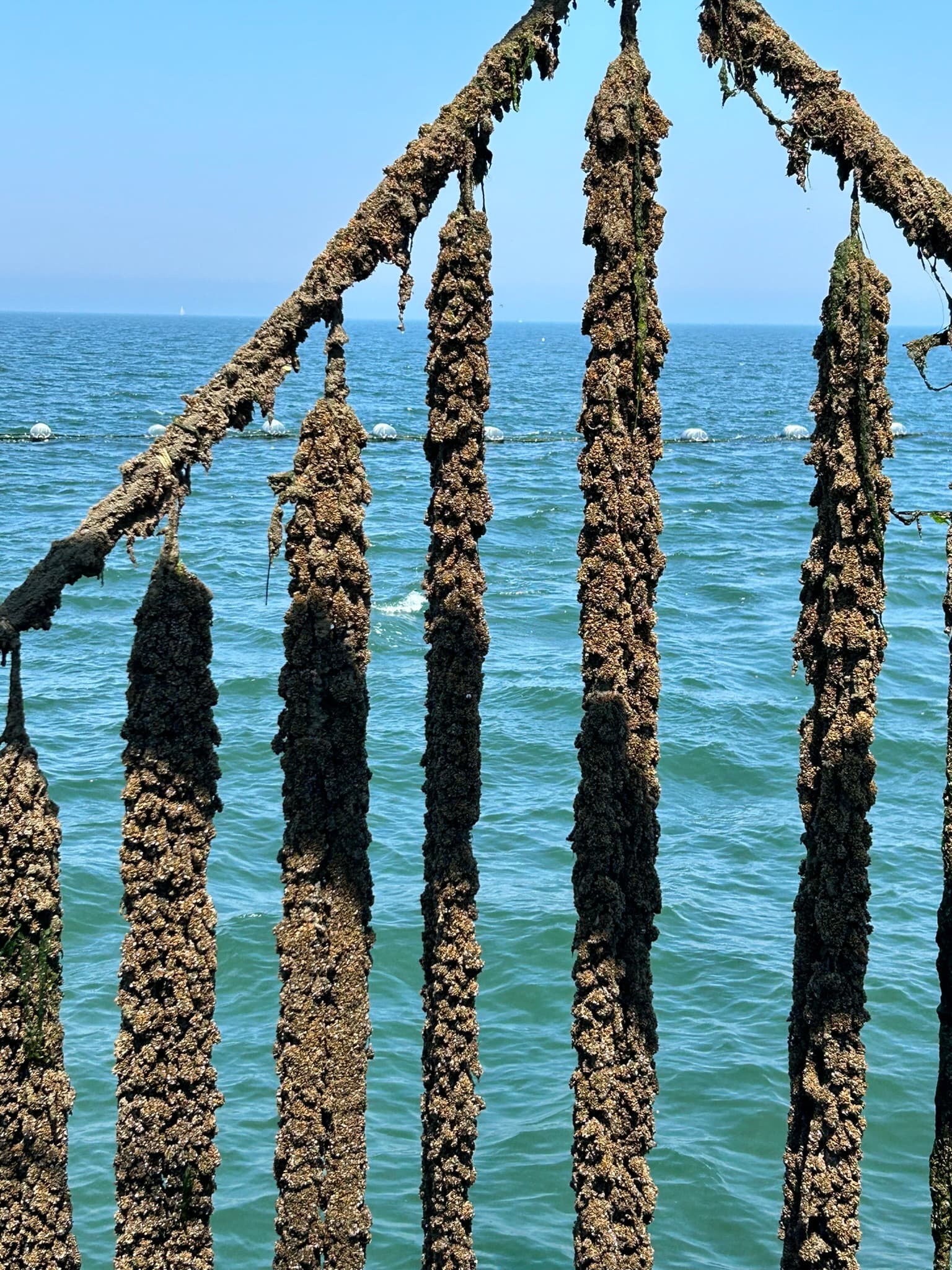
During the pilot, various techniques and materials were tested for the mussel farming installation. These included the materials used in the installations, the animals' growth, and potential effects on other marine life. Hartog explains: "This concerns the applicability of mussel farming in a dynamic area, taking into account the effect on the farming area. For example, mussels on ropes provide a good hiding place for small fish, and fish use the space between the mussels as a nursery because it is more sheltered, quieter, and safer there. In addition, the part of the installation above water also provides extra resting places for birds. We ultimately saw that more birds were coming. Another positive effect may be that mussels that come loose from the ropes end up on the seabed, where they serve as food for crabs and other bottom-dwelling creatures."
The pilot also revealed some things that did not work. “For example, we discovered that not every material was equally suitable,” explains Hartog. If the installation moves too much, reduced shell growth can also be seen in the mussels. “All the mussels' energy then goes into clinging to the installation, which prevents them from growing properly.”
Hartog continues: “On the other hand, the strong currents also ensure that a relatively large amount of food passes by, allowing the mussels that move less to grow well.” Overall, there are opportunities for cultivation in the coastal area, but mussel cultivation may require adjustments.
Prioritizing food production
There are plenty of opportunities for expansion, but to implement this at scale, policy priorities are needed. "In the North Sea program, the national government gives priority to energy generation, shipping, sand extraction, and nature. Strangely enough, food production is not very high on the list of objectives," says Hartog. The program is currently being revised. If food production becomes a priority objective in the future program, there will be more scope for permits and subsidies.
Innovation needed
Innovations are also needed to establish and expand mussel and oyster farming in the North Sea. Risseeuw: “Farming in the Oosterschelde and on the Wadden Sea takes place on the seabed. In the coastal area, we want to do this differently, namely with a hanging culture.” The mussels are suspended in so-called socks on ropes in the sea, where they can grow into adult mussels in 1 to 1.5 years. “The technique itself is not new; it is already being used in other countries, but for Dutch farmers it is a new way of working.”
In addition, the relatively rough North Sea also presents additional challenges. “A wild sea, for example, means that it is not always possible to sail to the installations. That limits the time you can work on them,” he says. The sea is also unpredictable and can only be captured in scientific models. “It's trial and error. We have to pioneer, keep trying things out, and see what works.”
Electrification
Mol also identifies several future developments from the VIN's perspective. “For example, the electrification of ships is an important topic. We often work in protected nature reserves, so the lower the emissions, the better. There are various initiatives for electric shipping, and the Dutch government is also increasingly focusing on the matter, alongside other alternatives to the gas oil currently in use. However, it is not yet possible on a large scale because the battery capacity is not large enough.” He explains that the government has commissioned the MARIN research institute to conduct a design study for an electrically powered plastic shrimp cutter. “This will probably be followed by a study for the development of an electrically powered mussel cutter.”
The shellfish sector not only provides more sustainable food but also greater food security. “Attitudes towards the sector are changing. There is more attention and more space,” says Mol. Risseeuw adds: "The Blue Deal consists of two parts: increasing production on the one hand and increasing consumption on the other. That second part is also incredibly important. Younger people eat relatively few shellfish. We need to look at how we can engage the next generation with shellfish. It's such a beautiful product, truly from Dutch soil."