
From startup to company? Solution from Eindhoven
The municipality of Eindhoven wants to continue to stimulate innovation and is doing so by collaborating with local startups.
Published on February 26, 2026
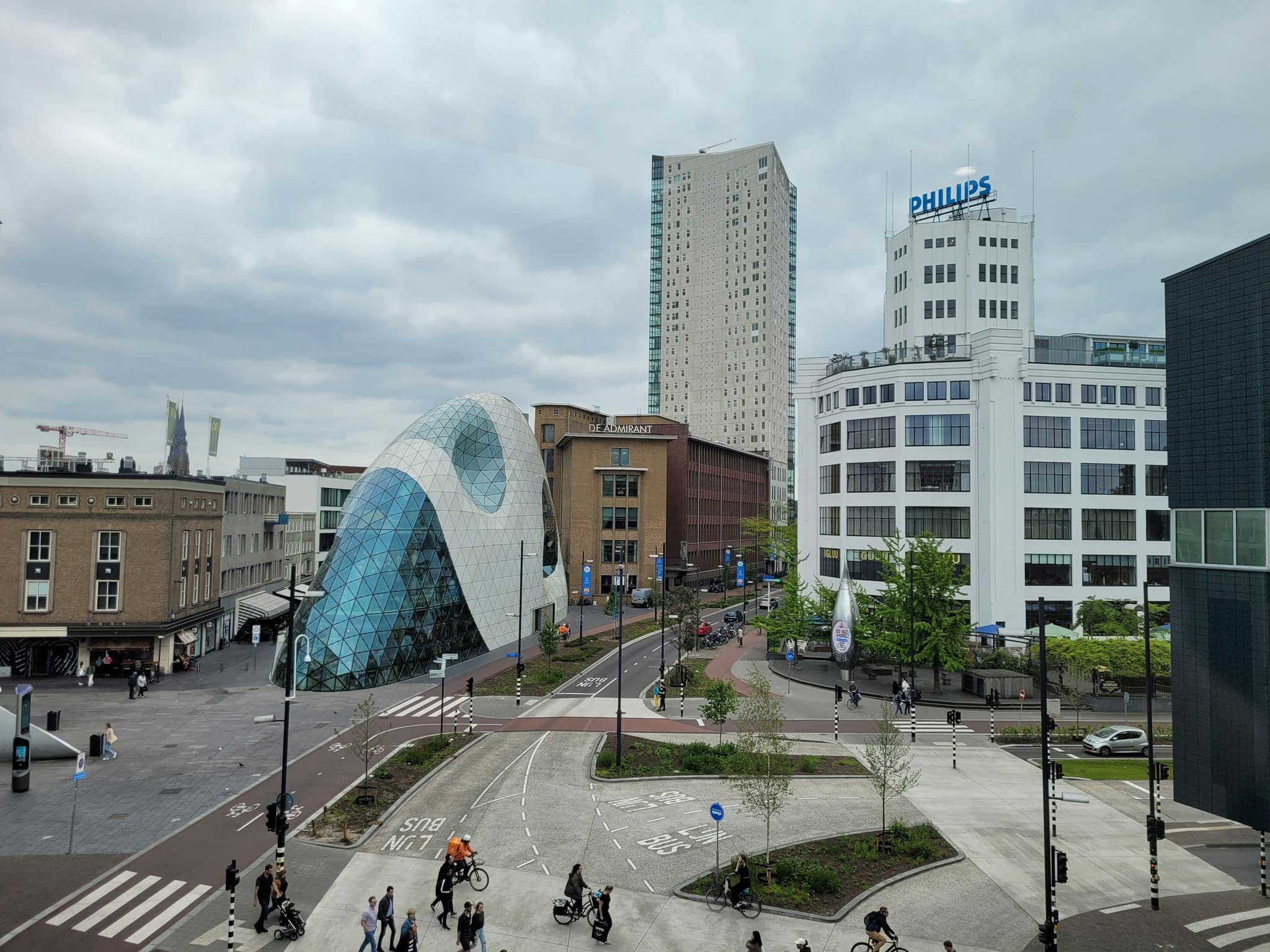
© Alex vd Slikke via Unsplash
Masterstudente journalistiek aan de RUG, stagiair bij IO+, schrijft graag over de integratie van AI in het dagelijks leven
Last Tuesday, three startups proudly demonstrated the capabilities of their products at Eindhoven City Hall. The startups are participating in the Launching Customer programme, a collaboration with the municipality of Eindhoven. Together, they look at what the startup has to offer, what needs to be improved, and whether it works. One of the startups, Tibo Energy, will analyse the residual heat from the ice rink in Eindhoven for the municipality.
Eindhoven is a buzzing city where innovation constantly takes place. With its Launching Customer Programme, the municipality wants to further stimulate the creation of new startups and help existing ones find their (first) customer. By acting as a Launching Customer, the municipality fulfils its social responsibilities and offers local startups, among others, a platform and opportunity to apply their technologies and innovations where promising and appropriate.
Why the municipality supports startups
It is important for the municipality of Eindhoven to encourage startups in order to keep innovation going, says alderman Stijn Steenbakkers (Brainport and economy). When Philips had around 400,000 employees in the 1970s, more than 40% of them were based in Eindhoven, according to Steenbakkers. According to the councillor, it is important to “continue to invest so that we are not dependent on a single company in the future and to keep the region diverse.”
Raymond Bergs, (interim) startup officer for the municipality of Eindhoven, explains that it is not easy for startups to gain a foothold and successfully continue their business. According to Bergs, Eindhoven contains several “microsystems” and Brabant is a “fragmented ecosystem for startups.”
According to Steenbakkers and Bergs, the aim of this programme is to create a “macrosystem” and “robust ecosystem”. Additionally, startups can turn to the municipality or other bodies such as The Gate or the MRE incentive fund for questions, financing, or other needs. This creates a kind of “one-stop shop,” says Steenbakkers.
These initiatives support startups with, for example, business premises, fair rents for offices, and contacts with potential clients. The idea of fair office rents ensures that startups have a place where they can establish themselves more easily. As soon as they need a larger workspace, they move out and the space becomes available for the next startup.
Why a launching customer matters
With the municipality as a trustworthy customer, companies can demonstrate to new potential clients that their product or service really works. The municipality acts as a springboard and is also a major customer because, according to Antoine Post, co-founder and CEO of startup Integer Technologies, strict rules apply to working with the municipality of Eindhoven. “We didn't like [the strict regulations] very much at first, but now we're very happy with them,” says Post.
As Post explains, if startups can demonstrate that their product works despite strict regulations, this success serves as proof of reliability and lowers the threshold for new customers to come on board.
7 ton available
The municipality is prepared to provide a maximum of €30,000 per promising startup that falls within the programme. In total, the municipality has approximately €700,000 available for the programme until 2028.
Which startups qualify
There is a great deal of diversity within Eindhoven's startup ecosystem. Steenbakkers gives the example of a startup that produced new water troughs for horses to prevent too much water from spilling outside the trough when used by the animals. Although this example does not fit within the programme, such startups are referred elsewhere. The Launching Customer programme is intended for startups that can contribute to the municipality and municipal objectives and tasks within various themes and sectors. These themes are: climate, energy, housing, healthcare, welfare and mobility.
The startups presented
The municipality is now working for three startups as launching customer. The three startups that presented their ideas at City Hall now focused on the smart generation (Omniwind), use (Integer and Tibo Energy), and distribution (Integer and Tibo Energy) of energy.
Omniwind, presented by CEO Pranav Tetali and mechanical engineer Sadeq Albdour, is a startup that manufactures compact wind turbines. In May, it will begin installing one such wind turbine on the municipal office building (formerly the NRE building).
Post gave a presentation on Integer Technologies. Integer has built a device that helps companies make their energy consumption more sustainable. By measuring how much electricity a building uses—from heating and air conditioning to computers and solar panels—the device can automatically optimise energy use to be as efficient as possible. No modifications to the building are required. Integer successfully demonstrates that its product works at Mercado, the municipal office building.
Chief Growth Officer (CGO) Jeroen Althusius provided insight into Tibo Energy’s activities. The company presented an energy management system (EMS) that manages solar energy, batteries, EV chargers, and flexible loads. Tibo’s EMS connects a company’s key energy assets, enabling energy trading and flexibility services. Tibo will propose an optimisation based on a residual heat analysis of the ice sports centre in Eindhoven. .