
From open-heart surgery to a hole as small as a pencil tip
From radiation-free navigation through a blood vessel to a tiny camera in the heart: Image-Guided Therapy is the future.
Published on July 13, 2026

Our DATA+ expert and Editor-in-Chief, Elcke Vels, explores AI, cyber security, and Dutch innovation. Her "What if..." column imagines bold scenarios beyond the norm.
A risky surgery that requires the body to be completely opened up is becoming less and less common. The future of surgery lies in razor-sharp imaging and minuscule medical instruments that allow surgeons to perform their work through small incisions. “Sometimes, a patient can go home the very same day after heart surgery,” says Atul Gupta of Philips. During a media session in Amsterdam, which was also attended by Elcke Vels of IO+, it became clear how Philips is accelerating this development.
For many people, surgery is a nerve-wracking prospect. I don’t look forward to it either. That’s understandable: surgery often involves risks, and anesthesia can take a significant toll on the body.
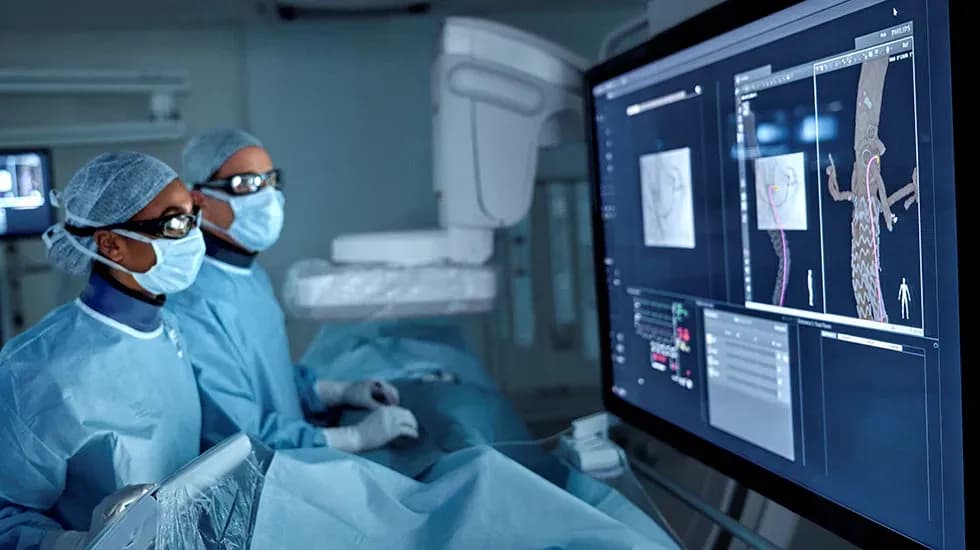
However, new forms of surgery are making procedures less invasive. Large incisions are giving way to small openings, and general anesthesia is no longer always necessary. How is this possible? Through innovative imaging. During the media session, it becomes clear to me: Image-Guided Therapy is the future.
“Image-Guided Therapy may sound like a complicated term, but simply put, it’s the modern form of surgery,” says Atul Gupta, Chief Medical Officer of Diagnosis and Treatment at Philips. “We use imaging techniques such as X-rays, ultrasound, and MRI to see exactly what’s happening inside the body. We then combine that with small medical instruments to perform treatments.”
Philips ranks among the absolute world leaders in Image-Guided Therapy. This division of the company generates approximately 3.5 billion euros in annual revenue.
Radiation-free navigation
At Philips headquarters, it’s not just talk. We’re taken to a demonstration setup. In front of me is the Philips LumiGuide, a breakthrough in radiation-free navigation. The device is primarily used in complex vascular surgery. I see several glass tubes meant to represent a patient’s heart and blood vessels. A very thin wire runs through one of the tubes. I’m given a task: to move the wire to the correct location in the body. “Go ahead and give it a try,” I’m told. The “patient”—that is, the glass setup—is covered, so I can’t see directly what’s happening. I have to rely entirely on a monitor next to the table. On it, I can see exactly where the wire is located. I manage surprisingly well.
Traditionally, doctors use X-ray images during these types of procedures to see where an instrument is located. That works well, but it does expose both the patient and the medical staff to radiation.
LumiGuide uses fiber-optic technology to visualize the position of a very thin wire in three dimensions, “without continuous X-ray radiation,” I’m told. According to Philips, the technology has already been used on more than 2,000 patients.
A balloon that can save lives
A little further on, the second demonstration is ready: the Philips Bridge Plus Occlusion Balloon Catheter. The device was developed for a specific but high-risk situation involving patients with a pacemaker or ICD. Sometimes the leads from these devices need to be removed, for example, when they no longer function properly or need to be replaced. “Over the years, the body forms scar tissue around the lead, which can make its removal difficult,” explains a Philips expert. In rare cases, a major vein can be damaged. Although this occurs in less than 1 percent of patients, bleeding can quickly become life-threatening.
The solution lies in the small balloon sitting in front of me. The catheter can be quickly inserted through a blood vessel using a camera, after which the balloon is inflated to temporarily stop the bleeding. This can significantly increase the survival rate: from about 56 percent without the balloon to nearly 90 percent with this technology.
A small ultrasound device in the heart
A third demonstration focuses on a different challenge. Millions of people worldwide have problems with their heart valves. In the past, open-heart surgery was the only option. Now there’s another way. Philips developed the VeriSight Pro 3D ICE: a small 3D ultrasound catheter. Through VR goggles, we get a glimpse into an operating room where the device is being used.
At the tip of the catheter is a miniature ultrasound camera that is guided to the heart through a blood vessel. This gives doctors a three-dimensional view from the inside. The goal is to better guide cardiac interventions, such as valve procedures or rhythm management.
A revolution that began in 1977
Better care for more people
Devices like these are not a luxury, but essential tools in a healthcare system under strain. They can ensure that more patients are treated in less time. “With some procedures, patients can go home the very same day,” says Gupta. That’s not only more convenient for the patient, but also helps hospitals operate more efficiently.
“Our vision is not only to deliver better care, but to make better care possible for more people,” says Bert van Meurs, Chief Business Leader of Image-Guided Therapy at Philips. “Many of the innovations we’re working on can help us reach more patients.”
A recent acquisition
Philips appears to be specializing more and more in Image-Guided Therapy. A recent acquisition underscores this trend. “In January 2026, Philips acquired the American company SpectraWAVE from Boston. With this acquisition, Philips is adding a new technology to its portfolio,” says Van Meurs. SpectraWAVE uses optical technology to visualize the interior of a coronary artery at a much higher resolution.
During the media session, I ask the experts if any more acquisitions or new developments in the field of Image-Guided Therapy are in the works. They assure me that more is on the way.
Like a visit to the dentist
As I drive out of the parking garage later, one thought in particular lingers: the operating room of the future will bear little resemblance to today’s.
After everything I’ve just seen, I’m convinced that in ten years, people will approach medical procedures with a completely different mindset. Not as something they have to dread for months, but more like a visit to the dentist.
It’s not fun, but before you know it, you’re back outside.