
From mist curtain to microchip: GLOW brings photonics into view
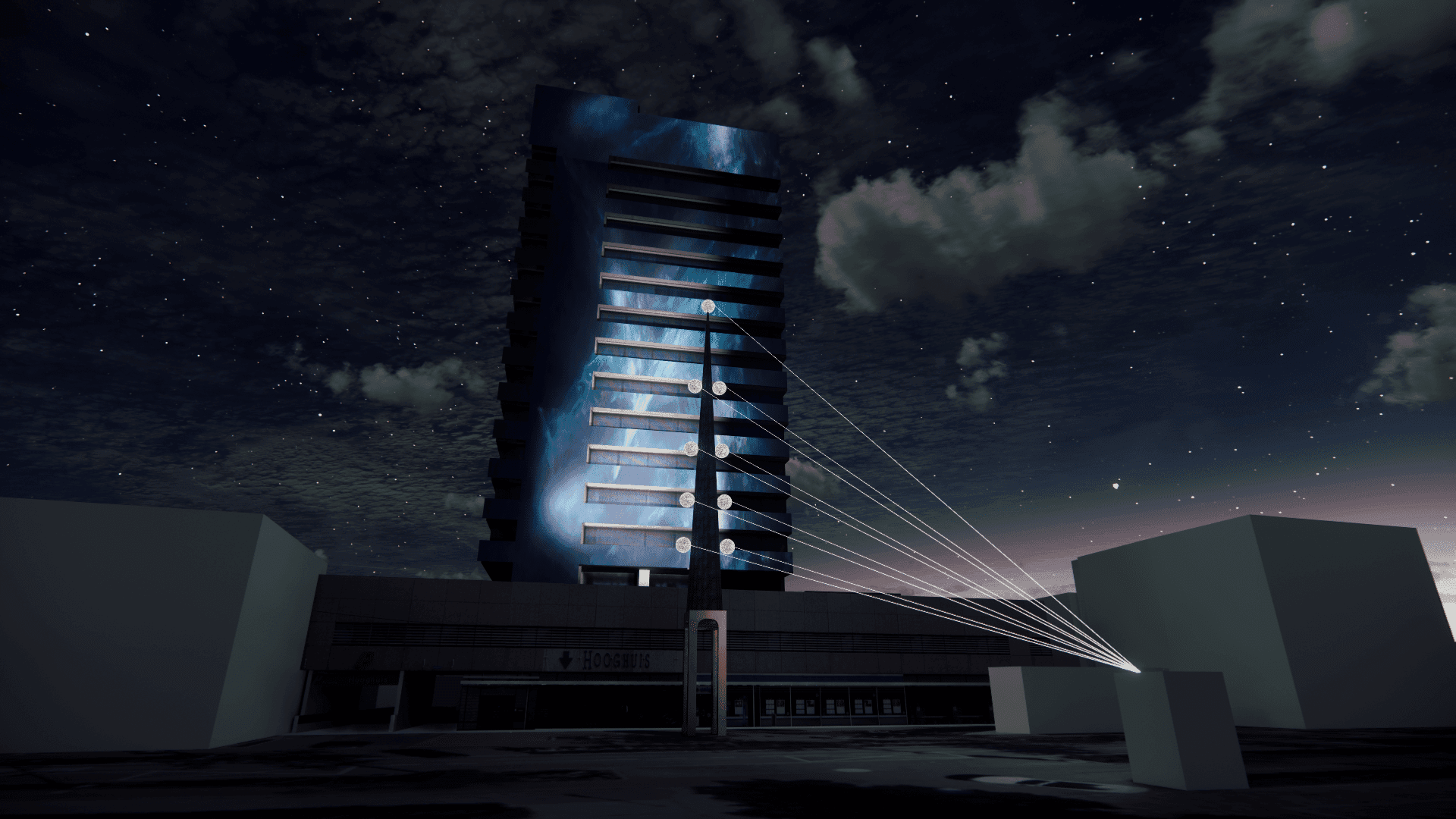
Antoine Goldschmidt wraps the Eindhoven Hooghuis tower in a fine curtain of mist and sends coloured laser light through it.
Published on November 6, 2026

Team IO+ selects and features the most important news stories on innovation and technology, carefully curated by our editors.
Artist Antoine Goldschmidt uses lasers and mist to make Eindhoven’s Hooghuis tower appear to change shape. SMART Photonics, TNO and PhotonJobs are backing the installation and using the festival to draw new talent into photonic chipmaking.
If you find yourself at the foot of the Hooghuis during GLOW, take a few steps back. That’s when you can see what Belgian artist Antoine Goldschmidt is doing with all 55 metres of the façade. He wraps the tower in a fine curtain of mist and sends coloured laser light through it. As the light scatters in the mist, the flat façade seems to take on depth. The building stands still, but from the street it looks as if it’s moving. Triple Point at GLOW
In Triple Point, Goldschmidt, who works through his studio Magicstreet, uses light to change the way visitors perceive space. A few kilometres away, Eindhoven’s chipmakers give light a different job. They design circuits that can generate, guide and modify light on a chip to transmit data, among other uses. SMART Photonics, TNO and PhotonJobs, an initiative of PhotonDelta, are helping make the installation possible. They also want visitors to see that the region has jobs for people who can design, make and test these chips.
When light carries data
A fibre-optic cable illustrates how it works. At one end, a transmitter converts an electrical data signal into variations in a beam of light. The light travels through the fibre to a receiver, which converts the signal back into electrical form. A photonic chip can bring several parts of that link together on a single piece of material. A laser supplies the light, a modulator encodes the signal onto it, and an optical waveguide directs it where it needs to go.
For data centres, what matters is how much data a link can carry per second and how much energy it takes. When large AI models are trained, many chips have to exchange data. Optical links can help them move more data while using less energy per bit. The benefit depends on the application and the link's total energy consumption, including conversion at both ends. TNO also sees applications for photonic chips in telecommunications and medical technology, where light can measure tiny changes.
“The same light that inspires wonder on the streets of Eindhoven during GLOW is also changing how information travels around the world,” says Ton van Mol, managing director at TNO, in the project announcement.
Who will make those chips?
The tie-in with GLOW comes as Eindhoven works to scale up production. At the High Tech Campus, TNO is building a pilot line where companies can manufacture and test photonic chips on larger indium phosphide wafers. The material is well suited to components that generate their own light, such as lasers. SMART Photonics manufactures these chips for other companies and announced in September that it would work with GlobalFoundries to launch a manufacturing service combining indium phosphide and silicon photonics.
Scaling up also raises the question of who will do the work. Designing a chip is one step. Someone then has to find out whether it can be manufactured consistently at higher volumes, how to connect it to an optical fibre, and how to test whether it still works as intended once assembled. That takes a range of specialists, from designers to process and test technicians. PhotonJobs connects jobseekers with companies in the Dutch photonics industry. With Triple Point, the partners are also reaching out to people who have never looked for a job in photonics.
For visitors, it starts with an effect they can see from the pavement. Where light meets mist, a sense of depth appears where by day there’s only a façade. Inside a photonic chip, the opposite happens. Light follows a precisely defined path so that it delivers a usable signal at the other end.
Triple Point is free to see at the Hooghuis from 7 to 14 November. The GLOW route in Eindhoven is open daily from 18:30 to 23:00. Visitor information