
From engine to compressor: Aeronamic rethinks aerospace hardware
At Blue Magic Netherlands, Aeronamic showed how high-speed components are converging with electrification, design, and energy systems.
Published on January 13, 2026

Business development manager Patrick Haagmans, Aeronamic, at Blue Magic Netherlands. © Nadia ten Wolde

Bart, co-founder of Media52 and Professor of Journalism oversees IO+, events, and Laio. A journalist at heart, he keeps writing as many stories as possible.
At first glance, Aeronamic may not appear to be a typical startup story. Founded in 1988 and deeply embedded in the global aerospace supply chain, the Dutch company has long been a quiet force behind some of the world’s most advanced aircraft systems. Yet at Blue Magic Netherlands, business development manager Patrick Haagmans made clear that Aeronamic is in a period of transformation and that electrification, ultra-compact compressors, and new partnerships may define its next chapter.
“We’re a privately owned Dutch aerospace company,” Haagmans began, “focused on high-speed components and products.” With around 250 employees and facilities in Almelo, Woensdrecht, and Sibiu (Romania), Aeronamic operates at the intersection of design, production, testing, and maintenance. Its customers include some of the biggest names in aerospace: Lockheed Martin, Collins Aerospace, Honeywell, Safran, and Pratt & Whitney. But what makes the company particularly relevant today is not just who it supplies, but how it is repositioning itself for a changing aerospace landscape.
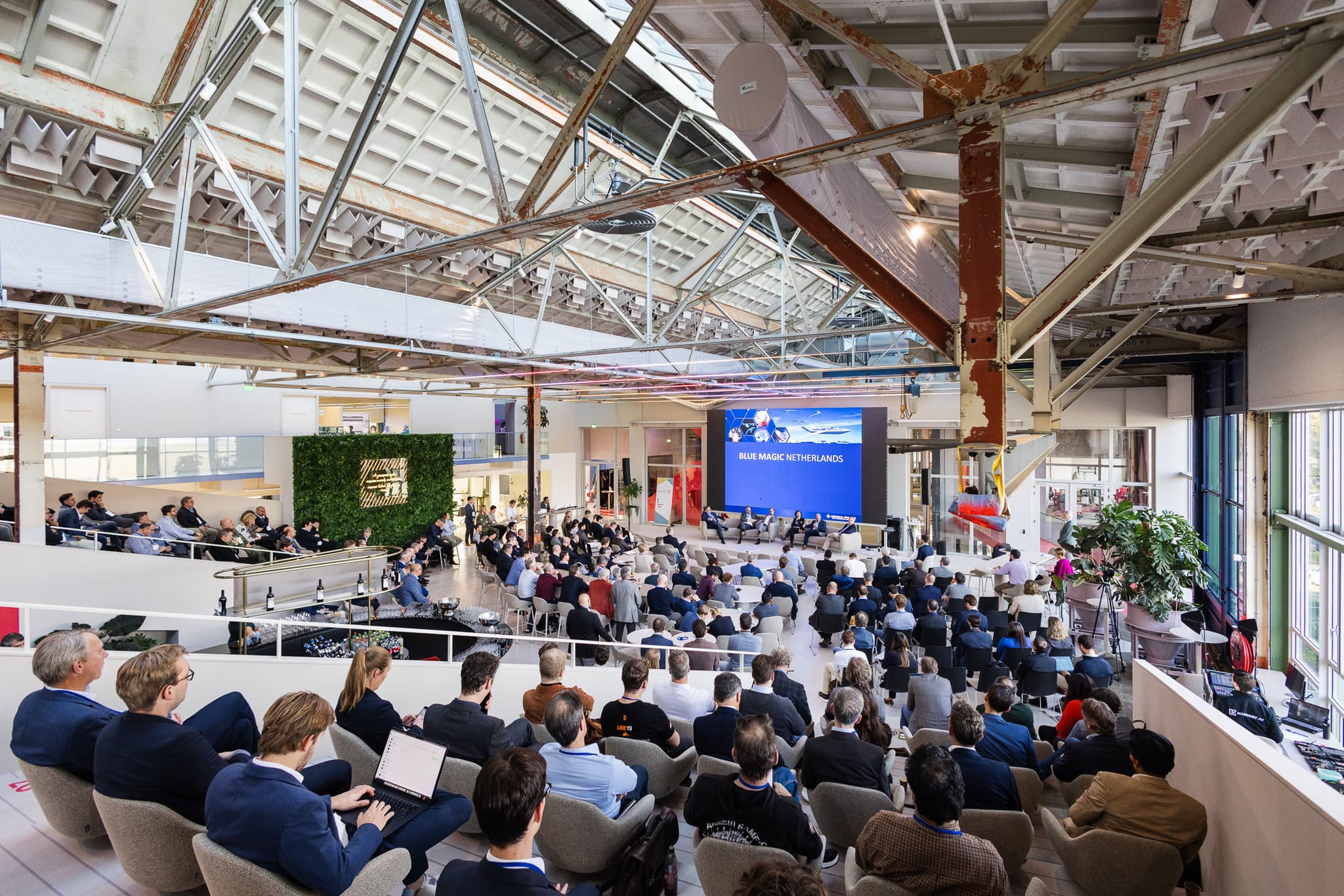
Blue Magic Netherlands
Read all the stories we gathered at the Blue Magic Netherlands event, focused on innovation in the Defene industry.
A vertically integrated aerospace specialist
Aeronamic’s strength lies in its vertical integration. The company designs, develops, manufactures, tests, and maintains high-speed components entirely in-house. That includes everything from precision machining and surface treatment to assembly, balancing, and testing. “We are virtually fully integrated,” Haagmans explained. “We can do design, development, production, testing, MRO, all under one roof.”
That integration has made Aeronamic a trusted single-source supplier for long-running aerospace programs, often with contracts that last for the full lifecycle of an aircraft. In practice, that means decades of involvement in both civil and defense aviation.
Roughly 60 percent of Aeronamic’s business is commercial aviation, with the remaining 40 percent in defense. On the civil side, the company supplies components for aircraft systems ranging from air cycle machines to cooling units. One lighthearted example Haagmans shared: if you’ve ever had a cold beer on board an Airbus A350, chances are Aeronamic hardware helped cool it.
On the defense side, the company works on mission-critical systems, including auxiliary power units (APUs) and forward modules for military aircraft. Some of this work is highly specialized - and restricted - with facilities that cannot even be shown publicly.
From mechanical to electric
What brought Aeronamic to Blue Magic Netherlands, however, was not its legacy, but its future. The company is increasingly focused on electrically driven, high-speed compressor technology, a crucial building block for next-generation aircraft, drones, and defense platforms. As aviation moves toward electrification, thermal management and energy efficiency become limiting factors.
“The industry is changing fast,” Haagmans said. “Electrification, higher power densities, and compact systems are becoming essential.” One of Aeronamic’s flagship developments is an in-house electric compressor. Where traditional systems might weigh around 20 kilograms, Aeronamic has reduced the weight to just 2 kilograms while still delivering approximately 5 kilowatts of power. That combination of high power density and low mass is what makes the technology interesting for a wide range of applications:
- aircraft cooling systems
- electronics and battery thermal management
- air compression
- high-energy laser platforms
- next-generation defense systems
“We focus on high-speed electric motor-driven compressors,” Haagmans explained. “That allows us to drastically reduce size, weight, vibration, and noise, while increasing efficiency.”
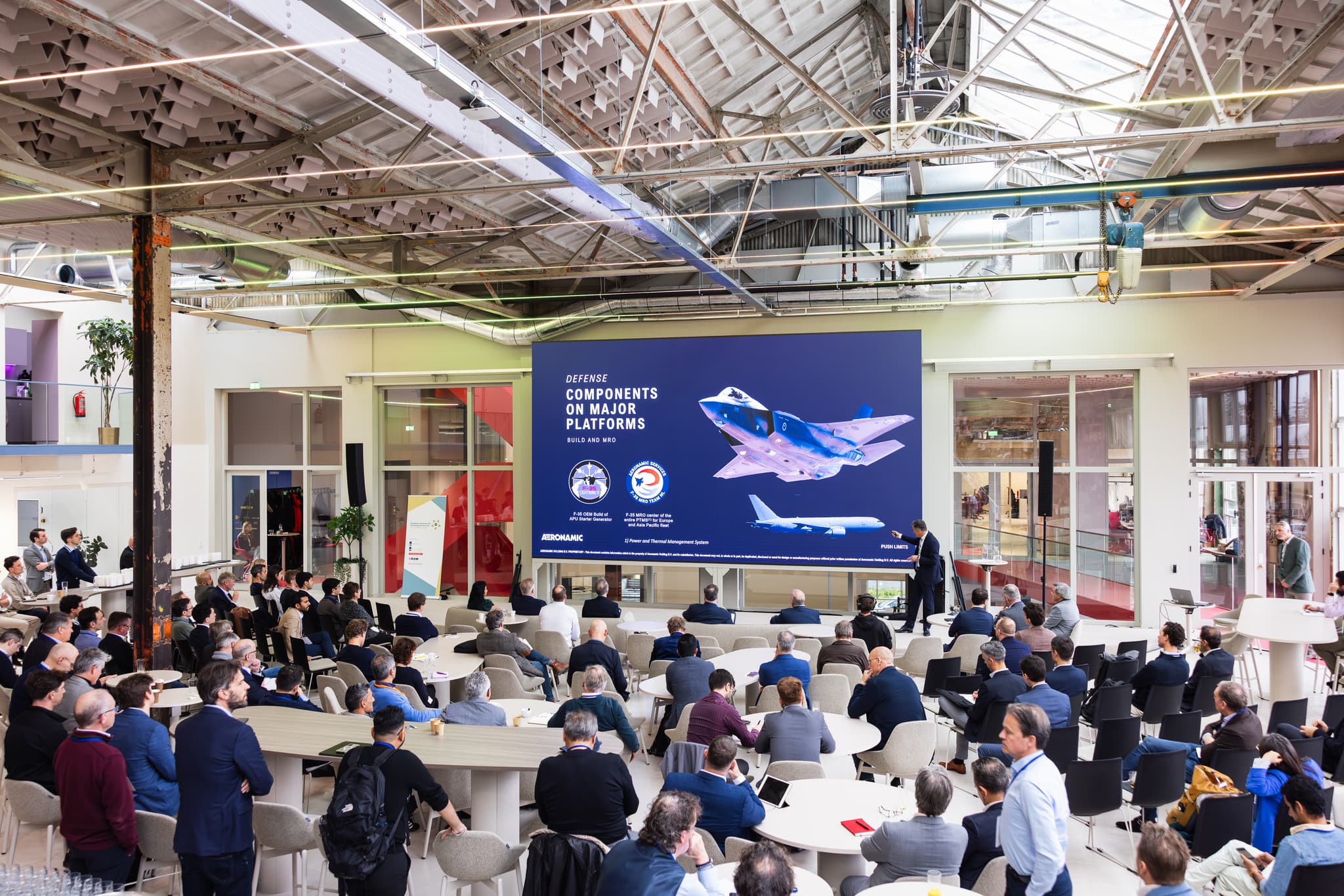
Business development manager Patrick Haagmans, Aeronamic, at Blue Magic Netherlands. © Nadia ten Wolde
Built for customization, not mass production
Unlike consumer tech companies, Aeronamic does not work with off-the-shelf components. Every system is tailored. “We don’t sell a standard product,” Haagmans said. “We develop to specification.” Each system combines two core components: the compressor and a digital electronic control unit (ECU). Together, they can be tuned for different voltages, cooling media, operating environments, and performance requirements.
The technology is already mature technically. Most systems currently sit at Technology Readiness Levels (TRL) 4 to 6, meaning they have been proven in lab and prototype environments, but are not yet in large-scale operational deployment. And that, Haagmans admitted, is the bottleneck.
The challenge: from prototype to flight
Despite strong interest from industry partners, Aeronamic’s electric compressor technology has not yet flown. Not because it doesn’t work, but because scaling aerospace hardware is slow and expensive. “Many of our partners are still in the prototyping phase,” Haagmans said. “They are refining their system architectures, their requirements, their power budgets. We’re helping them redesign components, but full-scale deployment takes time.”
Another challenge is integration. Aeronamic can deliver compressors and control units, but not complete cooling systems. To move faster, the company is actively seeking partners to help build and commercialize full-system solutions. “We can build the core technology,” Haagmans told the audience. “But to bring this to market at scale, we need partners, and we need investment.”
A glimpse of the future
What Aeronamic’s presentation made clear is that the future of aerospace is no longer just about engines and airframes. It is increasingly about power electronics, thermal management, and efficiency at extreme performance levels. As electric propulsion, directed energy systems, and high-density electronics become more common, the need for compact, reliable, high-performance cooling solutions will only grow.
Aeronamic, with its combination of aerospace pedigree and forward-looking R&D, is positioning itself squarely in that space. “We’re ready,” Haagmans concluded. “The technology is there. Now it’s about finding the right partners to bring it into the air.”
At Blue Magic Netherlands, that message landed clearly: the next leap in aerospace innovation may be smaller, lighter, and spinning at very high speeds.