
Exclusive look: upgrade of the Eindhoven-Oost substation
TenneT is investing billions of euros in the regional high-voltage grid. One of the projects is the Eindhoven-Oost substation.
Published on July 29, 2026

Our DATA+ expert and Editor-in-Chief, Elcke Vels, explores AI, cyber security, and Dutch innovation. Her "What if..." column imagines bold scenarios beyond the norm.
The power grid around Eindhoven, which dates largely from the 1960s, is under strain. To ensure the Brainport region has a sufficient supply of electricity in the future, grid operator TenneT is investing billions of euros in the regional high-voltage grid. One of the projects is the Eindhoven-Oost substation, which is set to double in size. How do you upgrade a high-voltage substation while it remains in operation? Reporter Elcke Vels got an exclusive behind-the-scenes look.
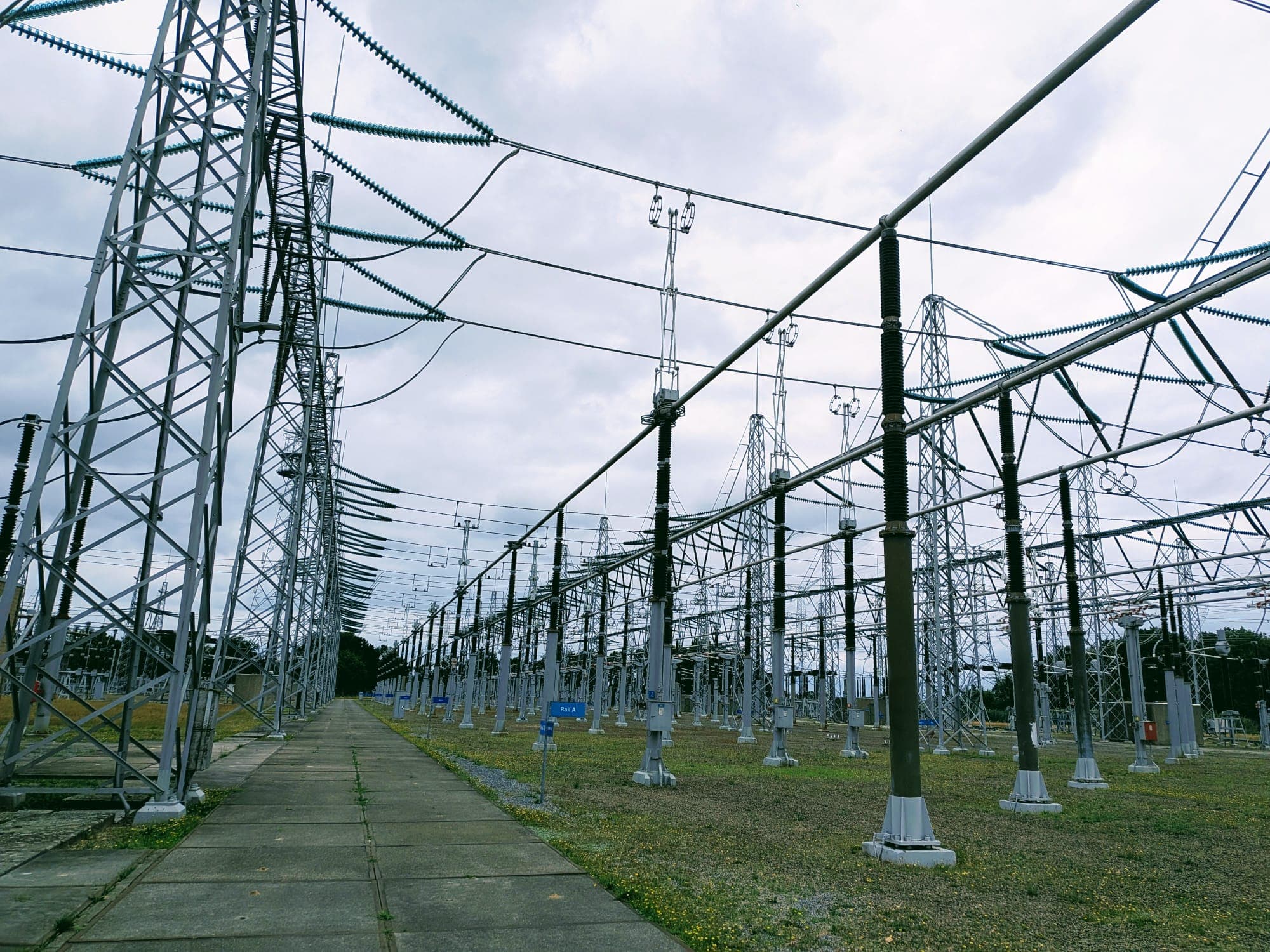
I drive down Daalakkersweg and catch my first glimpse of the substation. At first glance, nothing out of the ordinary: a fenced-off site, steel towers, and cables. Once I’ve parked by the gate, I’m warmly welcomed. I’m handed a helmet and safety boots, and not long after, I’m walking across the site alongside other media representatives and TenneT employees. It’s a unique experience. Sometimes I can literally hear the electricity crackling through the cables. We receive clear safety instructions beforehand. We know exactly where we’re allowed to go and where we’re not.
It quickly becomes clear that this is a key component of the Brainport region’s energy supply. “This high-voltage substation is connected to the national 380 kV ring,” says Katy Rosmulder, TenneT’s community relations manager for the Eindhoven region. “From here, the power is fed into the 150 kV grid and distributed throughout the region.”
A necessary expansion
We walk across the site together while TenneT’s community relations managers explain why upgrading the high-voltage substation is not a luxury. “We’re seeing grid congestion—in other words, a traffic jam on the power grid,” Rosmulder explains. “Many developments in society are driving up demand for electricity. For residential customers, think of electric cars and heat pumps. Businesses in the region are also demanding more power than we originally anticipated. That’s why we have to work hard to expand the grid.”
Renovation and expansion of the substation
We’re told that various construction projects are planned for the coming years. On the south side, the site will nearly double in size. It’s a complex operation that must also take place while the power supply remains fully operational. “That’s why TenneT is building in phases,” Rosmulder explains. “First, the new infrastructure will be installed, after which existing equipment will be replaced step by step.”
Dozens of kilometers of high-voltage transmission lines
This project is not an isolated one. In and around Eindhoven, several high-voltage substations are being expanded or modernized, and dozens of kilometers of additional high-voltage transmission lines will be added. Grid operator TenneT will invest billions of euros in more than twenty projects for this purpose over the coming years.
A modern transformer
We are led to a pair of large, gray behemoths: the high-voltage transformers. Behind their seemingly simple exterior lies a crucial process. These transformers step down the voltage to a level that makes the electricity suitable for consumption, allowing it to be transported further into the regional grid.
TenneT is replacing three transformers from the 1960s with a single new unit, Rosmulder explains. “It’s more compact, has greater capacity, and is quieter. For the surrounding area, this means a reduction in perceived noise pollution.” The current transformers have a capacity of 450 MVA; the new one has 500 MVA.
New connections: overhead and underground
A little further on, we see the overhead high-voltage line. To transport the increased amount of electricity, TenneT is installing new high-voltage lines. “A new 380 kV overhead line will be built between Eindhoven-East and Maasbracht,” says Rutger Vloet, who, like Rosmulder, is also a community relations manager in the Eindhoven region.
As for the old line, it will remain in service. It was upgraded earlier. On the old line, the conductors were replaced with so-called HTLS (High Temperature Low Sag) conductors. These conductors have a composite or carbon core instead of a traditional steel core. The result: “Significantly more current can be transmitted through the same line,” says Vloet. The line’s transmission capacity has thus increased from 3,000 to 4,000 amperes, an increase of approximately 33%. However, this is only possible when there is actually sufficient capacity available on the grid.
In the coming years, the high-voltage transmission towers around Eindhoven-East will also be replaced. As part of this, TenneT is introducing a new tower design, the Moldaumast. Vloet explains: “The current towers have two crossarms, from which the different phases hang at a certain angle relative to one another. The new tower is taller, has three crossarms, and is ‘slimmer.’ As a result, the magnetic field zone around the tower is smaller.” This is also relevant for nearby residents, who are sometimes concerned about the potential effects of magnetic field zones. However, according to TenneT, there is no cause for concern: the magnetic field strength remains well within the applicable standards. “For sensitive locations, such as homes and nursing homes where people stay for extended periods, a European guideline value of a maximum of 100 microtesla applies. We apply a maximum value of 0.4 microtesla,” says Vloet.
In addition to the overhead lines, the underground network is also being expanded. One of the projects is a new 150 kV cable connection between Eindhoven-Oost and Maarheeze.
Fall of 2026
The expansion of the substation is a major undertaking, but one with a clear goal: ensuring that the Netherlands is ready for the future. After the tour, I return to my car. As I get in, I realize just how dependent our society is on high-voltage substations like Eindhoven-Oost.
Work will begin in the fall of 2026 and is expected to continue through mid-2032.