
Europe’s tech leaders issue warning: “Act as one, or fall behind”
From semiconductors to AI, six of Europe’s most influential CEOs call for unity and industrial focus to safeguard the continent’s future.
Published on May 5, 2026
ASML, Airbus, SAP, Siemens, Nokia, Mistral AI, Ericsson

Bart, co-founder of Media52 and Professor of Journalism oversees IO+, events, and Laio. A journalist at heart, he keeps writing as many stories as possible.
A rare alliance of Europe’s industrial heavyweights is sounding the alarm. In a joint opinion piece, leaders from companies including ASML, Airbus, SAP, Siemens, Nokia, Mistral AI, and Ericsson argue that Europe is at risk of losing its technological edge. It's not because of a lack of talent or ideas, but because of fragmentation, slow decision-making, and a failure to scale, they state. Their message is clear: Europe must start acting as a single ecosystem, or risk becoming irrelevant in the global tech race.
A wake-up call from the core of Europe’s tech stack
The signatories are not fringe voices. Together, their companies represent the backbone of Europe’s industrial and digital infrastructure, from chipmaking equipment and connectivity to enterprise software and aerospace. Collectively, they generate hundreds of billions in revenue, employ nearly a million people, and invest tens of billions annually in R&D.
This is precisely why their message carries weight: they sit at the center of the technologies shaping the next decade: AI, semiconductors, advanced networks, and defense systems. And from that vantage point, they see a troubling pattern: Europe is losing ground.
Not a lack of innovation, but a lack of scale
The paradox at the heart of the op-ed is familiar to anyone following Europe’s innovation landscape: the continent excels at invention but struggles at industrialization. World-class research? Yes. Breakthrough technologies? Absolutely. Global champions at scale? Far fewer.
The CEOs argue that Europe’s problem is not creativity, but fragmentation. Markets remain divided, regulations are inconsistent, and capital is less accessible than in the United States or China.
The result: promising innovations fail to scale, or scale elsewhere. This echoes earlier warnings from Christophe Fouquet, CEO of ASML, who has pointed out that Europe risks becoming “a consumer rather than a builder” in key domains like AI.
The cost of hesitation
Timing is central to the argument. According to the CEOs, the world is entering a phase of “unprecedented technological acceleration,” where decisions made in the next few years will define competitiveness for decades. In that context, Europe’s slower pace is no longer just a disadvantage; they claim it is a strategic risk.
The consequences go beyond economics. The authors explicitly link technological leadership to social cohesion, security, and sovereignty. Lose the ability to build critical technologies, and you lose control over your future.
A call for “One Europe”
Their solution is both simple and politically complex: Europe must act as one.
That means completing the single market for technology and capital, aligning industrial policy across member states, reducing regulatory fragmentation, and accelerating decision-making at the EU level.
In essence, the CEOs are calling for Europe to behave more like a unified innovation system: closer to the scale and coherence seen in the US or China. It is not a new idea. But coming from the leaders of companies that depend on (and help define) Europe’s technological capabilities, the urgency feels different.
From ecosystem strength to execution power
One of the more subtle insights in the piece is that Europe already has many of the ingredients needed to succeed. The companies behind the letter form what they describe as a “nucleus” of technological ecosystems, spanning chips, connectivity, software, and industrial systems.
In other words, the foundation exists. What’s missing is execution at scale. That is a familiar theme all over Europe, where deeptech innovation thrives, but scaling often depends on global markets and capital. The CEOs’ argument reinforces a growing realization: Europe’s competitiveness challenge is less about invention and more about system design.
The tone of the piece is urgent but not defeatist. The authors stress that Europe’s situation is “largely of our own making”, and therefore fixable. But the window is closing, they say. As global investments in AI, semiconductors, and digital infrastructure accelerate, the gap between regions is widening. And once ecosystems reach critical mass elsewhere, catching up becomes exponentially harder.
The real question: can Europe coordinate?
The op-ed ultimately raises a deeper question, one that goes beyond technology policy: Can Europe coordinate at the level required to compete in a world of scale? For decades, the continent has balanced national interests with collective ambition. That model delivered stability and prosperity. But in a world defined by speed, capital intensity, and geopolitical competition, it may no longer be enough.
The CEOs are not just asking for better policy. They are asking for a shift in mindset. From cooperation to coordination. From fragmentation to focus. From potential to execution.
From warning to test
The message from Europe’s tech leaders is not subtle: the continent is at a crossroads. It has the talent, the companies, and the technological depth to lead in the next wave of innovation. But without structural change, those strengths risk being diluted.
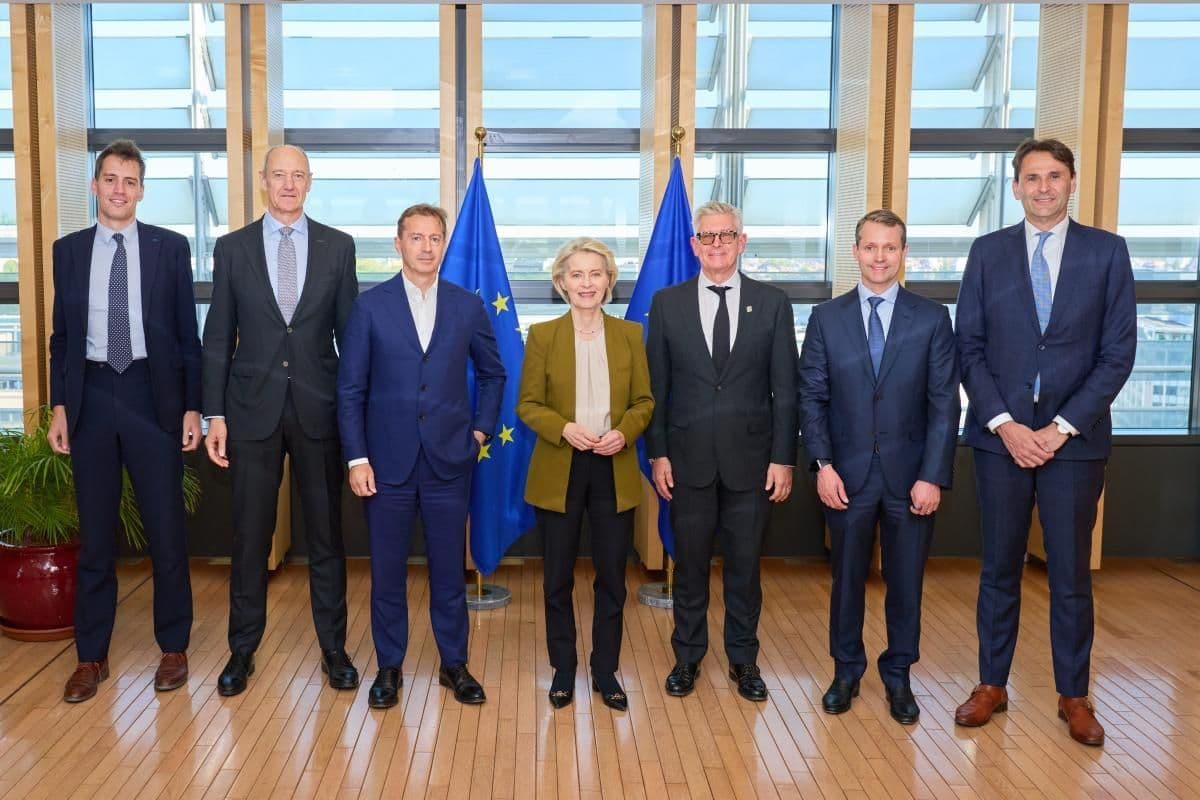
Von der Leyen with ASML, Airbus, SAP, Siemens, Nokia, Ericsson