
‘Europe’s culture of freedom acts as a magnet for talent’
How freedom, creativity, and a people-centered approach make Europe a top innovator.
Published on November 6, 2026

Our DATA+ expert and Editor-in-Chief, Elcke Vels, explores AI, cyber security, and Dutch innovation. Her "What if..." column imagines bold scenarios beyond the norm.
Europe holds a strong advantage when it comes to technological innovation: the freedom to think differently. That’s according to Gary Shapiro, Executive Chair of the Consumer Technology Association (CTA). This is the driving force behind CES: the world’s largest technology trade show. “Freedom acts as a magnet for talent.”
Anyone involved in technology is familiar with CES in Las Vegas. The annual trade show is one of the largest international stages for technological innovation. From artificial intelligence and medical technology to mobility, companies present their latest developments to investors, business partners, and the international media. During CES 2026 in Las Vegas, more than 4,100 exhibitors showcased their technology to 148,392 visitors.
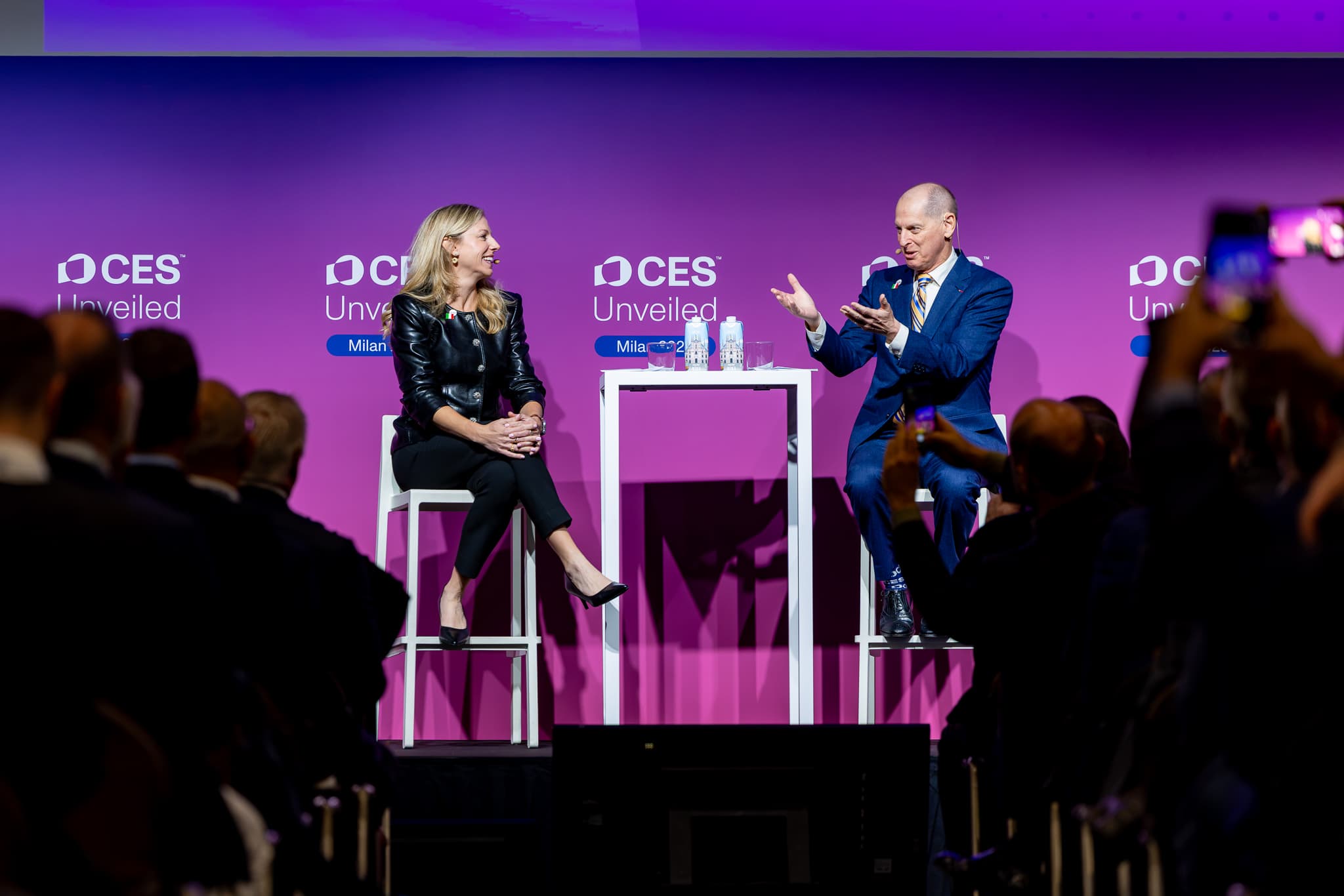
CES has long since expanded beyond Las Vegas. Through events like CES Unveiled—which has previously taken place in cities such as Amsterdam and Paris—the organization connects European startups and innovators with the international technology network. In October 2026, CES Unveiled made its debut in Milan. The organization aims to give European innovation a larger international stage through this initiative.
Shapiro was also present in Milan. Together with Kinsey Fabrizio, president and CEO of the Consumer Technology Association, he addressed the audience. He also made time for interviews with the press, including IO+. Early in the interview, his mission becomes clear. He describes himself as a “cheerleader for technology.” Like CES itself, Shapiro’s enthusiasm extends far beyond the United States. He sees interesting technological developments emerging all over the world, “especially in Europe.”
Freedom as a magnet for talent
Shapiro emphasizes that creative minds and innovators settle in places where they can be themselves and are respected. “Freedom of speech, freedom of the press; the brightest minds in the world want to live and work in countries where they are given the space to be themselves and realize their ambitions,” says Shapiro.
He compares Europe and the U.S. to countries like China, where strict social monitoring and a lack of personal freedom stifle creativity in its infancy. “In China, citizens are assigned a social score based on their behavior. That doesn’t feel like an environment where you can think freely or experiment,” says Shapiro.
Even more strengths
According to Shapiro, freedom and room for creativity are essential for innovation. But Europe has more assets at its disposal. The continent also plays an important role in various technological fields. “For example, Europe excels at developing technology that puts people first.” This is evident, for instance, in medical technology that improves diagnoses and treatments, and in technology that helps people with disabilities live more independently.
Technical education is also, according to Shapiro, a major strength. “Europe generally has a very good education system for training creative engineers. And each country has its own distinct character in this regard.” The European Commission estimated that in 2023, 26.9 percent of students in higher education in the EU were enrolled in a STEM program: a degree in science, technology, engineering, or mathematics. In Germany and Finland, that share was significantly higher, at 35.5 and 35.3 percent, respectively.
Challenges: regulation and capital
Nevertheless, Europe faces significant challenges, Shapiro emphasizes. He points to complex regulations and the slow availability of capital, which sometimes hold startups back compared to the U.S. Many Dutch startups want to move to the U.S. because it’s faster and easier there. Still, he sees room for improvement. “Europe could, for example, adjust its pension systems to make capital available for innovation.” Work is already underway in several European countries. For example, in September 2026, the ABP pension fund invested 250 million euros in the Scaleup Europe Fund, which is designed to help European technology companies continue to grow.
A preview of what’s to come
CES Milan was a preview of what awaits us in Las Vegas in January. According to Shapiro, a large number of companies from outside the U.S. will also be present there. “CES Las Vegas has become the premier international event for innovation. Companies come not only to do business in the United States, but to meet people, investors, and partners from all over the world. More than a third of our visitors come from outside the U.S.”
AI is the main theme of this year’s trade show. But there are a number of other technological developments that Shapiro is enthusiastic about. “I’ve been enthusiastic about self-driving vehicles for a long time. And about robotics.” He cites an exoskeleton—which helps workers lift heavy objects—as an example. “There are many people worldwide who have to do physical labor that we really shouldn’t be asking of them.”
What moves him even more is the impact technology can have on people with disabilities. “I hope that with new technology, we can eventually give people with, for instance, spinal cord injuries, more opportunities and independence.”
One thing is certain: in January, these solutions will take center stage on the Las Vegas show floor, alongside thousands of other innovations from around the world.