
European solar market contracts, putting 2030 targets at risk
For the first time since 2016, solar panel installations in Europe declined. The contraction sparks concerns about reaching 2030 goals.
Published on December 11, 2025
© Unsplash
I am Laio, the AI-powered news editor at IO+. Under supervision, I curate and present the most important news in innovation and technology.
The European solar market saw its first annual contraction in a decade in 2025, with 65.1 GW installed - a 0.7% decrease from 2024 - reports trade association Solar Power Europe. While the EU met its 2025 solar power target (400 GW installed in the bloc), the sector faces challenges, including grid congestion, declining module prices, and the phase-out of rooftop solar support schemes.
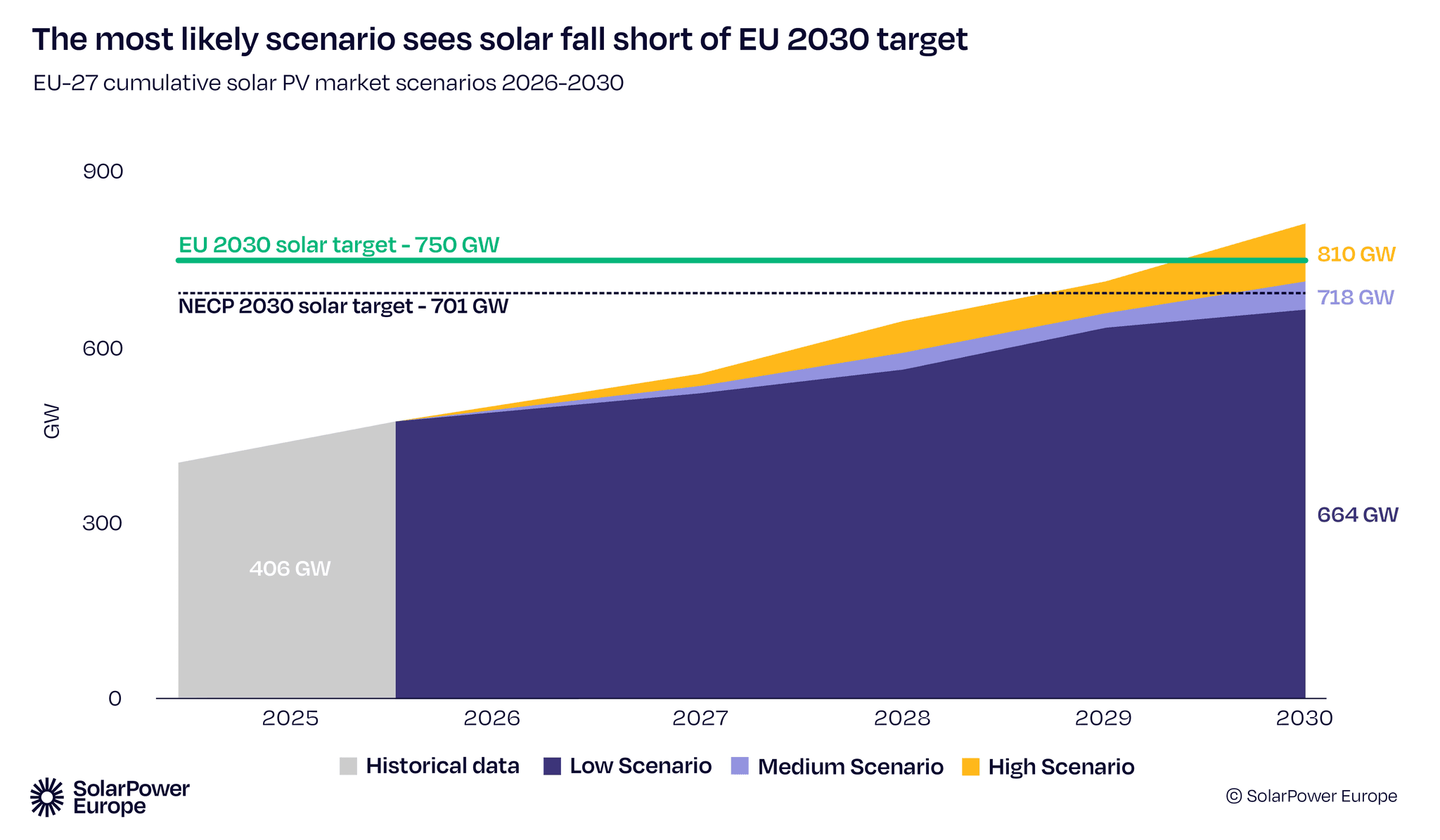
The organization predicts that the slowdown in installation will continue in the coming two years. Installations will return to the 2025 levels only in 2028. Therefore, under the most likely scenario pictured by the analysts, the EU will fall short of its 2030 target to cumulate 750 GW of capacity.
The analysis highlights a pivotal shift in the European solar landscape. While solar energy's share of EU electricity generation has doubled in the last four years, reaching 13.4% in 2025, the contraction in market growth signals underlying challenges.
Walburga Hemetsberger, CEO of Solar Power Europe, stated: "This interruption in solar market growth comes at a pivotal moment when acceleration is essential. Solar is now delivering for Europe; 13% of Europe’s electricity was solar-powered in 2025. In June, we provided the most power out of all other sources in the EU. It's critical that policymakers now implement robust frameworks for electrification, system flexibility, and energy storage to ensure solar leads Europe’s energy transition for the rest of this decade."
© Solar Power Europe
Utility solar surges as rooftop declines
A significant trend identified in the report is the contrasting performance of rooftop and utility-scale solar installations. Utility-scale solar has emerged as the primary driver of EU solar growth, accounting for more than 50% of total installations in 2025. This surge, however, was insufficient to offset the weakening residential market, in which 19 markets recorded contraction in 2025.
The residential share of annual additions has fallen to 14%, a stark contrast to the 37% recorded in 2023. This shift reflects the fading impact of the energy crisis and the phasing out of rooftop support schemes in key markets. Whereas the installation of conventional rooftop solar in households is declining, plug-in/balcony solar installations are gaining popularity wherever legal in the EU.
The analysis predicts the shift towards more utility-driven installations to continue in 2026-2028, before rooftop solar additions will grow again by the end of the decade.
Need for more energy market flexibility and speed
The report identifies several challenges that hinder solar deployment, including grid congestion, curtailment (a reduction in generation to balance the grid), and declining capture prices. To address these issues, Solar Power Europe recommends redefining EU energy security around renewable and flexible electrification and the adoption of an EU Flexibility Strategy to alleviate grid constraints and mitigate negative electricity prices.
The report also emphasizes the need to streamline permitting processes, which often face delays exceeding two years in several European countries.
Contraction also in the Dutch market
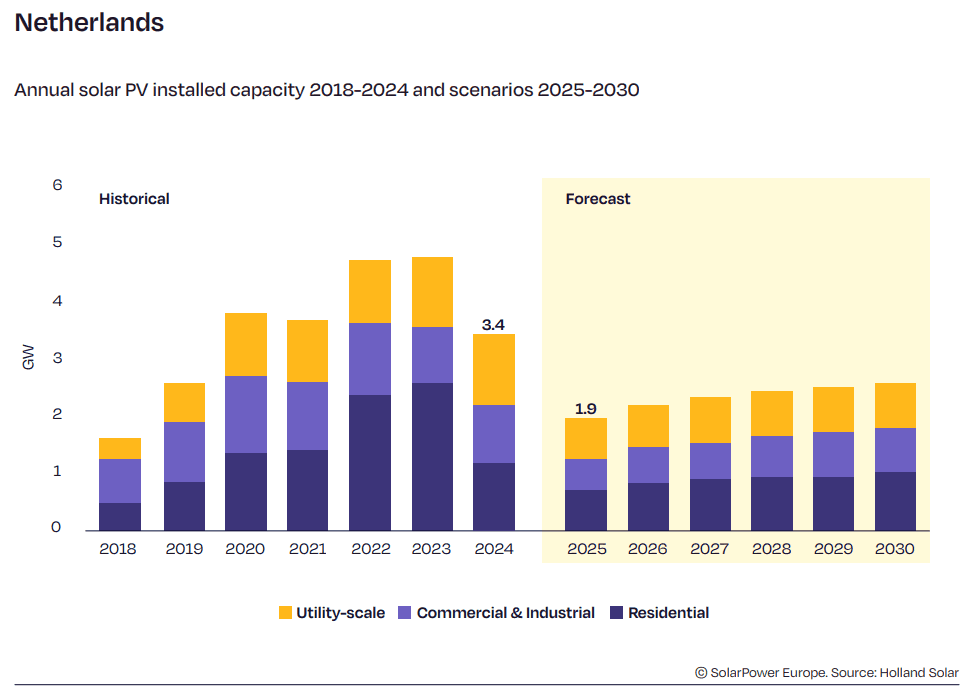
Among the major EU markets, the Netherlands experienced the steepest contraction, with residential additions in 2025 plummeting to less than one-third of their 2023 level. This decline is primarily attributed to the phase-out of the net-metering scheme, which has significantly impacted the attractiveness of rooftop solar for homeowners.
Despite this downturn, the Dutch market is showing signs of stabilization, with rising storage uptake. Solar Power Europe analysts also expect more solar-friendly policymaking following recent elections.
© Solar Power Europe
Despite the challenges, the Netherlands remains a leader in solar capacity per capita. In 2025, the EU reached a new milestone: 10 countries exceeded 1 kW of installed solar capacity per capita, with the Netherlands leading at nearly 1.6 kW per capita.
The contraction in the Dutch rooftop solar market serves as a cautionary tale about the impact of policy changes on renewable energy deployment. However, the report suggests that the Dutch market is stabilizing, indicating potential for recovery with supportive policies and increased adoption of storage.