
Europe has 10% of the chip market, but we know where the money is
Stefano Goeptar (Hezelburcht): The Netherlands holds strong positions in the parts of the chip value chain where profit margins are highest.
Published on August 14, 2026

Bart, co-founder of Media52 and Professor of Journalism oversees IO+, events, and Laio. A journalist at heart, he keeps writing as many stories as possible.
Europe is lagging far behind its ambition to account for twenty per cent of global chip production by 2030. But anyone looking only at market share is missing an important part of the story, according to an analysis by Stefano Goeptar of Hezelburcht. The Netherlands in particular holds exceptionally strong positions in the parts of the chip value chain where profit margins are highest.
This article is based on a market analysis by Stefano Goeptar, consultant at Hezelburcht, published on August 11, 2026. The calculations of market segments and profit pools in this article are taken from his analysis.
Europe’s chip industry has a problem. At least, if it is judged by the criterion Brussels itself has chosen. In 2024, Europe accounted for around ten per cent of the global semiconductor market. That is far short of the twenty per cent the European Union aims to reach by 2030. Last year, the European Court of Auditors already concluded that it is highly unlikely that this target will be achieved.
That sounds like a rather discouraging story about Europe’s chip industry. But according to Stefano Goeptar, it means we are looking at the wrong numbers. “The problem is the yardstick,” he writes in his analysis for subsidy consultancy Hezelburcht.
The semiconductor industry, after all, is not a homogeneous market. Behind that single percentage are dozens of very different technologies and business models. And once those are examined separately, the picture changes dramatically. The Netherlands then turns out not so much to be a major chip producer, but above all the owner of several of the most valuable links in the global chip machine.
Not chips, but the machines used to make them
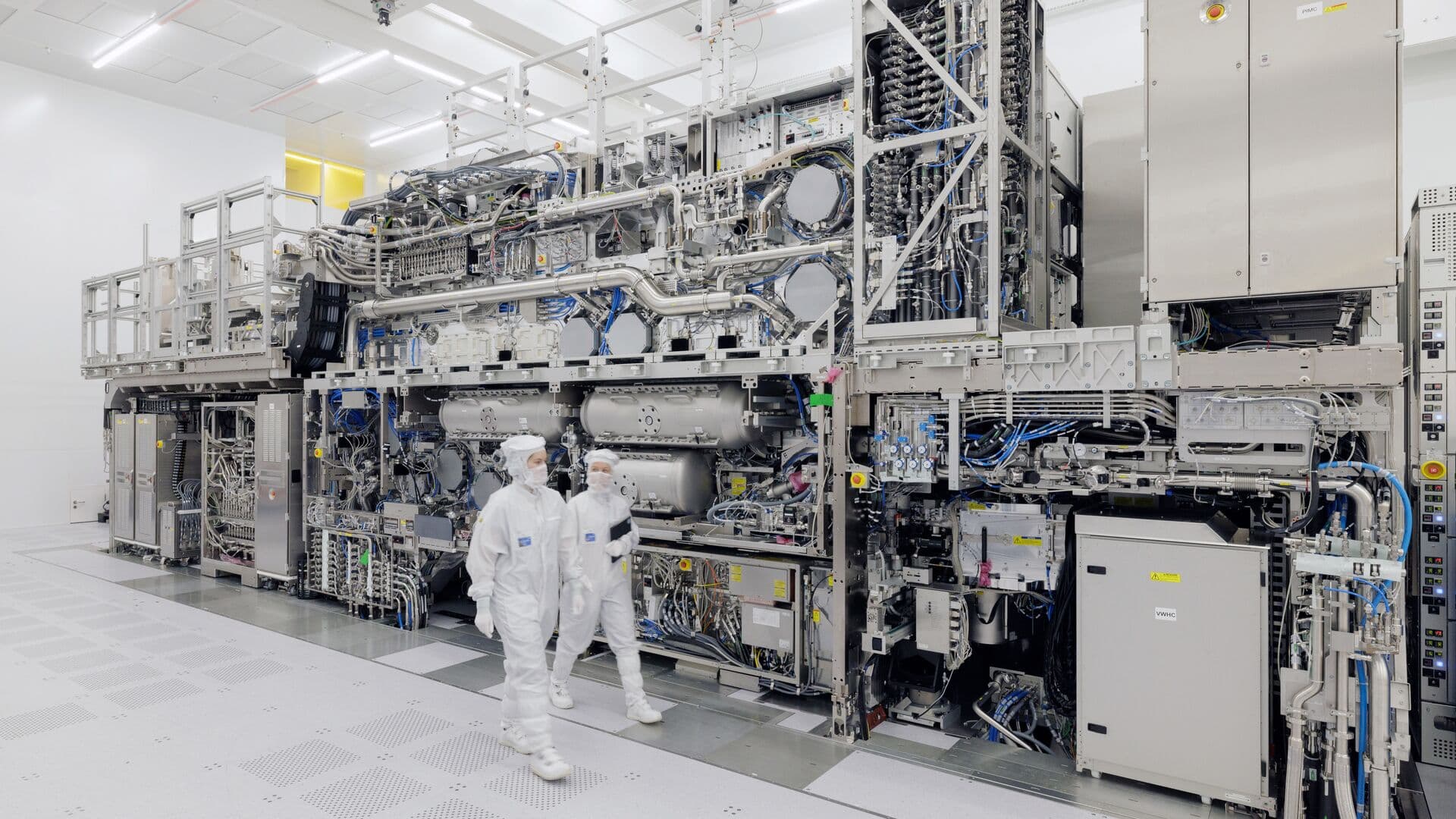
The best-known example can be found in Veldhoven. ASML holds a unique position in EUV lithography, the technology used to print the finest patterns onto the most advanced chips. Without EUV machines, companies such as TSMC, Samsung and Intel cannot produce their most advanced processors.
In this specific segment, Europe therefore effectively holds 100% of the global market. That entire share belongs to a single Dutch company. In the broader lithography market, including the older DUV technology, ASML is also by far the most important player.
That position translates into enormous economic value. ASML recorded revenue of € 32.7 billion in 2025 and a gross margin of 52.8 per cent. The company sold 48 EUV systems and 279 new DUV systems that year.
But ASML is not alone. From the Netherlands, ASM International holds a leading position in atomic layer deposition, or ALD: a technique for depositing extremely thin layers of material onto chips, one atomic layer at a time. ASM recently reported a global market share of more than 55 per cent in ALD.
And Besi, based in Duiven, is one of the leading suppliers of equipment for advanced packaging. This involves connecting different chips to each other in increasingly sophisticated ways. Hybrid bonding in particular is becoming increasingly important now that the performance of AI systems no longer depends solely on making a single transistor ever smaller, but also on how different types of chips and memory are combined. Besi itself sees this market as an important future growth driver.
Dutch success, therefore, is strikingly often not in the chip itself, but in the equipment that enables others to manufacture chips.
That is also where the margins are
And this is precisely where, according to Goeptar, an important difference becomes visible. Based on his analysis, the total operating profit pool of Europe’s semiconductor sector amounted to approximately €21.2 billion in 2024. More than half of that went to manufacturers of chip equipment, such as ASML, ASM International, Besi and Germany’s AIXTRON.
Together, according to his calculations, these companies account for around 34 percent of European semiconductor revenue, but 54 percent of operating profit. Average EBIT margins in this segment are around thirty percent.
The picture is very different for chip fabs. Front-end manufacturing – the actual production of wafers – represents around sixteen percent of European revenue in Goeptar’s analysis, but only seven percent of the profit pool. The average operating margin is around eight percent.
This creates an interesting paradox. Through the Chips Act, Europe is investing billions in new chip fabs to increase its share of global production. Yet a significant part of the economic value is earned by companies that supply the machines and specialized technology for those fabs. Or, as Goeptar summarizes it: “Three-quarters of Europe’s semiconductor profit is concentrated in a quarter of the value chain.” And a remarkably large part of that quarter is located in the Netherlands.
The Dutch chip industry is bigger than its revenue suggests
This also makes clear why national market shares can sometimes be misleading. The five major Dutch semiconductor companies – ASML, NXP, ASM International, Nexperia and Besi – generated more than € 45 billion in combined revenue in 2024, according to Goeptar’s calculations. Within that group, ASML, ASM and Besi stand out in particular because of their high margins and strong technological positions.
These companies benefit from something that is difficult to replicate with money alone: decades of accumulated knowledge. Lithography systems consist of thousands of extremely precise components and technologies. ALD requires deep knowledge of chemical processes at the atomic level. Advanced packaging demands ever greater precision in connecting chips.
This creates high barriers to entry. A competitor cannot simply build a factory and reach the same level a few years later.
The strength of the Dutch ecosystem also extends far beyond these large companies. Around them is an extensive network of specialized suppliers in areas including mechatronics, optics, vacuum technology, metrology, precision components and software.
It is precisely this combination that makes Brainport Eindhoven much more than simply the location of ASML.
Europe cannot do without chip fabs
That does not mean, however, that Europe should stop building semiconductor fabs. The coronavirus pandemic and geopolitical tensions surrounding Taiwan and China have made it clear how vulnerable global supply chains can be. Production capacity on European soil therefore has strategic value that cannot be expressed entirely in profit margins.
The European Court of Auditors also supports the strategic objectives behind the Chips Act, but warned that the available investments and instruments are insufficient to achieve the targeted 20 per cent global market share by 2030.
Goeptar’s analysis therefore primarily raises a different question: should Europe really measure success primarily by the percentage of chips produced here? If European companies supply indispensable technology to chip fabs around the world, a relatively small share of total revenue can still go hand in hand with extraordinary economic and strategic influence.
The next opportunity: packaging and photonics
That perspective is also relevant to the next generation of semiconductor companies. Goeptar points, for example, to advanced packaging as a market that may be at the beginning of a much larger growth phase. The industry is increasingly unable to improve performance simply by making transistors smaller. As a result, chiplets, 3D integration and new interconnection technologies such as hybrid bonding are becoming more important.
Besi is positioned right at the heart of this development. The company’s order intake rose sharply at the end of 2025, and Besi itself points to new investments in areas including 2.5D data centre applications and hybrid bonding.
A second area is photonics. With Eindhoven and Twente, the Netherlands has one of Europe’s most developed ecosystems for integrated photonic chips. The question is whether this could ultimately lead to a similarly specialised position to the ones the Netherlands previously built in lithography, ALD and packaging.
What is interesting about such markets is that they can initially appear small. For years, ASML’s EUV technology was above all an extremely expensive promise. Today, it is indispensable for producing the world’s most advanced chips.
Not bigger, but harder to replace
Ultimately, Goeptar’s analysis comes down to a different way of looking at industrial policy. Europe does not necessarily need to capture twenty per cent of the global market in every part of the chip value chain. Economically and geopolitically, it may be at least as valuable to be difficult to replace in a number of crucial areas.
The Netherlands shows what that can look like. The country produces hardly any of the advanced processors and memory chips driving today’s AI boom. But Dutch companies do supply some of the most complex equipment used to manufacture, assemble and further develop those chips.
According to Goeptar, this means that the Dutch share of global semiconductor revenue is a poor measure of the country’s true significance.