
Euclyd wants to raise €100 million and take on Nvidia
European startups such as Euclyd are seeking hundreds of millions to break Nvidia’s dominance in AI inference.
Published on April 17, 2026
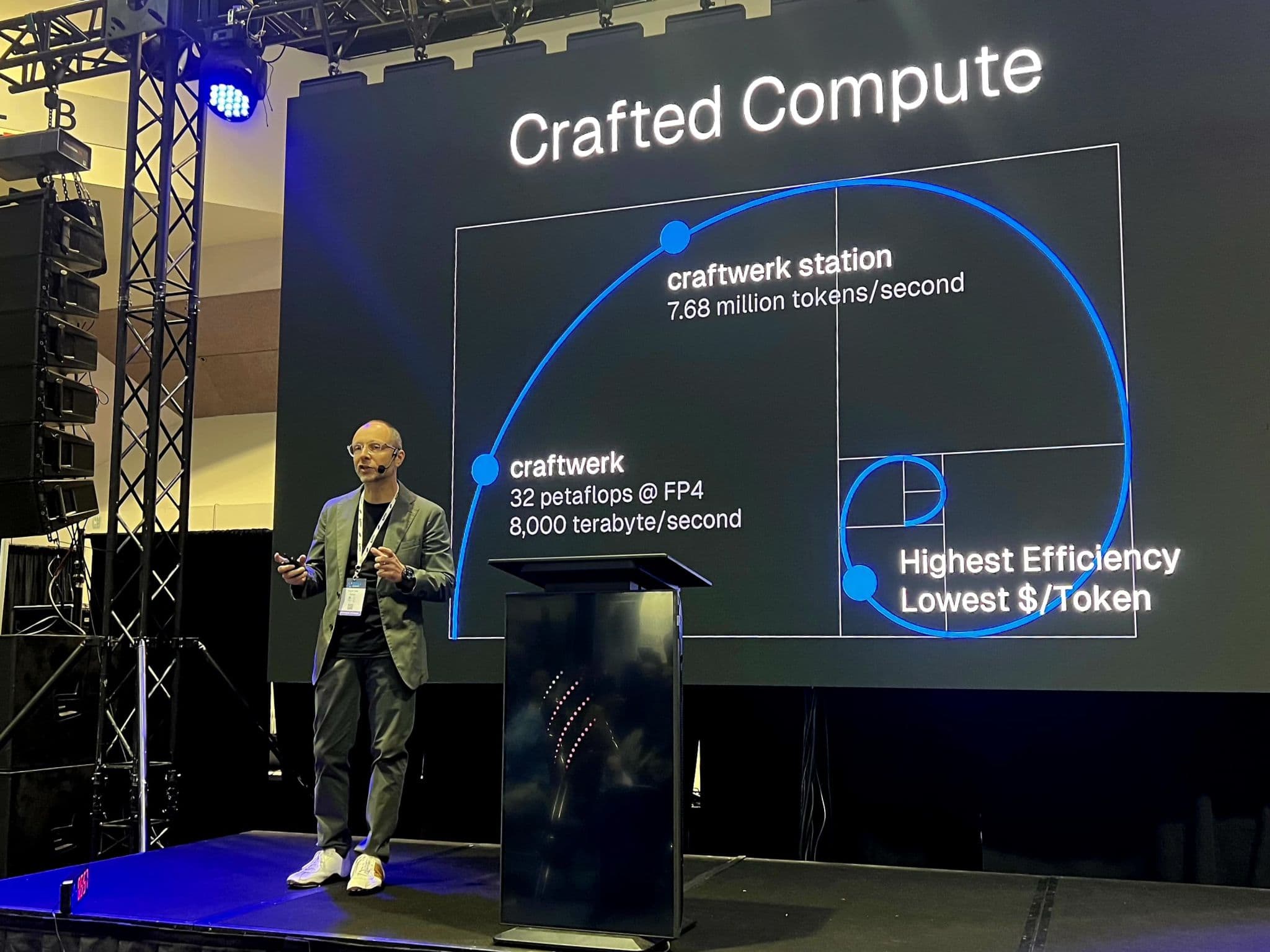
Euclyd's Ingolf Held at the AI Infra Summit in Santa Clara, California © Euclyd

Team IO+ selects and features the most important news stories on innovation and technology, carefully curated by our editors.
The European chip sector is experiencing unprecedented growth driven by the enormous demand for artificial intelligence. While American giant Nvidia firmly controls the market for training AI models, European challengers sense an opportunity in the next phase: AI inference. This is the process in which trained models actually perform tasks for users. Dutch company Euclyd is leading the charge. The company is backed, among others, by Peter Wennink, the former CEO of chip machine maker ASML. Euclyd is currently in talks with investors for a funding round of at least €100 million, the company said in an interview with CNBC. This capital injection is needed to challenge the established order in Silicon Valley.
The stakes are high because the winner will determine how efficiently and autonomously Europe’s digital infrastructure will function in the near future.
The shift from training to inference
The current AI market no longer revolves solely around training enormous language models. The focus is rapidly shifting to AI inference, meaning the practical use of these models. Nvidia is currently the most valuable company in the world thanks to its graphics processors (GPUs). These chips were originally designed for gaming but turned out to be extremely well-suited for AI training.
However, this architecture has disadvantages when used at scale for inference. Existing GPUs consume enormous amounts of energy because they constantly move data back and forth between memory and the compute core. Euclyd says it is building technology that handles this process far more efficiently. According to Patrick Schneider-Sikorsky of the NATO Innovation Fund, the current architecture was simply not built for the scale now required.
The geopolitical situation reinforces this trend. Export controls and the concentration of production at TSMC are forcing Europe to invest in its own sovereign computing power. This creates a unique opportunity for local players to offer an alternative to American dominance.
Euclyd and the legacy of ASML
Eindhoven-based Euclyd stands at the center of European ambitions. The company was founded in 2024 by former ASML executive Bernardo Kastrup. With Peter Wennink as adviser and investor, the startup has an impressive network and deep sector knowledge.
Euclyd claims to have achieved a technological breakthrough with its “Craftwerk” architecture. This chip is said to be up to 100 times more energy efficient for AI inference than Nvidia’s latest Vera Rubin chips. Instead of the traditional method in which data travels through a memory stack, Euclyd’s chip processes information in multiple places simultaneously.
This not only lowers energy costs but also significantly reduces the ecological footprint of data centers. Although the technology has not yet proven itself at a commercial scale, expectations are high. The company is currently working on a multi-chiplet system that is expected to enter production by 2028. With 16,384 proprietary processors per system, Euclyd is targeting 32 PFLOPS of compute power. This is meant to form the foundation for the next generation of European AI infrastructure.
Photonics as the new chip paradigm
Alongside Euclyd’s electronic innovations, investors are also looking at photonics as the future of computer chips. British company Olix is a major player in this field. It is developing processors that use light instead of electricity to move data and perform calculations.
Traditional electronic chips are running into physical limits in terms of miniaturization and heat generation. The heat modern chips generate has become a major obstacle to further performance gains. Photonic platforms can break through these limits by offering a massive leap in throughput per megawatt.
Olix integrates optical connections directly with compute logic, drastically lowering latency. Nvidia also sees the potential of this technology and recently invested $4 billion in photonics companies. Still, European startups such as Olix hope to move faster by focusing entirely on this new architecture.
They are targeting customers such as hyperscalers and governments that need ultra-fast inference services. The race for the most efficient light-based chip has now officially begun within the European ecosystem.
The funding gap with the United States
Despite technological progress, the European chip sector faces a significant funding disadvantage. In 2026, European AI chip startups have so far raised around $800 million. This stands in sharp contrast to the $4.7 billion received by their American counterparts in the same period.
American companies such as Cerebras Systems raise billions in a single round, while European players often have to fight for sums of €100 million. This gap limits European companies' ability to scale production quickly.
In addition, Europe’s venture capital market is less risk-tolerant than that of the United States. According to Fabrizio Del Maffeo of Axelera AI, European governments are often too conservative when purchasing products from new companies. There is no institution comparable to the American DARPA, which directly funds and supports high-risk innovation.
Although the EU Chips Act aims to mobilize more than €43 billion, implementation remains fragmented. Without a more united approach, European startups risk not surviving the “valley of death.”
Challenges in production and talent
Money is not the only obstacle for European chip developers. The ecosystem for the actual manufacturing of chips, the so-called foundries, still needs to mature in Europe. The path from a design on paper to mass delivery is long and complex.
Moreover, fragmented labor laws make it difficult to attract and retain international talent within Europe. Startups must compete with the enormous salaries and resources of American tech giants. Nvidia spent more than $18 billion on research and development in the past fiscal year. That is more than the total capital of almost all European challengers combined.
Still, the focus on specific niches, such as energy-efficient defense applications, offers a way forward. Euclyd is already in talks with four potential customers for its first systems. By focusing on secure, local AI infrastructure for European industry, they can build a loyal customer base.
This provides a counterweight to the general cloud solutions of American players, which are often subject to foreign legislation.
Euclyd hopes to deliver its first customers next year and is aiming for full production of its advanced systems in 2028.