
EU launches plan to slash reliance on non-European tech suppliers
The EU is pushing back against foreign tech dominance with a sweeping package targeting chips, cloud, AI and open source.
Published on June 3, 2026
© European Commission

Team IO+ selects and features the most important news stories on innovation and technology, carefully curated by our editors.
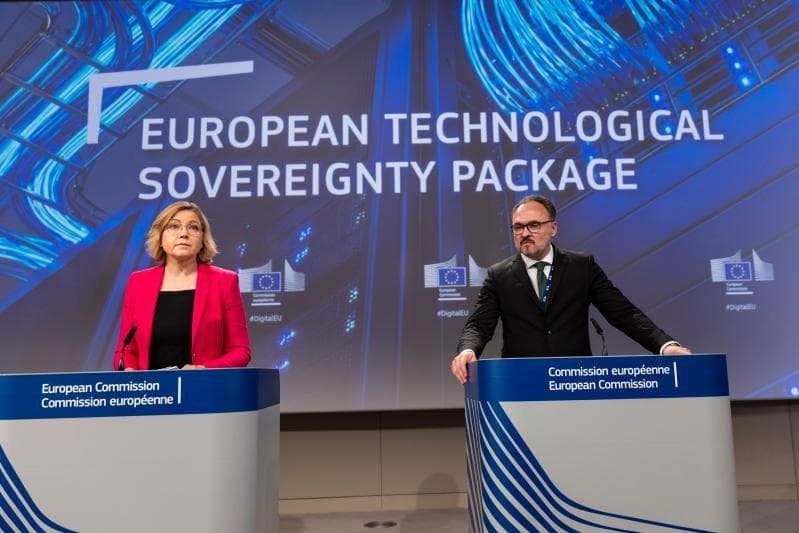
The European Commission unveiled a set of measures to dramatically reduce Europe's reliance on foreign technology, as Brussels formally presented the European Technological Sovereignty Package — its most significant shift in digital policy in years.
The package, announced in Brussels on 3 June, comprises four pillars: a revamped Chips Act (Chips Act 2.0), a new Cloud and AI Development Act, an EU Open Source Strategy, and a Strategic Roadmap for Digitalization and AI in the Energy Sector. Together, they are designed to reduce what Commission officials called a structural dependency that has left Europe dangerously exposed.
"We cannot afford to depend on others for the technologies that keep our hospitals running, our energy grids stable and our services secure," Commission President Ursula von der Leyen said at the announcement. The diagnosis underpinning the package is stark: Europe currently relies on non-EU providers for over 80% of its digital products, services and infrastructure.
Chips and cloud at the core
Semiconductors are the first front. AI-related components are expected to drive future growth and account for over 70% of the semiconductor market by 2030, and the Chips Act 2.0 will build on Europe's strengths, including in mainstream chips, and expand capacity in cutting-edge semiconductor technologies that power AI applications. The updated legislation will speed up permitting, introduce an excellence label for European semiconductor regions, and adopt an ecosystem approach to bring chipmakers closer to customers in sectors such as data centers and AI infrastructure.
On the cloud front, the Cloud and AI Development Act aims to triple data center capacity in Europe over the next five to seven years. It will introduce a four-level sovereignty framework for the public sector, allowing cloud and AI services to demonstrate their level of data protection against criteria including infrastructure location and cybersecurity standards — while keeping the broader market open to like-minded international partners.
Open source as a strategic asset
The package also bets heavily on open source as a lever for autonomy. Europe has 3 million open-source contributors and 500 for-profit open-source companies, yet every year Europe spends around € 264 billion on non-EU, proprietary digital products and services. The Open Source Strategy aims to channel that existing talent into sovereign alternatives in cloud, AI, cybersecurity, and semiconductors, while improving open-source procurement in public administrations.
Energy and digital: managing the tension
Perhaps the most urgent challenge the package addresses is the collision between Europe's digital ambitions and its energy system. In 2024, data centers in the EU consumed enough electricity to power nearly 20 million European households, and that figure is expected to more than double by 2030. The Strategic Roadmap for Digitalization and AI in Energy sets out how to integrate data centers into the grid sustainably, accelerate smart meter rollout, and develop AI models for the energy sector trained on European data.
Commissioner for Energy Dan Jørgensen framed the dual challenge plainly: "There can be no digital sovereignty without energy sovereignty." He pointed to the uneven rollout of smart meters — ranging from just 5% penetration in some Member States to 90% in others — as an area demanding urgent harmonization.
What comes next
The two legislative proposals — the Chips Act 2.0 and the Cloud and AI Development Act — must now pass through the European Parliament and the Council before entering into force. In parallel, the Commission is expected to launch a call for AI Gigafactories in July, following the European High Performance Computing Joint Undertaking Governing Board's agreement in principle on 1 June.
Brussels is also launching a consultation with Member States and the European Investment Bank Group to build what officials described as a European equity capacity at scale — recognizing that public funding alone cannot finance the ambition. As Executive Vice-President Henna Virkkunen put it, Europe has the talent, the industrial base, and the internal market. The question is whether it will choose to use them.