
Eindhoven searches for space on overloaded power grid in 33 hours
Recharge Eindhoven: “How do we create a less congested electricity grid so that Eindhoven can remain a liveable place for everyone?”
Published on September 25, 2026
Bart, co-founder of Media52 and Professor of Journalism oversees IO+, events, and Laio. A journalist at heart, he keeps writing as many stories as possible.
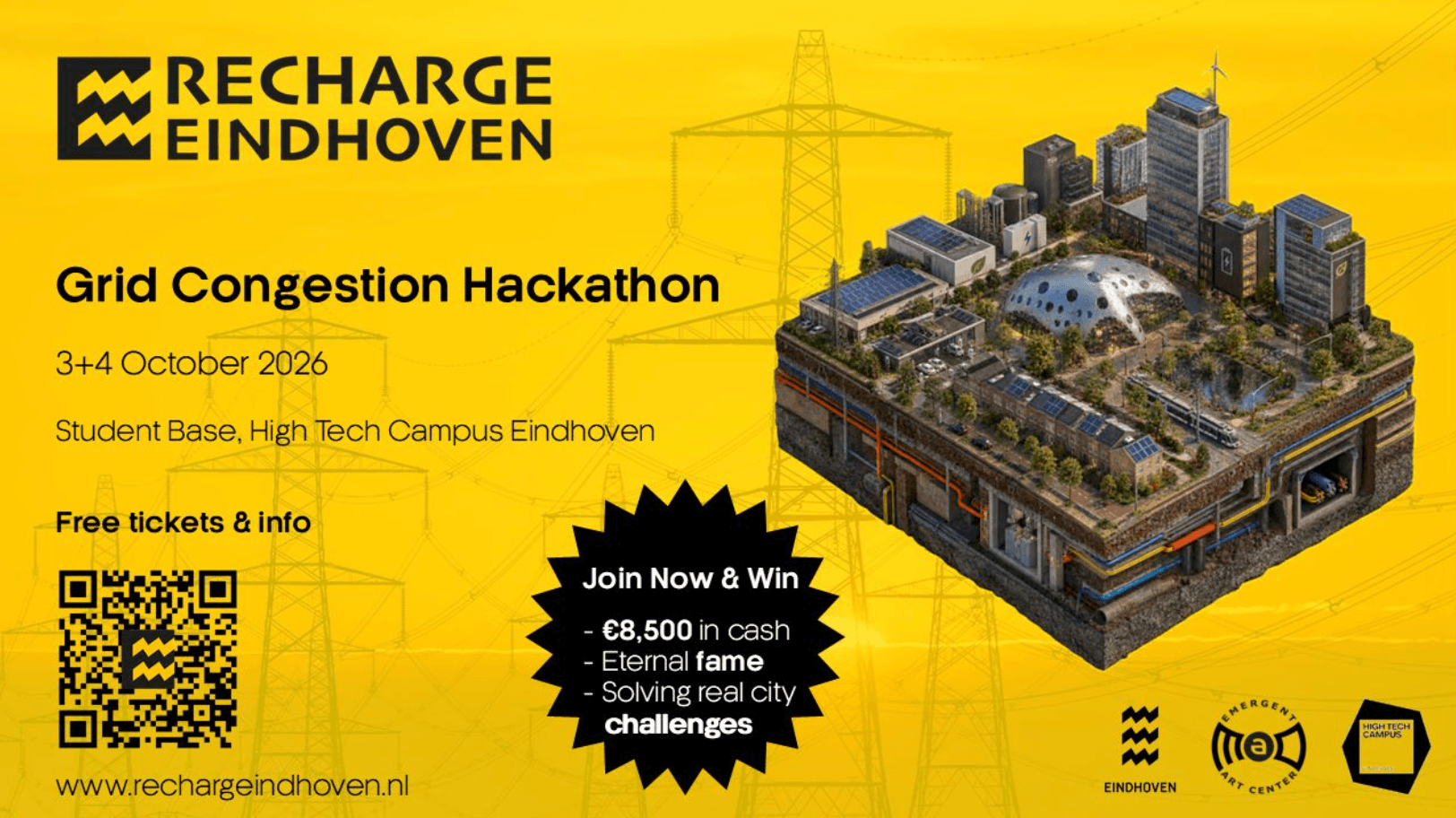
During the Recharge Eindhoven Hackathon, engineers, designers, entrepreneurs, and other unconventional thinkers will search for solutions that let housing construction, business growth, and the energy transition continue without waiting for a stronger electricity grid.
The electricity grid in and around Eindhoven is full, but the city cannot be put on hold. More homes are needed, businesses want to expand, and residential districts must move away from natural gas. On October 3 and 4, the Recharge Eindhoven Hackathon will therefore address a question that is becoming increasingly decisive for the region’s development: how can Eindhoven continue to grow without first waiting years for the electricity grid to be expanded?
The Municipality of Eindhoven and MAD emergent art center will bring together entrepreneurs, engineers, inventors, designers, artists, students and other problem-solvers at High Tech Campus Eindhoven. From Saturday morning until Sunday afternoon, participants will work on one of six concrete challenges. The event will be held in English and participation is free. A total of €8,500 in prize money is available: €5,000 for the winning team, €2,500 for second place and €1,000 for third.
In his call for participants, Harald Wouters sums up the urgency succinctly: “How do we create a less congested electricity grid so that Eindhoven can remain a liveable, smart and energetic place for everyone?” That broad formulation matters. Grid congestion may sound like a problem involving cables and substations, but it now affects almost every spatial and economic ambition the city has.
Not a contest to find the best cable
The hackathon is explicitly looking beyond electrical engineering alone. “These can be all kinds of solutions: technical, but also behavioural or social,” René Paré says in a video pitch for the event. The Recharge Eindhoven website also mentions smart energy systems, new forms of collaboration and governance models.
External Content
This content is from youtube. To protect your privacy, it'ts not loaded until you accept.
Paré gives the example of a business park where companies each have their own contract for grid capacity. Individually, they do not use that capacity all the time, yet it remains unavailable to others. By coordinating supply and demand, “together they can manage much more energy at the same cost,” Paré says.
That example is at the heart of the first of the six challenges. Companies in business parks, including De Hurk, could share transport capacity through a group agreement. The technology exists, but a lack of trust, legal complexity and concerns about operational risks are holding back collaboration. Participants are therefore being challenged to design a workable cooperation model, contract or digital platform.
A second assignment focuses on peak demand. Many companies retain capacity as a precaution for the relatively rare moments when they need maximum power. Financial compensation alone has not been enough to persuade them to reduce that peak capacity. The challenge is to devise a combination of policy, support and smart technology that gives entrepreneurs sufficient certainty while freeing up capacity.
From business park to residential district
The third challenge takes a more fundamental look at new business parks. Development in Eindhoven Northwest may be delayed for as long as a conventional grid connection is unavailable. Teams must therefore design a semi-autonomous energy system using local generation, storage and a microgrid capable of operating independently when necessary.
Heat can also help shift electricity consumption over time. The fourth assignment examines when collective systems should produce, store and distribute heating and cooling. Buildings, thermal buffers and smart controls can serve as temporary energy reserves, provided that comfort, security of supply and affordability are maintained.
The fifth challenge makes clear that it is not only the grid that is congested; the labour market is as well. Grid operators and installation companies face shortages of cable layers, technicians and electricians. Traditional training and recruitment routes are not producing the necessary workers quickly enough. The hackathon is therefore looking for new training, organisational, or digital models that can expand implementation capacity more rapidly.
The final case comes from Blixembosch-West. The district is among Eindhoven’s frontrunners in the heating transition, but grid congestion means that not all remaining homes can upgrade to a three-phase connection. The question is whether large-scale electrification of homes is also possible without those upgrades, for example by controlling appliances more intelligently and preventing peaks behind the meter. The solution must not only be technically sound, but also affordable and almost effortless for residents to use.
Ideas must work in practice
The hackathon therefore covers the entire system surrounding grid congestion: technology, regulations, behaviour, the labour market and mutual trust. The cases are also connected to recognisable locations and stakeholders, helping teams move beyond general visions of the future. On Sunday afternoon, they will present their proposals to a jury chaired by Eindhoven alderman Rik Thijs.
The challenge is considerable, but the underlying idea behind Recharge Eindhoven is practical: not every additional home, heat pump or commercial building necessarily has to wait for a new cable. Sometimes the available space lies in storage or smart control, sometimes in a collective contract and sometimes in a willingness to use electricity at a different time. One weekend will reveal which combinations are strong enough to keep developing after the final pitch.
The Recharge Eindhoven Hackathon will take place on October 3 and 4, 2026, at Student Base on The Strip at High Tech Campus Eindhoven. Participation is free; you can register at rechargeindhoven.nl.