
Eindhoven, Belgian Limburg, and Kempen: together for innovation
Eindhoven, Belgian Limburg and the Antwerp Kempen are strengthening cross-border cooperation.
Published on March 24, 2026
Masterstudente journalistiek aan de RUG, stagiair bij IO+, schrijft graag over de integratie van AI in het dagelijks leven
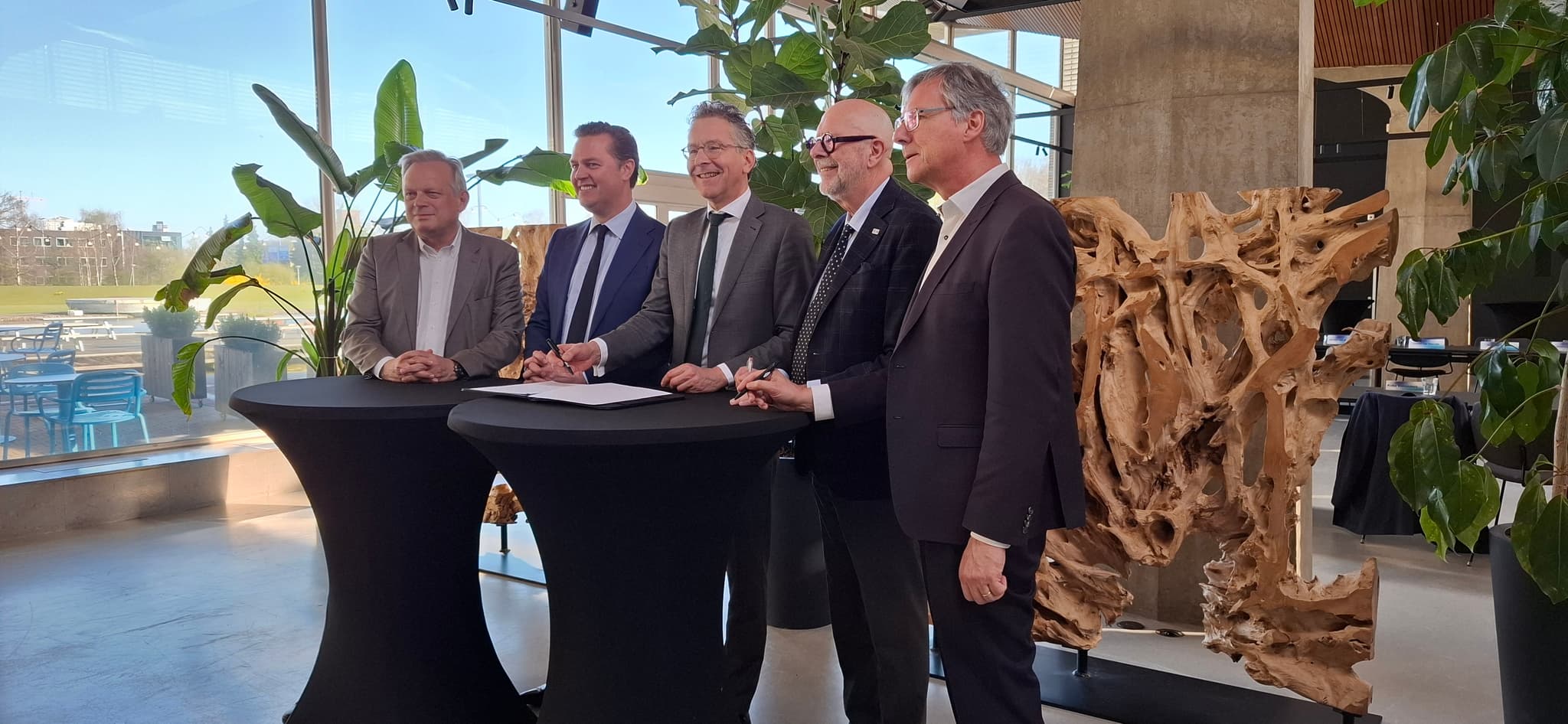
The Brainport Eindhoven Metropolitan Region, Belgian Limburg and the Antwerp Kempen are set to strengthen their cooperation in the fields of innovation, the economy, connectivity, and spatial development. On 18 March 2026, they signed a two-year cooperation charter aimed at reinforcing their economic and spatial ties.
By better aligning innovation clusters and spatial-economic developments, the partners see opportunities to strengthen the economic position of the border regions and achieve balanced growth.
The Eindhoven region is now home to around 6,000 to 7,000 companies and is under considerable pressure. According to Jeroen Dijsselbloem, chair of the Brainport Eindhoven Metropolitan Region and Stichting Brainport, such balanced growth is therefore inevitable: “Not everything can be accommodated here.”
Impressive growth, but also challenges
“The figures for Eindhoven are impressive,” emphasises Tom Vandeput, chair of POM Limburg and deputy of the Province of Limburg. He describes a region that inspires enthusiasm and offers opportunities for Belgian Limburg: “We should be swimming towards whales like Brainport, not avoiding them,” says Vandeput.
History must not repeat itself
Historically, Antwerp has not been known as a place where companies can easily expand. Take Philips, for example. The company once operated a factory in Antwerp but was forced to leave as the region could not offer sufficient support in areas such as economic development.
Ford also operated a major car assembly plant in Genk, Limburg, from 1964 until its closure in 2014 due to restructuring. Companies from Eindhoven expanding into Antwerp or Limburg must not face a similar fate, as this would be detrimental to both the businesses and the regions involved.
According to Ward Kennes, chair of the Kempen Regional Platform, the situation is now fundamentally different. The economic base is broader and less dependent on a single player. “We want to encourage scaling up and diversification, and there is already significant cooperation between companies in Eindhoven, Belgian Limburg and Antwerp,” he says.
Where does the focus lie?
The cooperation focuses on four innovation clusters in which the regions complement one another.
Within the High Tech cluster, the emphasis is on precision technologies such as 3D printing, semiconductors and robust electronics. Major scientific projects, such as the Einstein Telescope, also form part of this cluster.
Smart and Clean Mobility focuses on making better use of cross-border testing infrastructure and accelerating mobility innovations, with electrification of freight transport as a key priority.
Biobased Materials and Circular Construction centres on sustainable building practices, including circular demolition, reuse of materials and scaling up the use of biobased resources.
A fourth cluster, life sciences, was added at the last moment, focusing on innovation in healthcare and medical science.
At the same time, the partnership remains open to new domains in the near future, such as artificial intelligence.
Limited resistance so far
Notably, there has been little criticism so far. According to Dijsselbloem, there have been “no negative reactions, as the pressure on the Eindhoven region is being relieved.” At the same time, he remains realistic: “It can only happen where it is feasible.”
For example, encouraging companies to relocate or expand towards Antwerp or Belgian Limburg will not work if there are too many building restrictions or if local residents oppose new developments.
Housing and spatial choices
In addition to innovation clusters, spatial-economic developments are needed. Employees relocating with companies must have somewhere to live. Over the next two years, the regions aim to map housing demand in detail. “Measuring is knowing,” says Lemmens, referring to the importance of data in identifying where development is possible and what constraints exist.
The challenge is not only about numbers, but also about choices. Cities aim to build upwards and increase density, while villages seek to preserve their character. The partners therefore want to explore where people prefer to live and work. “Residents ultimately choose where they live,” says Dijsselbloem, “but perhaps we can guide this by making certain areas more attractive.”
He points to a strategically located bus station in an area open to development as an example of how people and businesses could be drawn to new locations. However, implementing this part of the charter will require extensive spatial planning.
Mobility between regions
Mobility requires more than just a well-placed bus stop. Although travel between Eindhoven, Limburg and Antwerp is relatively smooth by car, public transport still lags behind—particularly in Belgium, according to the parties involved. However, there are positive signals from The Hague regarding potential investments in rail and tram connections between the regions.
In the short term, fast bus connections are being considered, says Kennes. “Work must also be done on rail or tram links, but that is more of a long-term plan,” he adds.
Looking ahead
With the signing of the charter, the first step has been taken, but the real challenge lies in implementation. “There is a great deal of work ahead,” says Dijsselbloem. As Lemmens concludes: “Now we get to work.”