
Dutch nuclear revival has a people problem, not a tech one
As the Netherlands revives nuclear power, three experts explain why the reactors aren't the hardest part.
Published on September 3, 2026
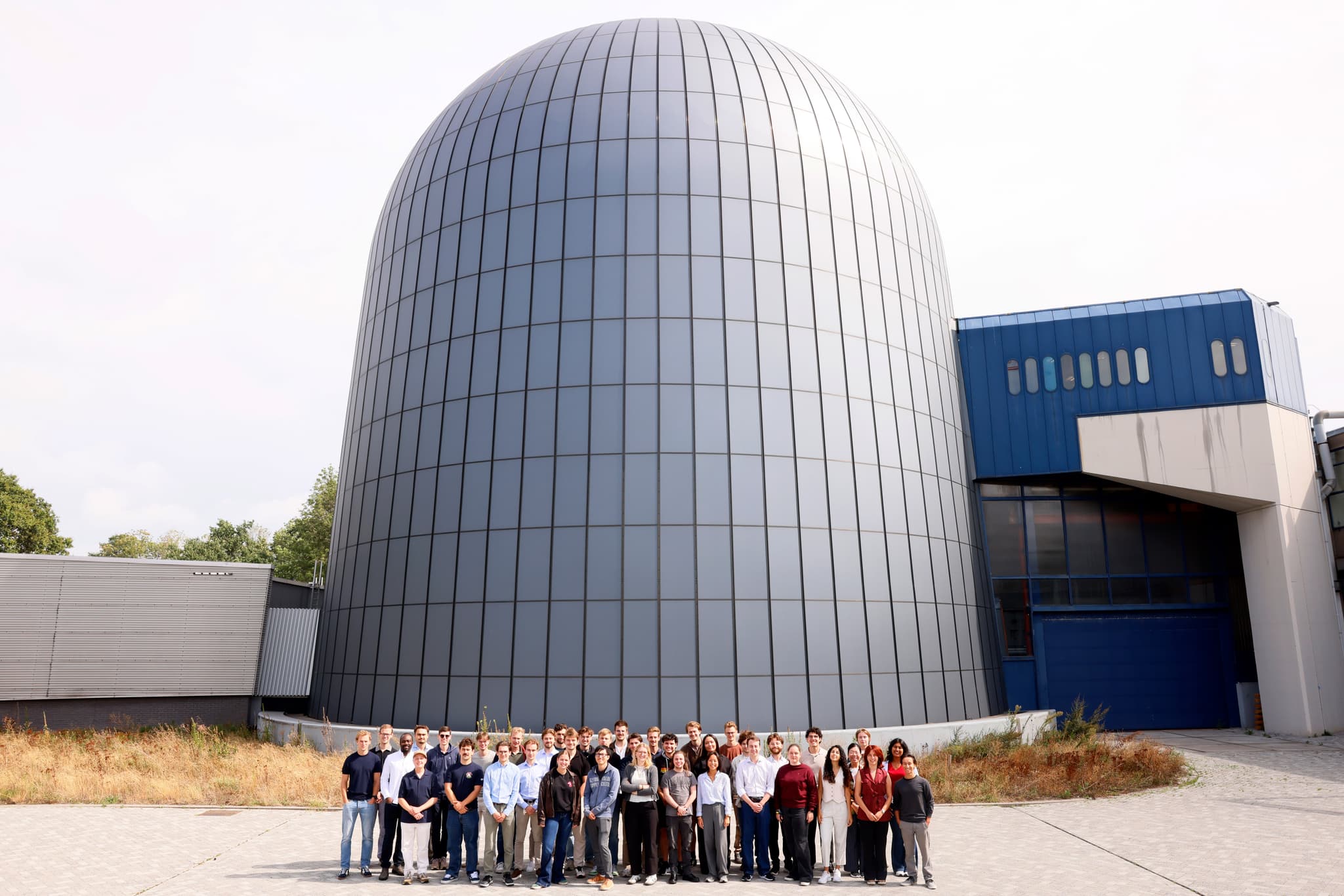
The Dutch-Belgian Nuclear Summer School participants posing in front of the TU Delft Reactor Institute - © Roy Borghouts, TU Delft

Mauro swapped Sardinia for Eindhoven and has been an IO+ editor for 3 years. As a GREEN+ expert, he covers the energy transition with data-driven stories.
The intention is clear: nuclear energy will play a role in the Netherlands' future energy mix. The Borssele plant – the only operating plant in the country — will run beyond 2033, and two more large power stations will be added.
As discussions on where to build these plants continue, one thing is already clear: getting there will take more than plants. A key factor is talent. To this end, the Dutch-Belgian Nuclear Summer School took place last week, with a cohort of students getting familiar with the industry. On August 28, the group convened at Delft University of Technology, spending a day at the TU Delft Reactor Institute, the university research center on nuclear energy.
“On the education side, the knowledge network has to expand, as our academic group in Delft is the only one active in the country,” says Martin Rohde, associate professor at TU Delft. “And there is more: to operate two large power plants we need welders, builders, and professionals who can run a reactor.”
To this end, the Summer School offered students a week-long program of lectures, visits, and workshops at Belgian and Dutch institutions. The cooperation between Belgium and the Netherlands will not only be key to revamping the Dutch nuclear industry, but also to forming a new generation of talent.
Training new talent
Rohde says the Netherlands is starting its nuclear renaissance from almost zero. To build competence and train new people, TU Delft, the Eindhoven University of Technology, and the University of Twente will offer new study tracks both at the bachelor’s and master’s level, the academic illustrated during a presentation. Vocational training tracks will also be included.
The talent problem isn't just about training new people fast enough — it's also about not losing what the current generation knows. "We call this the silver tsunami," says Tom Clarijs of the SCK CEN Academy in Belgium, describing the wave of retirements now hitting the sector.
Reactors built today are expected to run 60 to 80 years — "not one career, but three careers," Clarijs adds — which means companies need structural ways to pass on institutional knowledge before it walks out the door. It's also why events like the summer school matter, even though most attendees won't end up working in nuclear: "It's a bit like a leaking pipeline — you only catch a fraction of the people you reach, and that's normal."
The Dutch nuclear renaissance
To achieve its goal of making the country climate-neutral by 2050, the Borssele plant will run for longer. It is the only nuclear power plant currently operating in the country and provides 3% of the country’s total electricity production.
Ferry Roelofs is the Account Manager of Research at NRG Pallas, a nuclear research organization. In his opinion, the technology is not a problem. “The real hurdles are the regulatory framework, financing, and establishing a local supply chain.”
The experts agree that the two new plants should use pressurized water or boiling water reactors. “The technology can count on 70 years of experience, which has made the current fleet safe. Moreover, the European fuel cycle is already built around uranium,” underlines Rohde.
According to Roelofs, nuclear revival in the country should follow three parallel tracks. “First: get the energy you need as soon as possible by building proven technology reactors. Second, move forward with light-water SMRs – which use technologies similar to those already on the market – to facilitate regulators’ licensing process. Third, include advanced reactor technologies, such as molten-salt high-temperature gas and liquid-metal-cooled reactors, which require more research and development but promise real benefits down the line.”
Securing public acceptance
The Dutch cabinet has narrowed its shortlists to Eemshaven, in Groningen, and Terneuzen, in Zeeland. Transmission system operator TenneT informed the government that Eemshaven would work best, since there is more capacity available in the electricity grid.
According to Rohde, neither is a clean choice. "Groningen has plenty of space and water for cooling – good conditions on paper," he says. Zeeland, by contrast, has more public support, but tighter siting constraints.
For Clarijs, that trade-off is exactly why public engagement can't be treated as a formality that follows the technical decision. "It can't just be one-way communication from government saying 'this is the best option, let's proceed,'" he says. Building trust requires laying out the relevant information transparently and starting a dialogue as early as possible — and accepting the answer that comes back. "And if that means the answer from a community is no, then it's no."
Roelofs points to Sweden's experience siting a nuclear waste facility as a model for how that trust can be built rather than assumed. Communities there ended up competing to host the facility, he says, because of the concrete benefits attached to it. Without something offered in return, the dynamic flips: people oppose a project not because of the technology itself, but because "they don't see any benefit for their community, only the drawbacks."
A supporting ecosystem
The experts highlight different priorities for policymakers to address. "Stakeholder involvement, as soon as possible," says Clarijs. Roelofs agrees, but adds a second condition: solid, predictable financing. "Things accelerate when you put more budget behind them."
Rohde's message is about time horizons rather than money: "If we're twenty years down the road and we didn't put in the effort to develop new technologies now, it'll be too late. So bet on all the horses — not just one."
Technology won’t be the problem, then. But to achieve the goals the Netherlands set for itself, what surrounds the reactors — trusted tech, supply chains, and highly-skilled talent — will ultimately prove decisive.