
Dutch electricity production hits record levels
Electricity production in the Netherlands hit record levels in 2025, reports the statistics office CBS.
Published on March 9, 2026

© Unsplash

Team IO+ selects and features the most important news stories on innovation and technology, carefully curated by our editors.
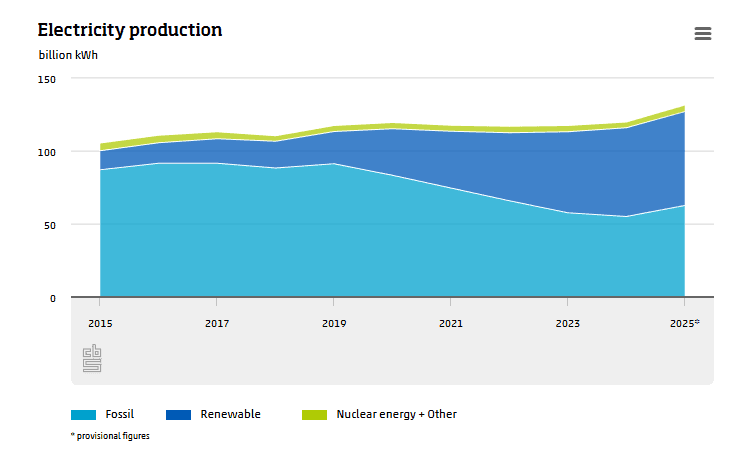
Dutch electricity production hit a new record in 2025. Last year, electricity generation surged by a 10% compared to the previous year, according to the data office CBS. In total, 132 billion kWh were produced.
Following years of decline, fossil fuel-generated electricity soared again. At the same time, solar photovoltaic output also increased, as exports topped. CBS notes how Dutch electricity production grew by a quarter in the past decade, driven by demand from abroad. As a result, power exports increased amid a stable local consumption.
© CBS
More sun, less wind
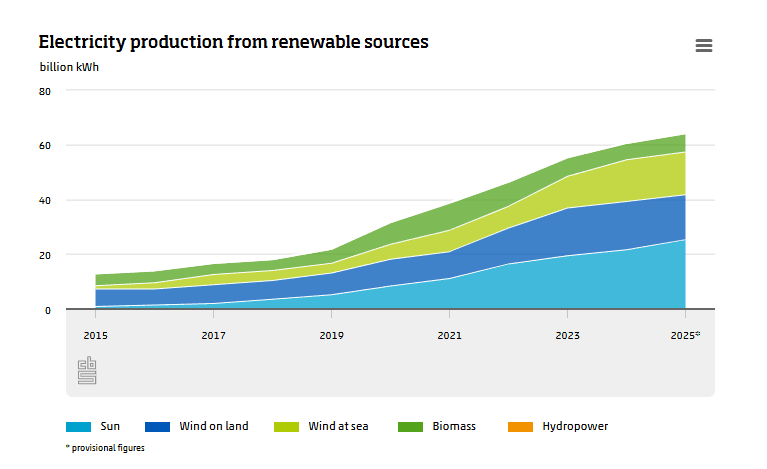
2025 was a sunnier year; as a result, solar energy production grew by 17%, also driven by a slightly higher number of solar panels (+4% as compared to 2024). Analysts underline that solar energy production has grown more than twentyfold over the last ten years.
Less favorable inland wind conditions affected the onshore wind electricity production. By contrast, offshore wind electricity production grew, as new wind farms at sea became operational. Biomass-derived electricity from coal-fired power stations also increased.
Renewables are once again the main source of electricity in the Netherlands, accounting for 49% of total production. This share is five times higher than in 2015. Overall, in 2025, renewables generated 6% more electricity than the year before.
© CBS
Soar in fossil fuel-generated electricity
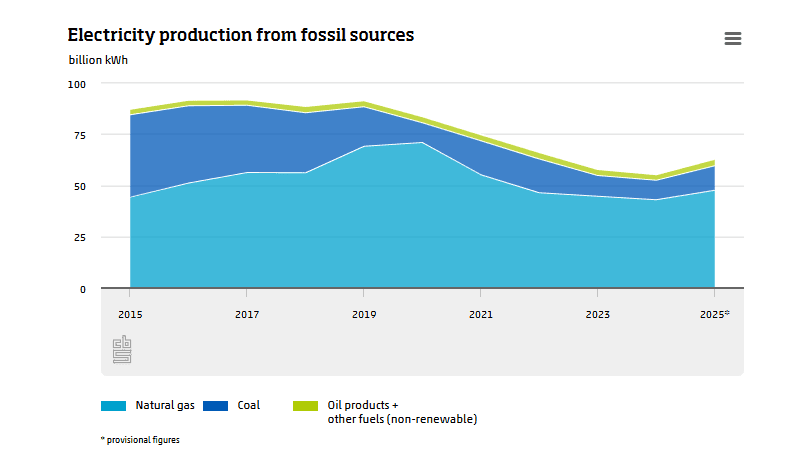
48% of the electricity produced in the Netherlands in 2025 came from fossil fuels. Coal and gas-derived electricity grew by 14%. While coal combustion produced 25% more electricity in 2025, the trend over the last decade shows a steep decline of 70% compared to 2015.
© CBS
Electricity exports grow by 25%
Last year also marked a new record in electricity exports, which grew by 25%. In total, the Netherlands exported 30 billion kWh. Exports to Germany and Belgium grew stronger.
The amount of electricity sent to Germany grew by nearly 50%. Berlin had to import more, given the lower wind electricity production in the German North Sea and the reduced hydroelectric output from Austria and Switzerland. Exports to Belgium increased by almost a quarter, as local nuclear plants'output diminished.
In turn, the Netherlands also imported 19% less energy than in 2024, continuing a downward trend driven by the increase in domestic production.