
Dutch and German agencies pool €40M to speed up AI chip design
The innovation agencies of Germany and the Netherlands are pooling €40 million to let AI design Europe's next chips.
Published on September 24, 2026
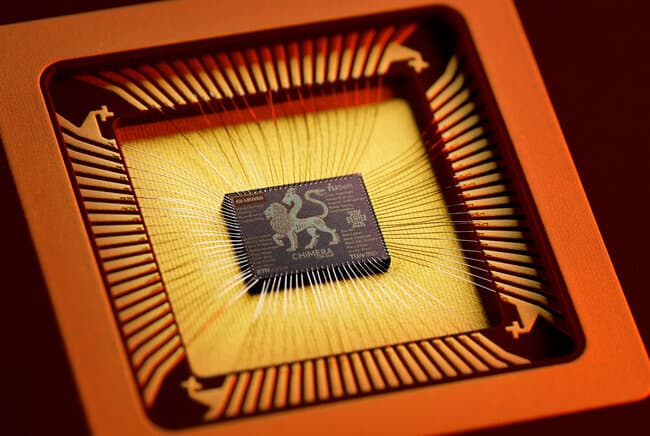
© Bart van Overbeeke

Team IO+ selects and features the most important news stories on innovation and technology, carefully curated by our editors.
Designing a new computer chip can take years. Germany and the Netherlands are betting €40 million that artificial intelligence can cut that to weeks. In the first programme of the newly founded Dutch innovation agency NADI, announced on Wednesday with its German counterpart SPRIND, the two will fund European teams that use AI to design faster and more energy-efficient AI chips. The goal is to reduce Europe's dependence on American and Asian technology.
The AI-Native Chip Design Challenge will fund small teams across Europe that use AI to design processors for training and running AI models. The aim is to cut development cycles that now take years down to a matter of weeks. SPRIND's head of challenges, Jano Costard, told Reuters the agencies were targeting "several orders of magnitude acceleration."
How the challenge works
The programme runs for 20 months in two stages. SPRIND provides most of the funding, and NADI covers the rest. In the first stage, seven teams will each receive €2.6 million to develop their ideas. After roughly eight months, the three most promising teams will each receive a further €7 million for a year-long second stage. Participants will also get technical and commercial coaching to help make their designs market-ready. Applications are open until 30 November.
The organisers want production-ready designs for high-performance AI training and inference, with a strong focus on energy efficiency and lower running costs. NADI co-founder Jelle Prins told Dutch broadcaster NOS that relying on today's AI hardware is like "doing your groceries with a moving van." Speaking to Reuters, he described Nvidia's chips as powerful but inefficient for inference work.
Sovereignty and energy
Europe depends heavily on the United States and Asia for AI chips. Rising energy prices and supply-chain disruptions have made that dependency more uncomfortable this year. SPRIND founder Rafael Laguna de la Vera pointed to a paradox. Thanks to ASML, the Netherlands leads the world in chipmaking machines, yet Europe produces very few chip designs that are actually manufactured on them.
Prins called a partnership with Germany a natural fit, since it combines the Dutch ecosystem around ASML with German strengths in research and manufacturing. Dutch Prime Minister Rob Jetten said the programme shows that Europe "cannot afford to innovate country by country."
A Dutch DARPA
NADI is modelled on the US Defense Advanced Research Projects Agency and on European counterparts such as SPRIND and Britain's ARIA. Its job is to back high-risk technologies that private investors avoid. It is expected to accept that some projects will fail, as long as the portfolio as a whole produces breakthroughs. SPRIND advised the Dutch government on setting up the agency. SPRIND itself has committed more than €100 million through its challenges this year and earlier ran a joint challenge with Sweden's Vinnova.
The Dutch government has reserved €500 million for NADI in its 2027 budget. That is well below the €1.5 to 2 billion recommended in the report by former ASML chief executive Peter Wennink, which led to the agency's creation. Economist Mathijs Bouman noted on NOS that a future cabinet could just as easily cut the budget as expand it.