
Demcon’s defense innovations drive the autonomy economy
From the frontline to the factory: at NCAS26, Demcon provided a fascinating look into the high-stakes world of defense robotics.
Published on April 18, 2026

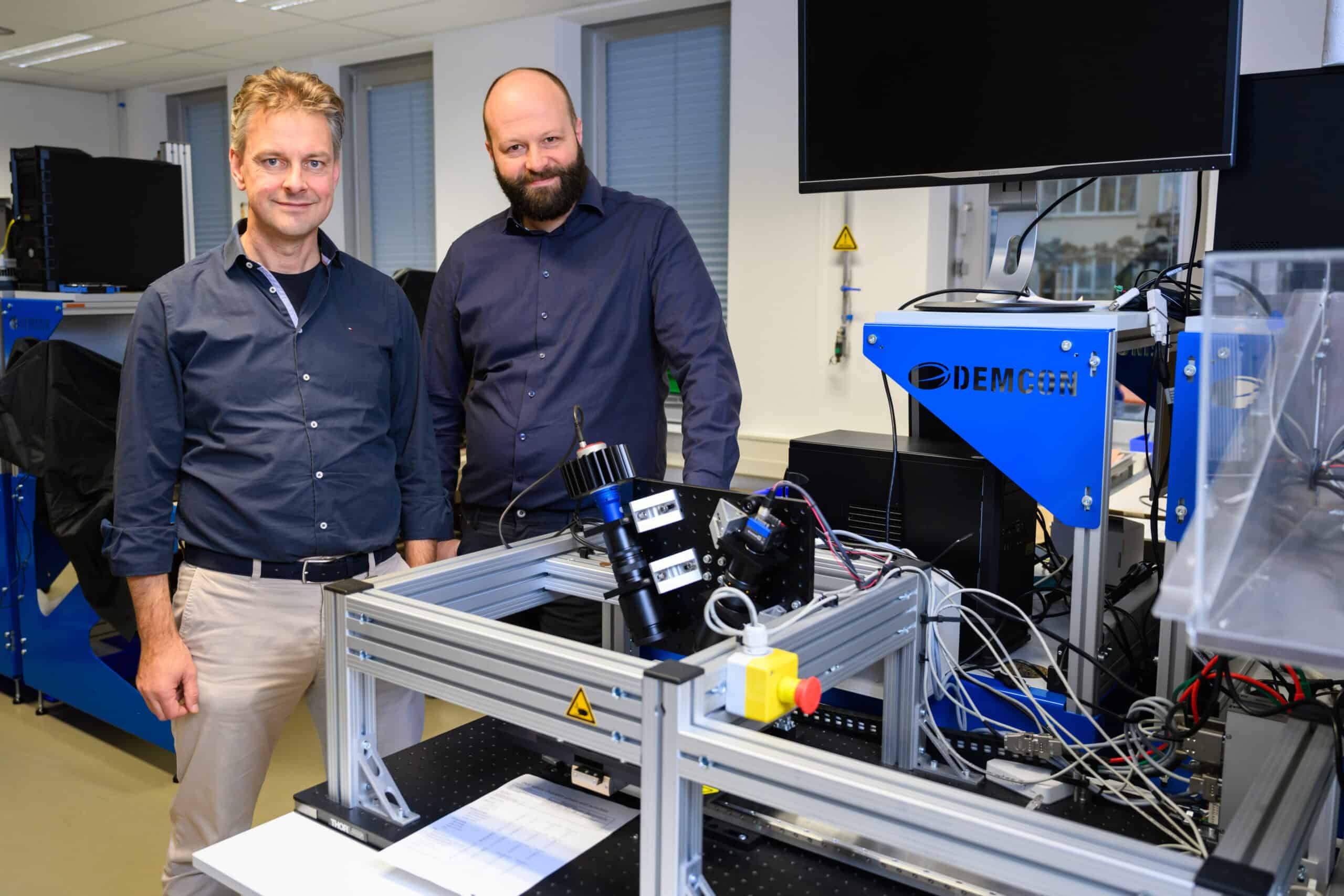
Timo Roestenberg, CTO of Demcon NCAS 2026 © NCAS

Bart, co-founder of Media52 and Professor of Journalism oversees IO+, events, and Laio. A journalist at heart, he keeps writing as many stories as possible.
At the Nationaal Congres Autonomous Systems (NCAS’26) in Drachten, Timo Roestenberg, CTO of Demcon, provided a fascinating look into the high-stakes world of defense robotics. While Demcon is a 1,200-employee engineering powerhouse renowned for high-tech, medical, and agricultural solutions, they made a strategic decision five years ago to launch a dedicated defense company. Focusing on high-energy systems and robotics, Demcon is now pioneering the development of autonomous UXVs (unmanned ground, aerial, and surface vehicles).
Roestenberg’s presentation illustrated a powerful reality: the extreme demands of modern warfare are forcing rapid breakthroughs in Artificial Intelligence, and these military solutions are directly translating into civilian industrial breakthroughs.
Training the tactical AI: Lessons from Russian doctrine
One of Demcon’s major projects, started before the war in Ukraine, answers a critical question: Can a computer learn to make clever tactical decisions on the battlefield?.
To achieve this, Demcon utilizes deep reinforcement learning, a process Roestenberg compared to training a dog—rewarding the AI when it behaves correctly and punishing it when it fails. Because training requires millions of iterations, Demcon built a highly optimized simulation environment. This virtual world procedurally generates new terrains while applying realistic physics shortcuts, such as vehicles becoming harder to spot when hiding in foliage or kicking up dust while moving.
In a chilling proof of concept, Demcon modeled their simulated enemy on standard Russian motorized rifle battalion doctrine. Six months into the war in Ukraine, real-life Russian river crossings played out exactly as Demcon’s simulation had predicted.
By simulating these battles, Demcon can mathematically determine the best hardware for future UXVs. For example, if the AI is equipped with off-map loitering munitions, it will safely pick off enemies from a distance; if that capability is removed, the AI immediately changes its tactics to rush the bridge.
Solving the "T-90 Problem" with synthetic data
For a UXV to operate autonomously, it must be able to visually recognize threats. However, training computer vision AI requires massive, balanced datasets. "You can't just go to Russia and take a thousand pictures of a T-90 tank in all sorts of different conditions," Roestenberg explained.
Demcon’s solution is to generate the training data themselves. While many companies use fast, video-game engines for this, Demcon utilizes highly realistic VR engines. These engines take up to 20 minutes to render a single image, but they produce flawlessly realistic, parametric 3D models of enemy vehicles in various environments, camouflages, and lighting conditions. As a result, Demcon's algorithms successfully identify vehicles in real-world drone footage despite having never "seen" a real vehicle before.
When ordinary data is no longer enough: Demcon shows the power of synthetic data
Hoe Demcon Data Driven Solutions de toekomst vormgeeft met algoritmiek en synthetische data.
The civilian crossover and the six-week rule
The innovations forged in the defense sector are highly applicable to the broader Autonomy Economy. The exact same deep reinforcement learning methods used to teach a simulated tank to cross a river are being used by Google to teach robots how to toss objects, or to teach walking robots how to navigate complex terrain. Similarly, Demcon’s synthetic data generation is directly applicable to training civilian autonomous vehicles to distinguish between a paved road and a dirt path.
Roestenberg concluded with three vital takeaways for all tech developers:
- Autonomy is here today: It is no longer science fiction; it can be integrated into products now.
- System-level design is required: Autonomy cannot just be "added on" to existing machines.
- Rapid iteration is survival: In the defense world, a new technology deployed to the frontline in Ukraine becomes obsolete in just six weeks as the enemy adapts. Civilian developers must adopt this same agility to survive in the fast-paced Autonomy Economy.