
Debunking the Wall Street myth, firing up Europe
"Europe doesn't need to reinvent its public markets from scratch; it needs the confidence to back its scale-ups through late-stage growth."
Published on November 27, 2026
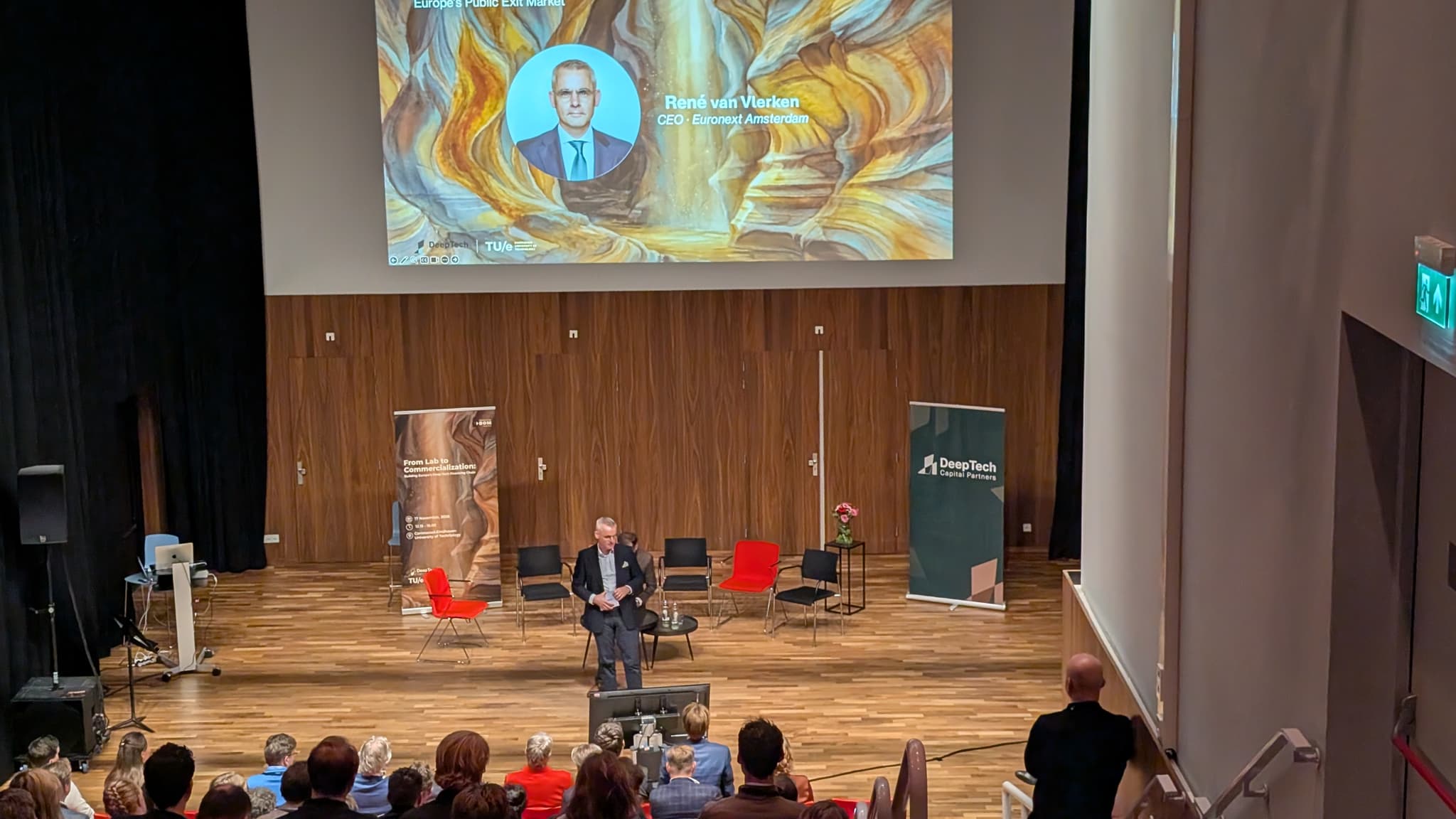
René van Vlerken

Bart, co-founder of Media52 and Professor of Journalism oversees IO+, events, and Laio. A journalist at heart, he keeps writing as many stories as possible.
In Europe’s deep-tech boardrooms, an almost reflexive dogma has taken hold: build the technology in Eindhoven, Delft, or Munich, survive the early years on European grants and venture capital, and then, once the company matures, pack up and head to Wall Street for the grand finale. The United States, the conventional wisdom goes, is deeper, more liquid, and simply better at valuing ambitious tech companies.
Taking the stage in a sold-out Coronazaal at Eindhoven University of Technology, Euronext Amsterdam CEO René van Vlerken set out to dismantle that assumption. From Lab to Commercialisation, a symposium organised by Hessel Mittelmeijer ahead of his PhD defence, Van Vlerken delivered a pointed message to founders, venture capitalists, and pension funds alike: while debunking the U.S. myth, Europe needs to fire up.
The reality behind the American dream
Earlier in the afternoon, speakers had dissected how deep-tech ventures cross the notorious "valley of death", that perilous stretch where brilliant lab science struggles to become a commercial product. Mittelmeijer’s doctoral research already showed that only 23% of European venture-backed startups scale beyond their early phase, compared to 54% in the U.S., largely because of a lack of coordinated, hands-on support.
Van Vlerken picked up the story where the valley of death ends: what happens when a deep-tech scale-up actually makes it, and needs €100 million, €200 million, or €300 million to conquer global markets?
For years, founders and investors have assumed Nasdaq or the NYSE is the only logical destination for that leap. Yet when Van Vlerken pulled up independent data from New Financial, HSBC, and Goldman Sachs, the numbers told a very different story:
- The Performance Trap: Since 2021, European companies that went public in the United States have suffered an average aftermarket performance of -30%, dragged down heavily by the SPAC boom-and-bust cycle. Over the same period, companies listing on Euronext delivered an average post-IPO performance of +3%.
- Triple the Price Tag: Crossing the Atlantic to ring the bell comes with a steep bill. Typical IPO costs in Europe, covering banks, lawyers, and auditors, average 4% to 5% of the deal size. In the U.S., those costs triple to 12% to 15%, accompanied by a far harsher legal climate where founders face personal liability if things go sideways.
- Small Fish in a Vast Ocean: Unless a European company already commands a market capitalisation north of €5 billion to €10 billion, Wall Street tends to treat it as an overlooked micro-cap. Without major analyst coverage or institutional attention, liquidity dries upmand valuations suffer.
"The valuation is clearly not there," Van Vlerken told the room. "The European capital market is actually providing European founders a much better exit opportunity than going to the U.S."
The battle is won (or lost) at Series B
If the numbers favour staying in Europe, why do so many promising European tech firms still look westward? According to Van Vlerken, an IPO's fate isn't decided in the months leading up to a listing. It is decided years earlier, during Series B, C, and D funding rounds.
While Europe does a respectable job funding early-stage startups, a bottleneck emerges once companies need larger growth checks. Forced to look abroad for capital, founders bring American and Asian venture funds onto their cap tables. Those international investors naturally bring their own playbook, and their own bias toward Wall Street exits.
Referencing a recent interview with a European tech CEO who admitted he wouldn't even consider a European IPO because his investor base was heavily American, Van Vlerken pointed out the structural chain reaction: when domestic late-stage capital is missing, Europe effectively exports its future champions before they ever reach the public markets.
Firing up the European engine
Van Vlerken’s message wasn't a plea for complacency. Europe’s capital markets are still too fragmented, and he urged policymakers and institutions to keep pushing forward on the European Commission’s Savings and Investments Union and the new Listing Act. Crucially, he echoed a theme running through the entire symposium: Europe must better channel its massive pools of pension and household savings into the companies building its industrial future.
Yet, looking at Euronext’s track record, now Europe’s largest exchange operator, roughly twice the size of the London Stock Exchange and three times Deutsche Börse, with success stories ranging from ASML and ASM to Philips and BE Semiconductor, Van Vlerken argued that the foundation is already built. When global players anchor themselves in Amsterdam, smaller local firms benefit from the ecosystem and liquidity they attract.
To close his remarks, Van Vlerken looked back at a slide Marcel Andringa of Dutch pension giant PME had shown earlier, featuring rising Dutch deep-tech stars like Nearfield Instruments, Axelera AI, and Smart Photonics. Euronext, Van Vlerken noted, is already in active dialogue with several of them.
The glass isn't empty, he concluded; it is half full. Europe doesn't need to reinvent its public markets from scratch; it needs the confidence to back its own scale-ups through their late-stage growth, and the ambition to watch them ring the bell at home.