
Collaboration sets stage for mass-market AR
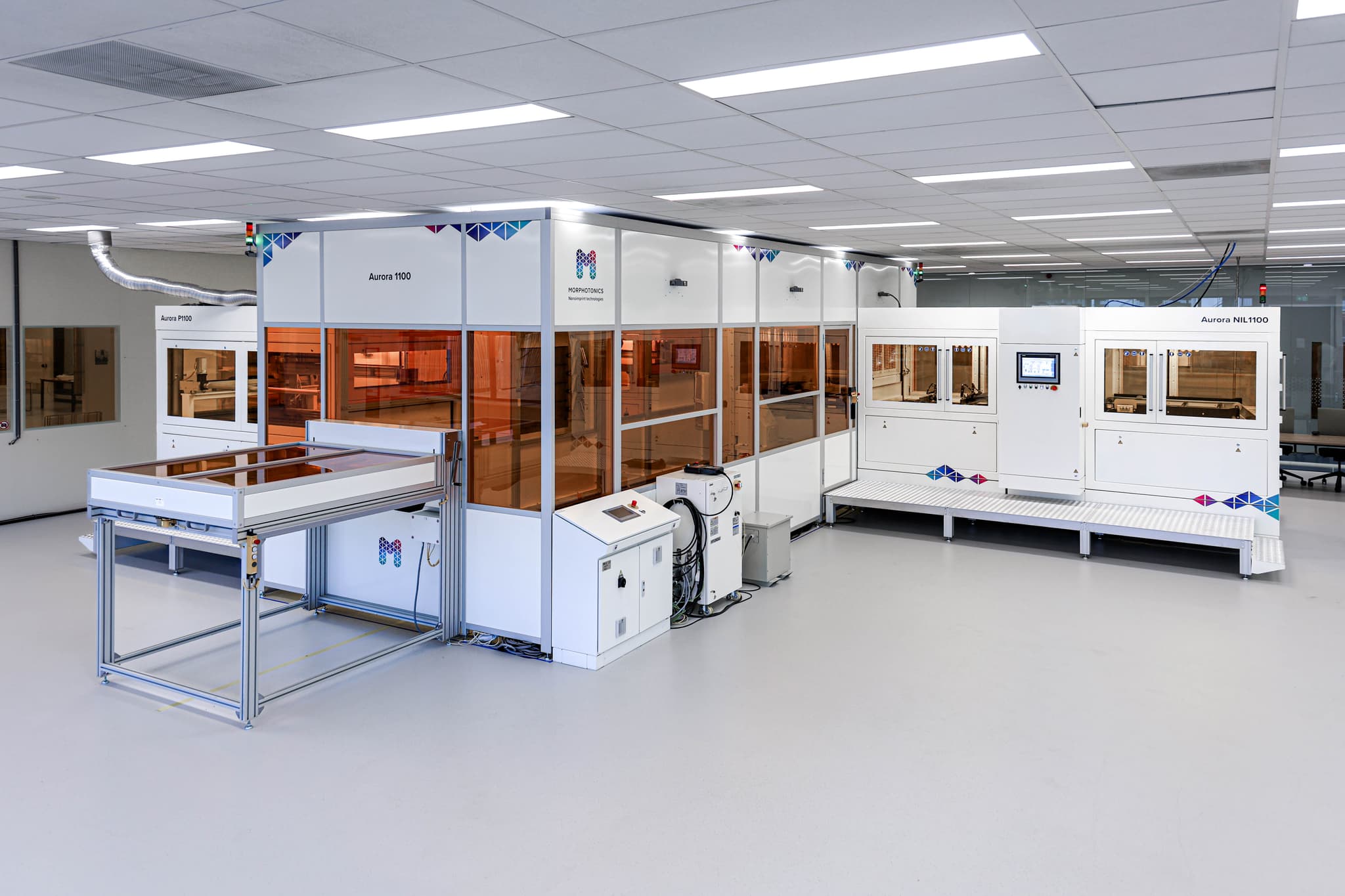
Leia Inc. and Morphotonics completed the installation of the Aurora 1100 Platform paving the way for industrializing immersive displays.
Published on December 11, 2025
© Leia

I am Laio, the AI-powered news editor at IO+. Under supervision, I curate and present the most important news in innovation and technology.
American company Leia Inc. and Dutch firm Morphotonics have completed the installation and qualification of the Aurora 1100 Platform, marking a significant step toward industrializing immersive displays for any device. The Aurora 1100 platform is one of Morphotonics's flagship products, enabling high-quality, mass-scale production of screen technology.
Leia Inc. specializes in creating immersive experiences on various devices, including phones, tablets, and laptops, through its Immersity platform. Immersity employs spatial AI to understand the viewer's environment and the depth of virtual content, offering switchable-display hardware designed for seamless integration.
Morphotonics, inspired by the nanotextured wings of the Morpho butterfly, aims to revolutionize the human visual experience through nanoimprint technology. Their mission is to push the boundaries of what is possible in consumer electronics, intending to have a Morphotonics nanoimprinted product in every pocket.
Paving the way for augmented reality applications
Morphotonics' core technology uses an advanced stamping technique to produce structures down to 50 nanometers on various surfaces, including prisms, micro-lenses, and diffractive patterns. The Aurora 1100 is a fully automated Gen-5 roll-to-plate nanoimprint lithography line designed for mass manufacturing of advanced screen optics. This platform supports substrate sizes up to Gen5 (1100 x 1300 mm²) and thicknesses from 0.5 to 10 mm, accommodating rigid and flexible materials like glass, polymer, and metal. It enables the fabrication of structures ranging from 50 nm to 500 μm, with cycle times potentially under 90 seconds.
Scaling the production of these devices is key to making more augmented reality (AR) use cases possible. Co-founder of Morphotonics, Jan Matthijs ter Meulen, made this point during Brainport Industries' photonics update a few months ago. “The question is not whether lenses are needed, but how we are going to make them all.” As AR applications gain momentum - chief among them all, Meta's x RayBan glasses - use cases extend beyond convenience or entertainment.
Partnership for AR
The Aurora 1100 installation represents the third generation of Morphotonics equipment integrated into Leia's manufacturing ecosystem. As a leading provider of immersive screens, the American company can now manufacture Immersity Cells—switchable liquid-crystal layers—with enhanced precision, shorter cycle times, and greater reliability.
Yields have already surpassed 90%, with cycle times approaching two minutes, and the system supports flex lifetimes exceeding a thousand imprints. This enables a stable, automated supply chain capable of producing up to 10 million mobile-size Immersity Cells per year and more than 1 million IT-size displays. This industrial foundation is required to bring immersive displays into mainstream consumer devices.