
China’s all-or-nothing race for chip independence
China’s EUV chip prototype in Shenzhen challenges Western tech blocks—but can it achieve mass production by 2030?
Published on December 18, 2025
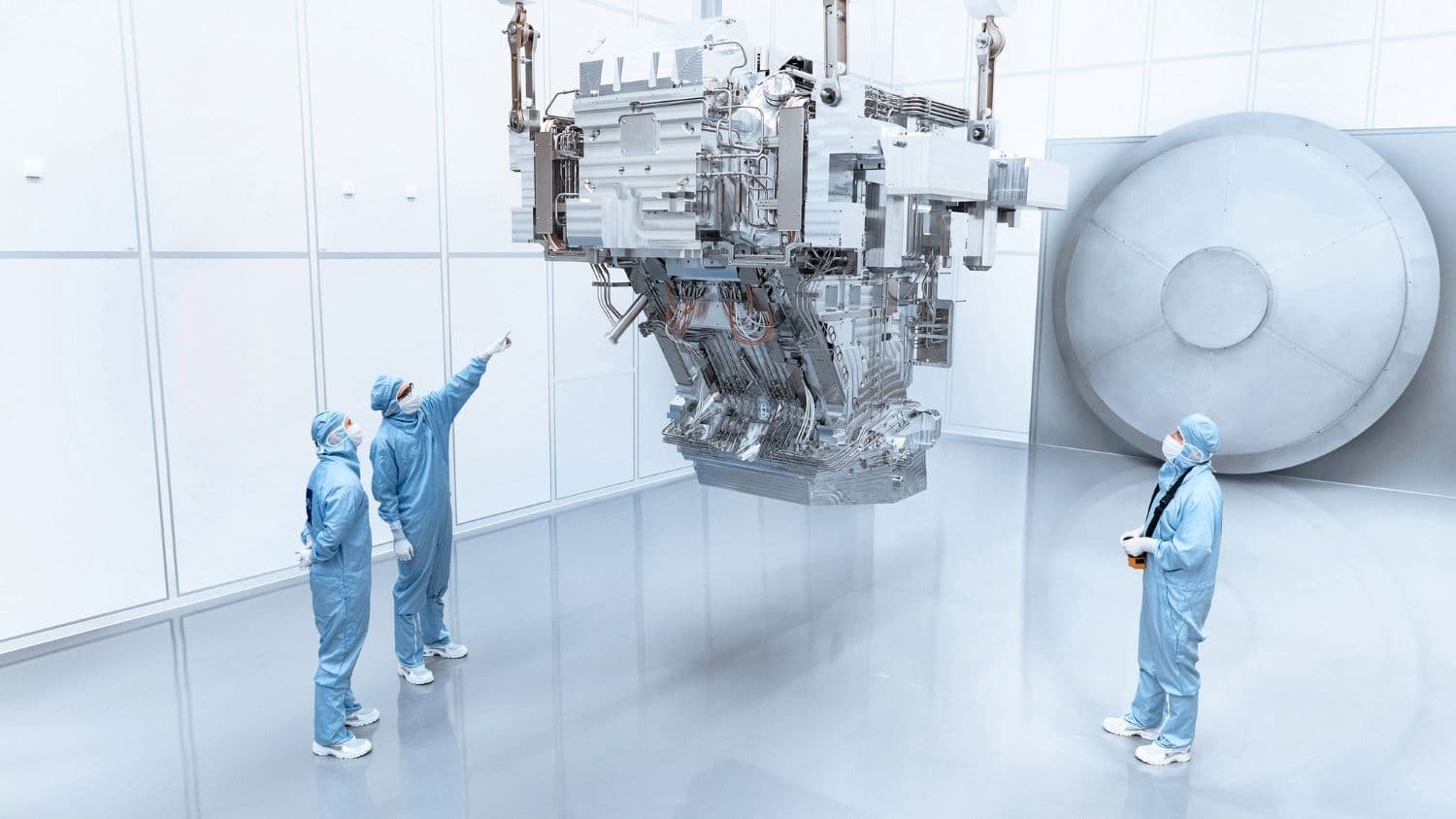
zeiss illumination system for high na euv lithography, © imec / ZEISS

Merien co-founded E52 in 2015 and envisioned AI in journalism, leading to Laio. He writes bold columns on hydrogen and mobility—often with a sharp edge.
It is December 2025, and the rumor mill that has gripped the semiconductor industry for months has come to a halt in the face of a stark reality. According to an exclusive report by Reuters, China has developed a functional prototype of an EUV machine (Extreme Ultraviolet lithography). While Western policymakers hoped that strict export restrictions would stifle China’s chip ambitions, the opposite seems to have occurred. The blockade has acted as a catalyst for what is internally referred to in Beijing as the “Manhattan Project” of the chip industry.
What are the technical and geopolitical implications of this breakthrough? How did China, without access to Zeiss lenses and ASML systems, reach this point? And more importantly, is this prototype a paper tiger or the beginning of a genuinely independent chip industry in China?
Talent as a crowbar
The foundation for the Shenzhen prototype was laid not only with state support but also through aggressive headhunting. When ASML machines became unattainable, China turned its focus to the people who built them. Reports confirm that former ASML engineers, including key figures like Lin Nan (former head of light source technology), were recruited with signing bonuses of up to 5 million yuan (€700,000) and generous housing subsidies.
The impact of this knowledge transfer is difficult to overstate. Lin Nan’s team at the Shanghai Institute of Optics filed eight critical patents for EUV light sources in just 18 months. This confirms that China is not simply copying but is addressing specific technical bottlenecks by directly importing knowledge from Veldhoven. Without this human capital, reverse-engineering a machine with over 100,000 components would have taken decades.
Frankenstein machine or innovation?
The prototype now standing in Shenzhen is described as a colossus occupying an entire factory floor. A consortium led by Huawei manages the machine, but technically, it is a patchwork of forced innovation and older technology.
The biggest stumbling block remains the optics. ASML relies on an exclusive relationship with Germany’s Carl Zeiss for mirrors so precise that, if enlarged to the size of the Earth, their deviations would be less than the width of a hair. China has no access to these mirrors. According to sources, China is attempting to fill this gap with components from Japan’s Nikon and Canon, combined with its own optical breakthroughs from the Changchun Institute of Optics (CIOMP).
Additionally, China has been forced to pursue an alternative light source. While ASML set the standard with Laser-Produced Plasma (LPP), Chinese institutions like the Harbin Institute of Technology are experimenting with Laser-Induced Discharge Plasma (LDP). This method is theoretically cheaper and more compact, but historically less stable for the high power levels required for mass production.
The chasm between prototype and production
Having a working machine is one thing; producing chips economically is another. It took ASML 18 years to go from its first alpha demo in 2001 to commercial machines in 2019. China has set itself a 2028 deadline for functional chips, though analysts consider 2030 a more realistic timeline.
The challenge lies in yield. If a machine, due to vibrations, contamination, or an unstable light source, produces only 20% usable chips per wafer, the costs become astronomical. For military purposes, this may be acceptable, but for commercial applications, it is fatal. Yet the Chinese state appears willing to absorb these losses for years to achieve supply-chain independence.
The AI hunger of Baidu and Huawei
AI drives the urgency behind this project. Chinese tech giants like Baidu and Alibaba are in a tight spot. With Nvidia chips becoming difficult to obtain or prohibitively expensive due to U.S. policies—including President Trump's recent 15% tariff proposals—domestic hardware has become essential.
Baidu, through its subsidiary Kunlunxin, is positioning itself as China’s answer to NVIDIA. JPMorgan predicts that Baidu’s chip revenue will sextuple to 8 billion yuan in 2026. However, to design chips that compete with Nvidia’s Blackwell series, lithography at 5nm or 3nm is necessary. Without its own EUV machines, Baidu and Huawei face a physical barrier, causing their AI models to lag behind those of OpenAI or Google in efficiency.
What China can’t buy, China will build
Developments in Shenzhen show that the Western strategy of “starvation” is only temporary. It has forced China to build a parallel, entirely domestic supply chain, spearheaded by Huawei.
ASML CEO Christophe Fouquet previously warned that it would take China “many, many years.” This is likely still true. But with an investment fund of €37 billion and the knowledge that national security depends on it, time is the only thing China is willing to lose. The question for Europe is no longer whether a competitor to ASML will emerge, but what the market will look like once Chinese machines, despite their teething problems, become operational around 2030.
However, it is worth noting that this is not the first time claims have emerged that other companies have built EUV machines that could rival ASML. The latest of them is Substrate, an American company that declared it had developed a particle-accelerator-based chipmaking tool to rival both the performance of the Veldhoven-based company and that of chipmaker TSMC.