
CD player, surgical robot: the role of Dutch mechatronics
In this series, you will get to know the people behind Holland High Tech.
Published on December 16, 2025

Our DATA+ expert and Editor-in-Chief, Elcke Vels, explores AI, cyber security, and Dutch innovation. Her "What if..." column imagines bold scenarios beyond the norm.
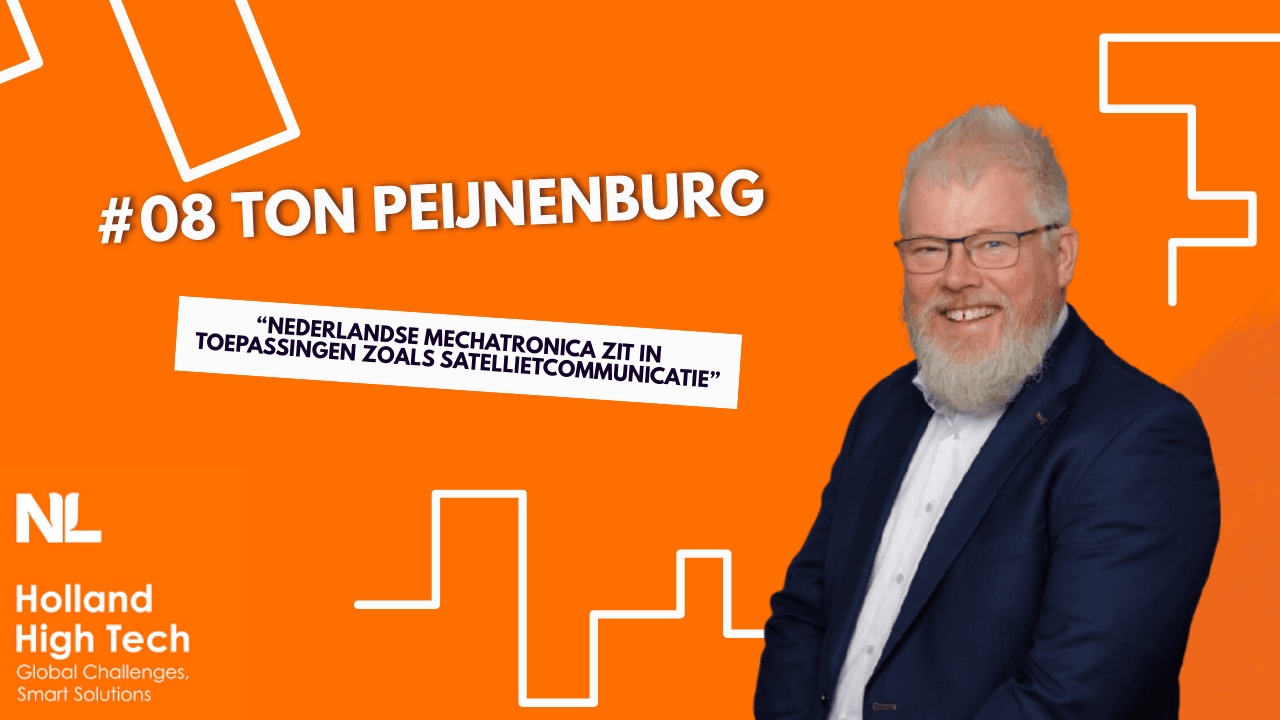
Quantum, sustainable mobility, safety. High tech is playing an increasingly important role in our daily lives. Today, we are interviewing Ton Peijnenburg. He is involved with Holland High Tech as a program council member in the innovation domain of Mechatronics and Optomechatronics. He is also the deputy director of VDL Enabling Technologies Group. He talks about the role of Dutch mechatronics in applications such as satellite communication and surgical robots.
How would you describe yourself in one word?
“I would choose the word curious. Even as a child, I was curious about technology and electronics. For example, I was already repairing old radios back then. That curiosity is still evident in my working life today.”
What does the innovation domain of Mechatronics and Optomechatronics entail?
"The term mechatronics comes from Japan and was introduced by robotics company Yaskawa. They wanted to move away from the traditional way of thinking, where you first design the mechanics, then screw a motor onto it, and only later write a piece of control software for it. Their approach was to develop everything at the same time, synergistically. Mechatronics is therefore an integration of mechanics and electronics, to which control technology has also been added over time."
What are some applications of mechatronics that we already see in everyday life?
Take the CD player, for example, and later the DVD and Blu-ray player. These have almost disappeared now, replaced by solid-state storage technologies. But they are a very good example of how you can still make very precise movements even when miniaturized. With mechatronics, you can aim a laser beam precisely at a disc. ASML's machines are another example. They also incorporate a lot of megatronics. You could also think of a surgical robot. It enables a surgeon to make movements for very delicate interventions, such as suturing a blood vessel."
Do you have a glimpse into the future? In which areas will mechatronics play an important role?
“Mechatronics plays an important role in satellite communications. In Free Space Optics (FSO), modules use lasers to communicate with each other. This method of communication is much more secure than radio waves. In recent years, the importance of this technology has become increasingly clear, partly due to geopolitical tensions.”
What are the Netherlands' strengths in mechatronics?
"In the Netherlands, we have a unique advantage: there is a complete chain of companies here that work together to develop and build mechatronic systems. Take ASML, for example. The machines they make cannot be built anywhere else, and the entire chain — from design to supply — is involved in this. What's more, the Dutch have a unique way of working together: less hierarchy, more shared responsibility. It's a culture in which people take the initiative themselves instead of waiting for instructions."
Where is the untapped potential in the Netherlands?
"In semiconductor technology, you see that there are more and more transistors on chips. You can calculate more and more bits per second. The transistors on the chips have also become smaller. The striking thing is that as those transistors get smaller, the machines you need to make them have to get bigger. The first machine ASML made was about the size of a large refrigerator. Today's machines are the size of a small bus. And the factory in which they are located has grown proportionally. The factories are becoming enormous, now costing 10 billion or more and using huge amounts of energy. This is a mechatronic issue that we will have to address in the coming years.
We are also a major producer and pioneer in the field of agriculture and livestock farming. Many mechatronic solutions are already being applied in these sectors. Think, for example, of lasers that help combat weeds: a camera detects what is growing on the land, after which the laser removes the weeds in a very targeted manner. Such applications are promising. Nevertheless, I think the Netherlands can still make progress in this sector. In fact, we owe it to ourselves to do so."
Do you have a closing message for the reader?
“The Netherlands is good at many things when it comes to mechatronics. We must maintain our lead. That requires continued investment. Not only in the field of semiconductors, but also in the medical sector, agri-food, and optical communication. The rest of the world is moving fast, and we must not be left behind.”
External Content
This content is from youtube. To protect your privacy, it'ts not loaded until you accept.
Sponsored
This story is the result of a collaboration between Holland High Tech and our editorial team. IO+ is an independent journalism platform that carefully chooses its partners and only cooperates with companies and institutions that share our mission: spreading the story of innovation. This way we can offer our readers valuable stories that are created according to journalistic guidelines.
Want to know more about how IO+ works with other companies? Click here