
CC Diagnostics wins NextGen Award for home cervical cancer test
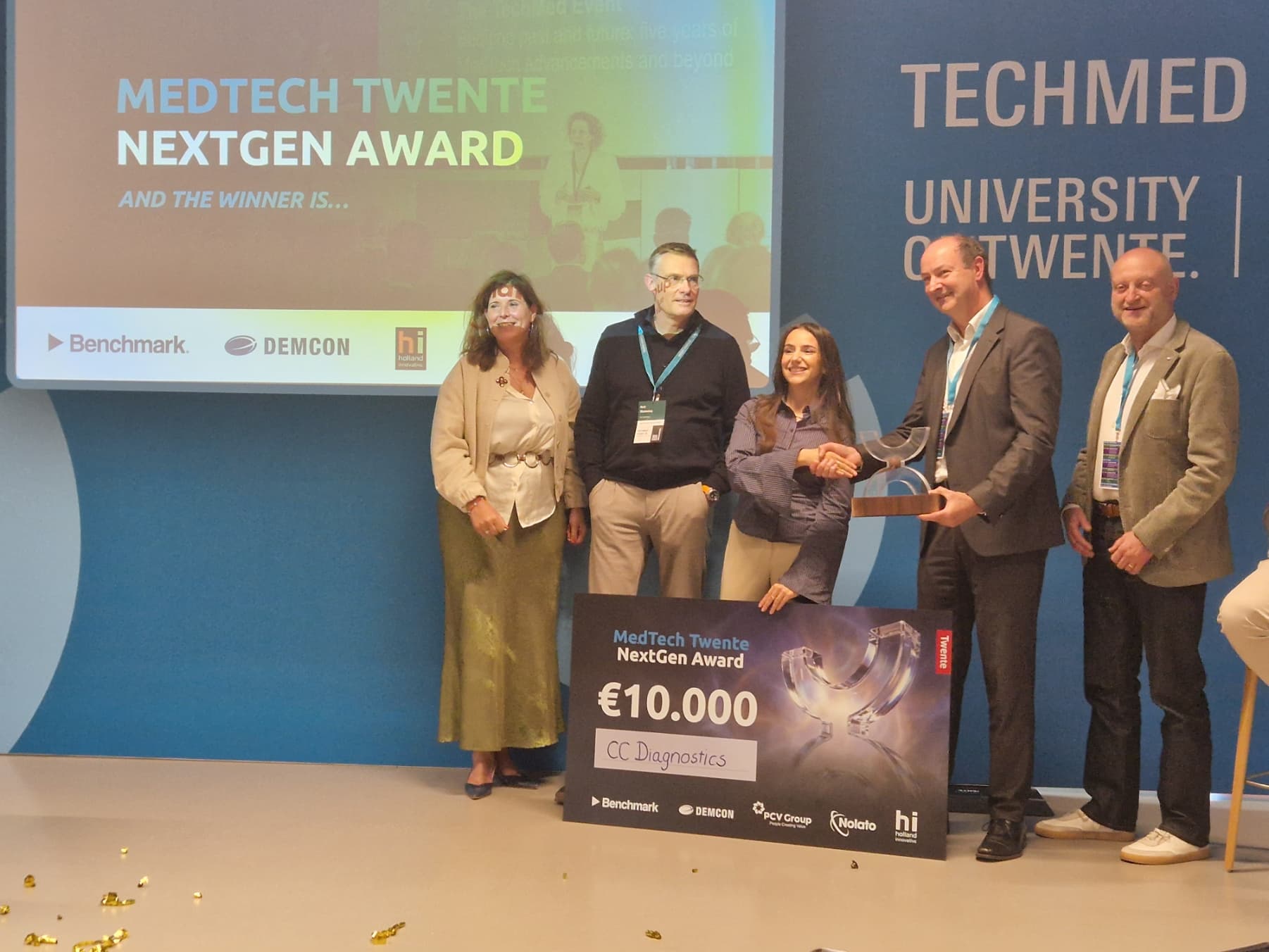
Groningen startup CC Diagnostics wins the MedTech Twente NextGen Award and €10,000 for its at-home cervical cancer test.
Published on November 5, 2026

Mauro swapped Sardinia for Eindhoven and has been an IO+ editor for 3 years. As a GREEN+ expert, he covers the energy transition with data-driven stories.
CC Diagnostics wins the MedTech Twente NextGen Award with its non-invasive cervical cancer detection technology. The startup, based in Groningen, earned the jury’s approval for the high impact its technology can have.
Cervical cancer is the 5th most common cancer in women, and every year, thousands of cases go unnoticed. Currently, women need to undergo invasive and uncomfortable testing procedures. Nearly a quarter of all cases are missed by current screening practices.
The Groningen startup has developed an innovative PCR testing kit – working similarly to a home test for COVID-19 — with patented biomarkers that enables earlier detection while improving patient comfort. “The advantage is that women can simply test at home and ship the sample to a laboratory, without even needing to step into a gynaecologist's practice,” said Ilinka Stanciu, the startup's quality assurance manager.
The NextGen Award recognizes healthcare technology startups, and it is organized by MedTech Twente, the University of Twente’s (UT) medtech cluster. The final took place during the TechMed event, a gathering of health tech professionals hosted today on the UT campus.
Impact for millions of patients
Four finalist startups competed for the prize. Inspired by the Dragon’s Den, each startup had three minutes to pitch its idea to a jury, which then had five minutes to ask questions. In addition to the judges’ feedback, the winner received a €10,000 prize. “We plan to use this money to accelerate to start pilot studies in the US,” said Stanciu.
“We saw four really great ideas, all of them ready for the market, and we listened to four nice pitches,” said judge Harald Vonkeman, Professor of Patient-Centered Health Technology at UT. “Of all the four, we believed that CC Diagnostics’s idea can really have an impact on healthcare.”
Henk Westendorp, a partner at venture capital firm NLC Health Ventures and a jury member, shared extra advice for the winner when presenting the prize. “You only have one chance in this kind of business, so make sure that you are well set and conditioned to enter the US market,” he said.
The other finalists
The three other runners-up also presented ready-to-market ideas to improve healthcare.
FlowBeams - founded at Twente University - is developing non-invasive injection technology, aiming to disrupt cosmetic and pharmaceutical treatments. Instead of using a needle to inject medicine, their technology uses a laser to heat the liquid to be injected into the body. As the temperature rises, a rapidly expanding microbubble forms, propelling a high-speed jet through the skin for quick absorption.
I See U Baby Care developed a system to check on premature babies’ sleep. The technology combines a camera that records sleep with an algorithm that makes sense of the data. Tracking sleep in premature babies is crucial because, due to their condition, they sleep fewer hours. Sleep is essential for healthy growth, immune function, and brain development. Tracking premature babies helps caregivers and patients understand how to support the newborns.
Twente Medical Optics has developed HAPI, a handheld device to scan organs before a transplant. The startup pitch underlined how a large share of organs, although good to use, are discarded. The device could help perform more transplants, saving more lives. Having gained experience in burn assessment, the company is gearing up for the next step.
The hospital of the future
The four innovations align well with MedTech Twente’s vision: designing the hospital of the future. As care evolves, pressured by staff shortages and an aging population, and helped by AI and robotics, new technologies can help shape the future.
To this end, the TechMed Event hosted a day-long program of presentations, panels, and exhibitions to think of how to integrate technology into healthcare pathways. AI, robotics, and personalized medicine were among the hot topics of conversation, alongside the ethical consideration that the adoption of these innovations entail.
The sector agrees: there is no way to guarantee high-quality care in the years to come, without a fruitful technology input. A tip for innovators, as a hospital clinician on stage remarked: “Make sure to develop technology with us and not for us.”