
Can we really beam solar power from space?
Space-based solar power promises to deliver clean, abundant energy. How does it work? And where does the technology stand?
Published on March 6, 2026
.png&w=2048&q=75)
AI-generated picture

Mauro swapped Sardinia for Eindhoven and has been an IO+ editor for 3 years. As a GREEN+ expert, he covers the energy transition with data-driven stories.
Imagine a space station that collects solar energy in orbit and beams it down to Earth. The planet’s power supply depends on just two astronauts, Powell and Donovan. and their robot companion, QT-1—affectionately called ‘Cutie’. This is, in brief, the plot of Isaac Asimov’s 1941 short story Reason. The tale explores the relationship between humans and robots, but most importantly, it introduces the visionary idea of harvesting solar power in space.
Over the decades, the visionary idea of the American writer prompted scientists to look at the feasibility of collecting solar power in space and beaming it to Earth as needed. Many concepts have been produced since the 1970s. Yet we haven’t succeeded in harvesting energy from space. Still, the possibility of capturing the much more powerful solar rays in orbit has kept researchers busy.
The wait may soon be over. A recent study by the United Kingdom’s government has found that space-based solar power could be cost-competitive by 2040, driven by technology advances. But how does this technology, promising to satisfy the world’s need for green power, work?
Green Tech Decoded
From revolutionary wind turbines to futuristic materials, a lot is happening in green tech. But what are all these technologies about? And why should we care? In Green Tech Decoded, we explain how these innovations work and why they could redefine our society.
How does space-based solar power work?
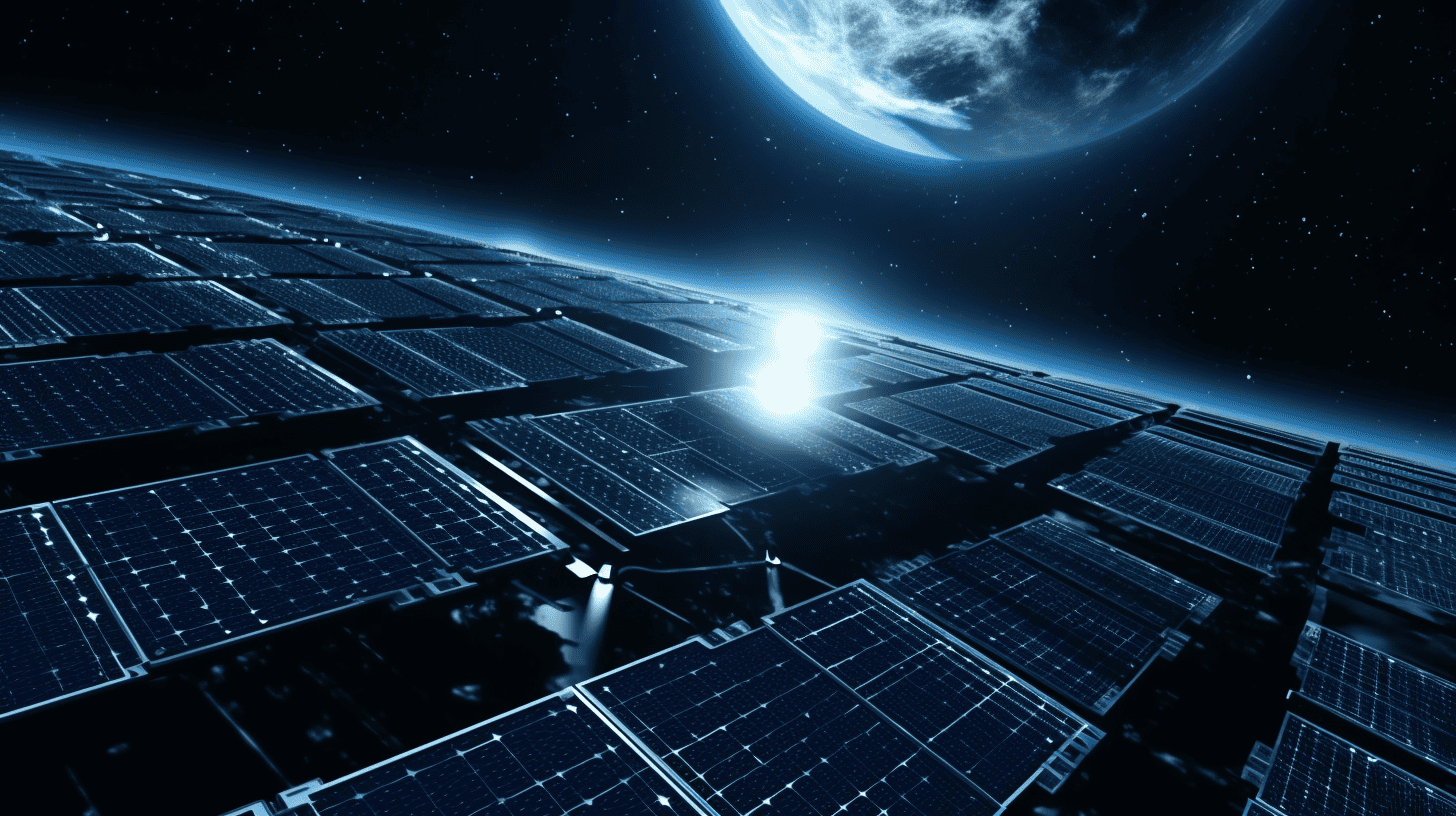
The core idea behind SBSP is to have a constellation of solar panels in orbit. Approximately, the reflectors are placed at an altitude of 36,000 km above Earth, known as geostationary orbit.
Sun rays are then converted into microwaves or radio waves. This process can happen through electronic components that can convert direct current (DC) from the sun into a form that can be transmitted wirelessly, such as from the music on your phone to your headphones.
Once the sunlight is in a suitable form for transmission, it is sent to ground-based receivers. Called rectennas, these stations convert microwaves back into electricity, which is then fed into the power grid.
What are the main advantages?
In addition to being a clean source of power, there are some other advantages:
- One of the downsides of solar energy—as well as wind power—is its inconsistency. Simply put, on Earth, the sun doesn’t shine at all times. In the orbit, without the constraint of the day and night cycle, as well as from clouds, solar panels can constantly collect sunlight.
- On the orbit, there is no reflection nor atmospheric absorption. Gases and particles present in the Earth’s atmosphere trap some light wavelengths. Although visible light passes through, this phenomenon affects solar panels’ performance, as they can harvest only a limited range of the light spectrum. In space, reflectors can collect it all.
- Interestingly, the energy beams from space can be directed to different locations on Earth. Why is this a big advantage? Imagine an area that is facing a power outage because of an emergency. Thanks to space solar, it would be possible to promptly restore power.
- Scalability is another pro. Since sunlight is available at all times, each satellite could generate more energy than a ground-based solar farm. In addition, the sun’s energy orbit is up to 10 times more intense than on Earth, allowing for higher yields per area.
Why don’t we have space-based solar power yet?
Solar-based solar power is undoubtedly easier said than done. Before we can actually have on-orbit power plants, some critical bottlenecks need to be addressed. As things stand, money and technology constraints are the main barriers.
- First and foremost, launching materials into space is extremely expensive. Depending on the technology, launching a kilogram of material into orbit costs between $1000 and $10,000. NASA’s average has been around $4,990 per kilogram. Although SpaceX Starship is aiming to reduce costs to $10–$100 per kilogram, we are not there yet.
- Just like cleaning, vegetation management, and electrical inspections at on-ground solar farms, on-orbit systems would also require regular maintenance. Not to mention that space systems would have to be assembled in space. Scientists are working to create robotic assembly and autonomous repair systems, yet the hurdles and costs remain hefty.
- Creating technology that functions in orbit is hard, but developing rectennas isn’t easy either. The Earth receivers must be able to process a constant inflow of gigawatts of power efficiently, safely, and without energy loss.
- The orbit is getting busier. More and more satellites are being launched into space, increasing the risk of collisions and the accumulation of space debris.
Where are we now with the technology development?
The race for SBSP is on, as research teams across the world are working to advance the technology.
In 2023, the California Institute of Technology (Caltech) reported an important breakthrough. In a successful experiment, scientists validated the functioning of a device that wirelessly transmitted power in space and sent a detectable signal to Earth. Although they transmitted a low amount of power, the team proved that the concept can work in real-world conditions.
China is moving forward. By 2028, plans are to launch a small-scale SBSP plant in the geostationary orbit. It will be an experimental plant, and it is expected to produce only a few tens of kilowatts of energy–enough to power a few households. In the meantime, lots of experiments have been going on in the buildup to the grand launch.
The European Space Agency (ESA) SOLARIS research project, which ended in 2025, also examined the feasibility of SBSP in Europe. ESA concluded that the technology remains too immature for Europe to proceed with a demonstration mission. Still, the focus should be on improving the technology further before launching.
Solar energy from space could be the answer to Earth’s escalating energy demand
Work is in full swing at the European Space Agency (ESA) and TU Delft to make space-based solar power a reality.
What can we expect?
Solar energy from space is expected to reach cost competitiveness within a decade. The aforementioned UK government study reveals SBSP would make sense, especially if connected to existing grid infrastructure, such as offshore wind farms. The analysis confirmed that launch costs are the most significant cost driver.
The same time estimate has been confirmed by ESA’s SOLARIS, which also estimated cost competitiveness to be reached around 2040. ESA underlined that improving technology—to launch materials and collect laser beams—is a critical step.
Asimov ingrained in our minds the vision of space-based solar power. Decades later, that utopian idea is less fanciful—though many hurdles remain to its deployment. And who knows, maybe, in a few years, solar energy from space will be an integral part of our energy mix.