
Can robots help hospitals treat ten times more patients?
At the TechMed Event in Twente, a panel of experts discussed whether robots can relieve a healthcare system, and at what price.
Published on November 23, 2026
© Jip Huis in 't Veld

Mauro swapped Sardinia for Eindhoven and has been an IO+ editor for 3 years. As a GREEN+ expert, he covers the energy transition with data-driven stories.
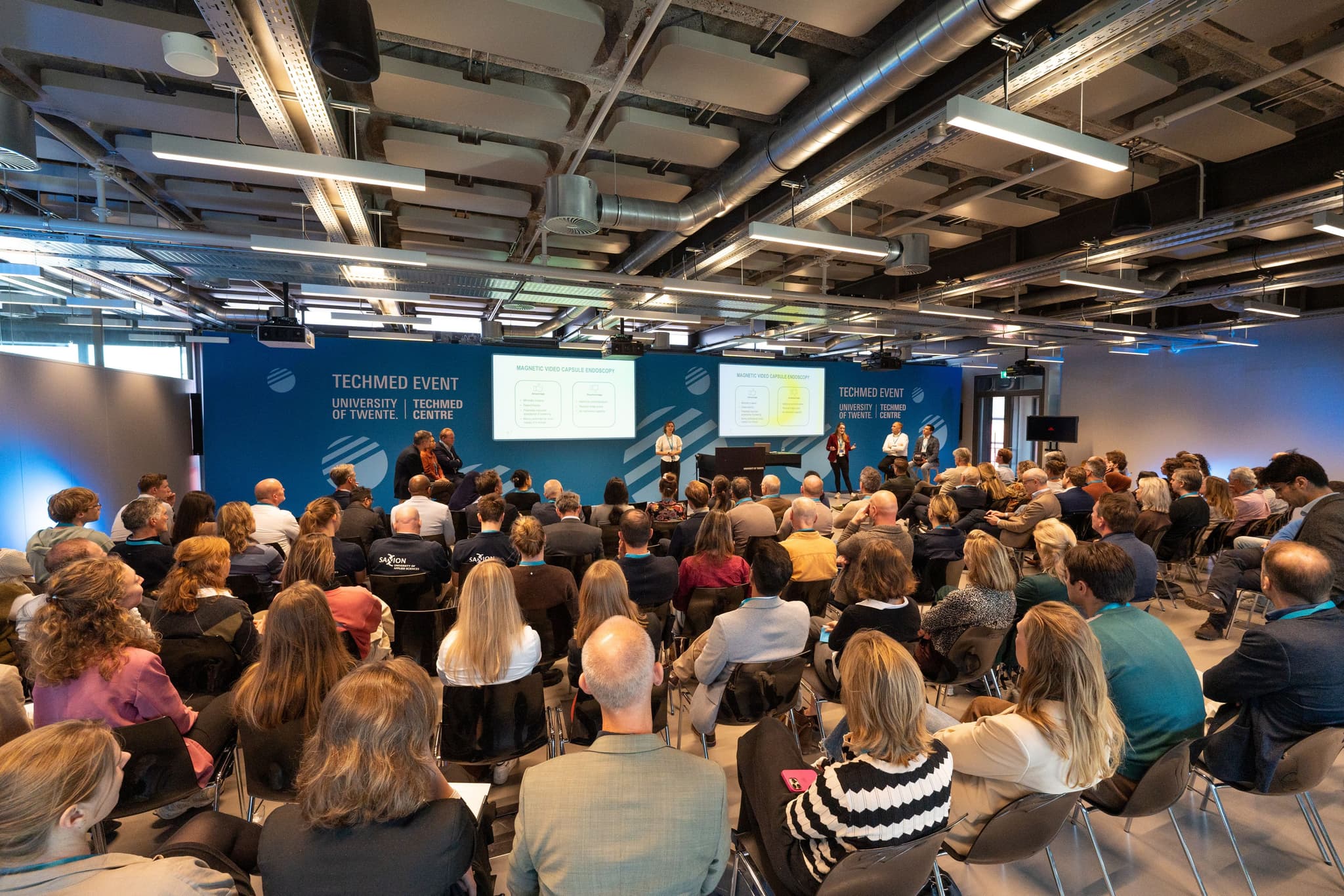
AI is poised to offer many solutions to the healthcare sector's challenges. In parallel, there is another technology that promises — and in fact, already is — to make a difference: robots. During the TechMed Event, held at the University of Twente on November 5, a panel of experts discussed the potential of robots to relieve a system running out of people, and at what price.
Islam Khalil, associate professor at the University of Twente (UT), opened the session with a thought experiment. What if hospitals had to treat ten times more patients, without more nurses or doctors? Staff are scarce; robotics and AI are advancing fast. "The question is not about what robotic systems can provide," Khalil said. The question is whether they can meet healthcare providers' real needs.
Healthcare robots: not just an extra interface
Reinoud Bokkers, an interventional radiologist at the University Medical Center of Groningen (UMCG), was the first to present. His talk started with him showing a photo of an emergency repair of a ruptured aortic aneurysm – a severe bulge in the aorta, the human body’s largest artery. Five to ten years ago, he said, the procedure would not have been possible. But the picture also showed 14 people in the room.
"While our surgeries and treatments are getting more and more advanced, it's also requiring more personnel," Bokkers said. In the Netherlands, one in six workers already works in healthcare, and that share is set to rise. At some point, there will be neither the money nor the staff.
His hospital already uses robots to transport goods, mop floors and distribute medicine. Yet he was frank about the evidence: "We have no real proof that it works." Robots should not become "just an extra interface" between provider and patient, he argued. They should raise throughput or let less experienced staff perform advanced procedures.
Saving time is not saving money
UT’s health economist Sopany Saing focused on budgets. Every technology must prove it beats the alternative, and "the comparator is not necessarily your competitor," she told the audience. It is usual care, which may be nothing at all. "You really need to demonstrate that your high-tech solution is worth its cost."
The economist underlined how developers must take into account the costs it entails. Her yardstick is the cost per quality-adjusted life year, or QALY, a measure combining how long and how well patients live. Divide a technology’s extra cost by the extra healthy years it delivers, and compare the result with “the value that society is willing to pay”. Below that threshold, it is worth reimbursing.
She warned against a common assumption: "Just because your technology might save time, that doesn't always translate to cost savings." It pays off only if staff use the freed-up minutes. Her advice: assess value early, before the big money is spent.
"We humans need the robots"
Andreas Keibel of German robot maker KUKA argued from demographics. Europe faces 24 million fewer working-age adults, he said, while every healthcare worker hired is one taken from the industries that fund the system. "Healthcare cannot hire its way out of the demographic crisis."
KUKA robots already sit inside plenty of hospital robots across the world. In addition to radiotherapy systems and surgical systems, he envisions robots that carry loads, serve meals and take care-home residents for a walk.
Europe, he said, has an "innovation jam" of care robots stuck before market entry. "Neglecting [people] in their own room is not ethical," he argued, but a walk with a robot is. His closing line: "We humans need the robots for the future."
A gentler colonoscopy
UT researchers Yara Daoud and Nicole Rabou focused on colonoscopy. It is the standard for detecting colorectal cancer, but it is hard to learn, uncomfortable, and often unnecessary: according to Daoud, only 31% of people who undergo it after screening actually need a resection. Around 15% of those referred never show up.
Their first answer is a robotic platform that steers a conventional colonoscope via a joystick-like console with force feedback. Even technicians without clinical experience could navigate it, and in colon models insertion took about two minutes. Insertion, the slowest and most uncomfortable step, could one day be handed to a nurse.
The second is a magnetic video capsule, guided through the colon by a robot arm with a rotating magnet, taking about six pictures a second. It cannot remove polyps, but it is far less invasive. "Robots can focus on the repetitive, technically demanding tasks," Rabou said, "so humans can do the things humans do best."
A robot touching patients, the researchers stressed, faces a higher bar than one serving dishes: "It doesn't just need to be safe. It needs to be really, really safe."
Keeping care human
Steven Dorrestijn, lector in Ethics and Technology at Saxion University of Applied Sciences, offered the counterweight. Technology is a means, he said, and the end is good care. If an innovation does not serve that end, "then we have new technology but not good healthcare."
He raised a deeper worry, too. "Maybe we as a society also look down on doing the work of care," he said. If so, "the technical solution to the problem is second best."
Keibel answered personally. "I would be fine to be cared for by a robot when I'm old," he said. His family has its own lives; a robot beats sitting alone by the window. Dorrestijn doubted that view is typical, and argued for keeping "a human in the loop", like a pilot in a plane that can fly itself.
A healthcare professional in the audience named the paradox. Technology promises to free up time, yet history suggests the opposite. Thirty years ago, the patient in Bokkers' photo would probably have had only "the village priest". New tools create new demand, and someone must decide where to stop.
No one, among the panelists and the audience, ventured to predict what the future may hold. Robots will be there for sure, but they won’t deliver the extra capacity Khalil hinted at the beginning of the session alone. There is a need for more evidence, good business cases, and, most importantly, humans in charge who decide how to make the best out of them.