
Brainport’s strength as a foundation for European resilience?
At Brainport’s New Horizon reception, Ton van Mol, Vivian Smetsers, Albert Maas and Tijn Swinkels discuss the geopolitical situation.
Published on January 7, 2026
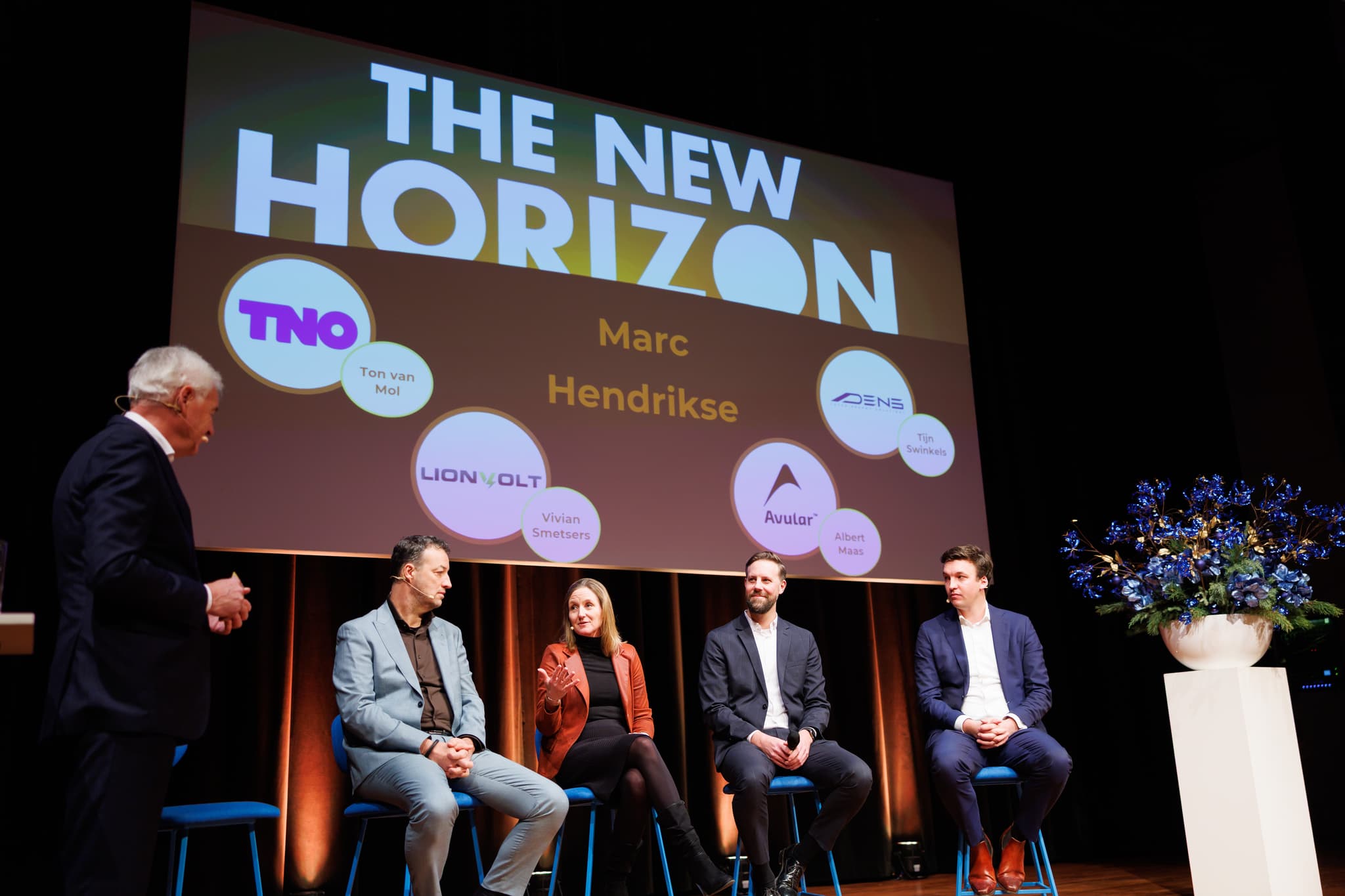
Marc Hendrikse with Ton van Mol (TNO), Vivian Smetsers (LionVolt), Albert Maas (Avular) and Tijn Swinkels (DENS) © Bram Saeys
Bart, co-founder of Media52 and Professor of Journalism oversees IO+, events, and Laio. A journalist at heart, he keeps writing as many stories as possible.
The question Marc Hendrikse uses to open the panel discussion sounds like a management challenge, but it lands as a geopolitical wake-up call: how do you turn ideas into action while the world order is shifting? In the audience are executives and entrepreneurs; on stage, four voices from the heart of Brainport: Ton van Mol (TNO), Vivian Smetsers (LionVolt), Albert Maas (Avular), and Tijn Swinkels (DENS). Their shared diagnosis is clear: the era in which companies primarily competed with one another is coming to an end. “It’s no longer companies versus companies, it’s continents versus continents,” Maas says. And that is precisely why the Netherlands, and Europe, must organize its own strengths differently: more purposefully, more strategically, and with more boldness.
1) Brainport has a seat at the table, but must keep it
Ton van Mol kicks off from a familiar point of Brainport pride: the region is world-class in supplying. “That’s why we have a seat at the table in semicon.” However, that seat is not guaranteed. “ASML alone, together with its supply chain, is not enough.” Van Mol argues for a next step: using the semiconductor strength already built up to develop new strategic domains, not as a hobby project, but as a geopolitical necessity. He mentions two examples: battery technology and integrated photonics. Precisely there, Europe can build - on top of its existing knowledge base - a position that goes beyond dependent purchasing.
The core of his argument is that strategic autonomy requires choices. Not everything can happen at once, and not everything needs to be done in-house. But if you don’t make choices, they will be made for you.
2) “Control points”: choose where you do want to hold the key yourself
The conversation then shifts from pride to tactics: where should Europe retain control? Hendrikse explicitly frames it in terms of control points: places in value chains where power, leverage, and negotiating room converge.
Van Mol puts it bluntly: “We can’t do everything ourselves all at once.” So the question becomes: what is strategically important, and where are we genuinely strong? In batteries, for example, this does not mean every component must be “EU-made.” Still, it does mean understanding which parts of the supply chain are critical to security, continuity, and future innovation.
That nuance stands out because at the same time the panel is highly critical of Europe’s naïveté.
3) Batteries: from energy transition to security issue
At DENS, the geopolitical storyline takes on a concrete, almost uncomfortable, shape. Swinkels compares the drone world with the energy world: in the U.S., Chinese batteries were barred from sensitive applications years ago. In Europe, he says, “we keep happily filling the whole country with Chinese batteries.” His concern is twofold:
- Cyber and sabotage: batteries are not dumb blocks of steel, but digital systems inside the energy network. “When we see what you can do with a small battery… You can bring the grid down if you really put your mind to it.”
- Waste and lifespan: “In China, they don’t build them for 20 years, they build them for 3.” Which raises the question: what will we do with that mountain of hardware later?
It’s a classic Brainport tension: you build solutions for grid congestion and energy challenges, yet you are hindered by power shortages, nitrogen restrictions, and sluggish procurement. Swinkels sums it up cynically: DENS is a solution for the grid, but sometimes can’t grow because there is no grid capacity.

Marc Hendrikse with Ton van Mol (TNO), Vivian Smetsers (LionVolt), Albert Maas (Avular) and Tijn Swinkels (DENS) © Bram Saeys
4) LionVolt: differentiation in the chain and IP as a defensive line
Where Swinkels highlights systemic risks, Vivian Smetsers shows how a deeptech company operationalizes strategic autonomy. LionVolt focuses on a specific point in the battery world: the anode. According to her, it is “a unique position in the chain.” The goal is not to “shout against China,” but to become indispensable: if your anode makes the difference, you become relevant, even to players producing cells elsewhere.
Notably, LionVolt made a pragmatic move: alongside its locations at High Tech Campus and Brainport Industries Campus, it acquired a factory in Scotland to integrate anodes into cells and deliver them. That creates something Europe often lacks: proof at scale, not just lab results, but production experience.
At the same time, the conversation turns to protection: how do you prevent copying? Smetsers answers with a mix of patents, know-how, and discipline. “We do say what we do, but never how we do it.” And with a motto that hangs over the evening like a warning: “Only the paranoid survive.” Yet realism follows: eventually, technology will leak. The only valid defense is to keep innovating.
5) Avular: Europe must dare to become more technocratic
Avular CEO Albert Maas is the most outspoken voice. He sketches a world in which China dominates robotics and drones not only through scale (millions of drones per year) but also through something he says Europe lacks: a technocratic long-term strategy. China plans, builds, and finances as if it were a national mission. The U.S. is more opportunistic but has a vast capital ecosystem and strong reinvestment.
Europe? “Not technocratic at all.” Maas is not triumphant about shielding markets - “not something I’m proud of” - but sees it as a necessary correction: without borders and rules, you become a plaything.
His biggest point may be this: robotics is not a nice-to-have but an economic engine for coping with labour shortages. “If we want to keep living the way we live now… We’ll have to do something.” And that “something” could be robots, but not ones dependent on systems “that can be switched off”, or that leak data. He captures the future risk in one sentence: no one wants care robots from China that you can’t trust.
6) The missing layer: OEMs, products, brands
The panel repeatedly returns to the same frustration: Brainport is phenomenal in components, chains and knowledge, but too often misses the step to its own end products and global brands. Maas says it out loud: “What I miss are the OEMs… bringing products to the end market.” Europe has icons like ASML and strong industrial brands, but too few “Googles and Apples.” And, he adds, many European champions are “old companies.”
That observation points to something more profound: in geopolitics, power isn’t only about technology, but about who controls systems, who sets standards, and who dominates markets. Brainport can do a lot, but must take the lead more often at the end layer.
7) Financing: too many allocators, too few investors
If there is one theme that unites the panelists, it is capital. The problem isn’t that Europe lacks money; it’s how it works. Maas: In the U.S., you can commit 100 or 200 million over dinner. In Europe, it goes through fund managers, committees, and governance. “That takes a long time… and technology grows exponentially.”
Swinkels adds a painful image: one large investor in Europe can be “an ugly duck in the pond”: alone, vulnerable, and often loss-making because the ecosystem is missing. Deeptech needs a layered capital network, not occasional heroes.
Smetsers brings it back to policy: deeptech must move from lab to factory, and precisely there, Europe gets stuck. She points to a concrete bottleneck: the “undertaking in difficulty” test, through which startups with accumulated losses quickly fall outside subsidy eligibility. “Which is what every startup will face after x years.” The result: less money for R&D exactly when you need it most.
Van Mol adds another dimension: if you want investments to work, design them so they unlock private investment. Public money should be a leverage, not a safety net. And above all: remove physical bottlenecks - power, nitrogen, space - because without those conditions, every funding round remains theory.
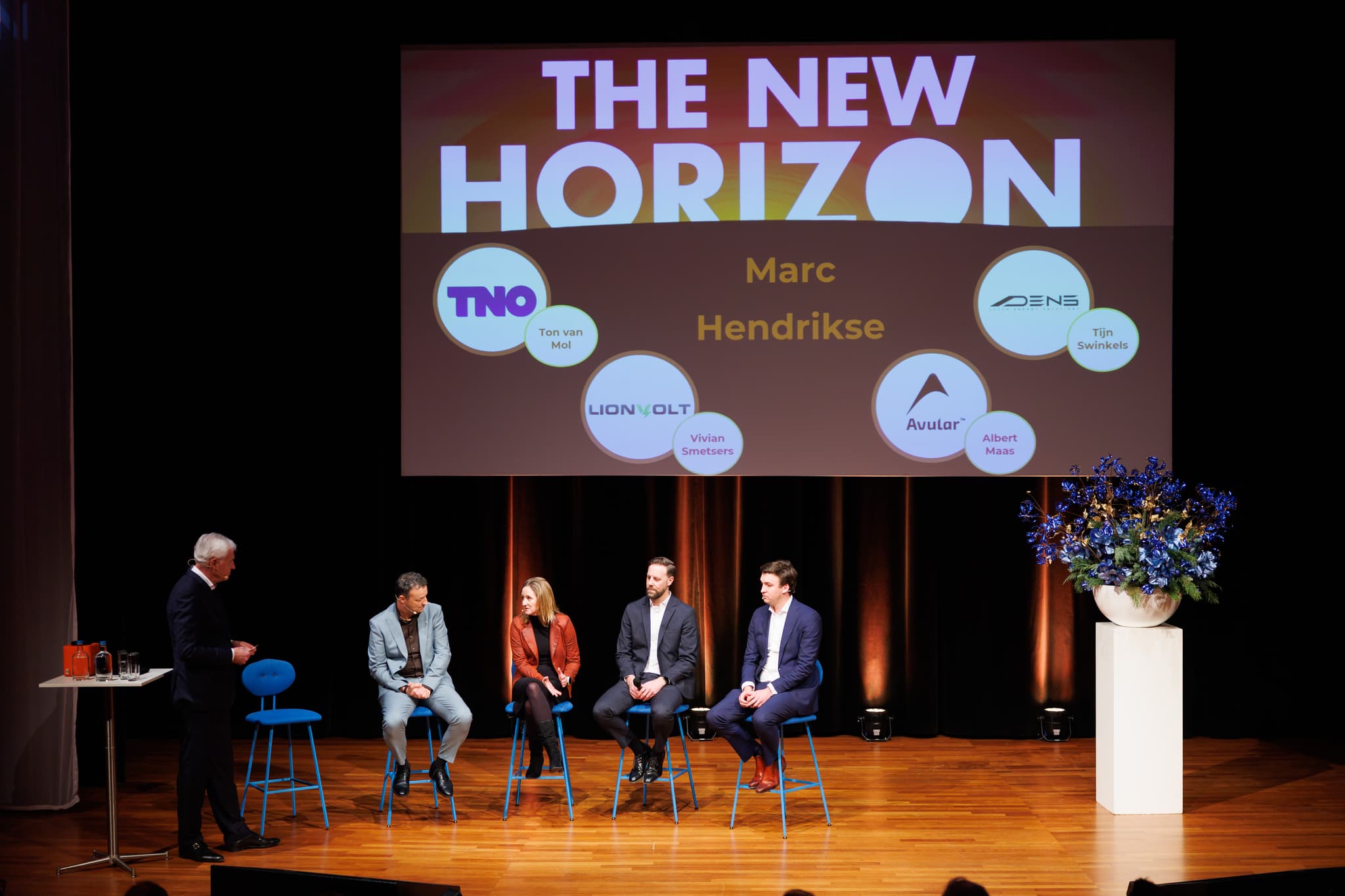
Marc Hendrikse with Ton van Mol (TNO), Vivian Smetsers (LionVolt), Albert Maas (Avular) and Tijn Swinkels (DENS) © Bram Saeys
8) Talent: Brainport as a magnet, the Netherlands as a bottleneck
On talent, the panelists are relatively optimistic: Brainport attracts people. The region’s character helps: many companies, so there is always an alternative, and an environment in which international knowledge workers can move freely. At the same time, there are real shortages in specific domains (batteries, photonics). And the real problem often isn’t recruitment, but housing and scalability.
Maas makes it a cultural point: put engineers on a stage. “Engineers are the new rockstars.” Not as a marketing trick, but because status and pride are part of an innovation culture. That links to another unexpected topic: storytelling. Maas says Europe is too reluctant to shout from the rooftops what it can do. That’s more than communication; it’s a tool to mobilize talent, capital, and political support.
9) What should the Netherlands and Europe do now?
At the end, Hendrikse turns it into a thought experiment: Rob Jetten calls and asks: What do you want to change? The answers together form a kind of Brainport agenda for geopolitical resilience:
- Fix the enabling conditions (power, nitrogen, space) so scale-ups can scale (Van Mol).
- Define what is strategic: choose control points in energy, digital systems, high-tech chains (Van Mol, Swinkels).
- Accelerate risk capital and accept failure as part of returns: “do it a thousand times” instead of holding ten rounds of meetings (Maas).
- Repair rules that punish deeptech (such as the “undertaking in difficulty” test) so R&D subsidies don’t disappear precisely when things get exciting (Smetsers).
- Make Europe more technocratic in execution: more engineers and entrepreneurs in The Hague, stronger links with Brussels, and a real long-term roadmap for strategic autonomy (Maas).
- Build your own products and brands: from component strength to OEM ambition (Maas).
- Take security seriously in procurement and infrastructure, even when a “free” offer is tempting (Swinkels).
The underlying message: Europe is not Calimero, but sometimes behaves like one
That may be the line that lingers after this conversation. Maas says it explicitly: why do we compare one 300-billion pearl with twenty 3-trillion pearls “across the Atlantic,” and then conclude that it can’t be done here? Brainport has a history that proves it can, from Philips to an ecosystem that now ranks among the top in the world. But the next phase requires different reflexes: faster investing, sharper choices, more complex scaling, and better storytelling.
The panelists differ in tone - TNO strategic, LionVolt pragmatic, Avular combative, DENS cautionary - but their shared call is the same: use your strengths not only as an export engine, but as the foundation for European resilience. Not by trying to do everything yourself, but by deciding where you must keep the key in your own hands. And then: act.