
Brainport’s energy ecosystem moves from promises to impact
A new snapshot identifies 26 active energy startups and scaleups in the Eindhoven region. Together, they have raised €231 million.
Published on June 23, 2026
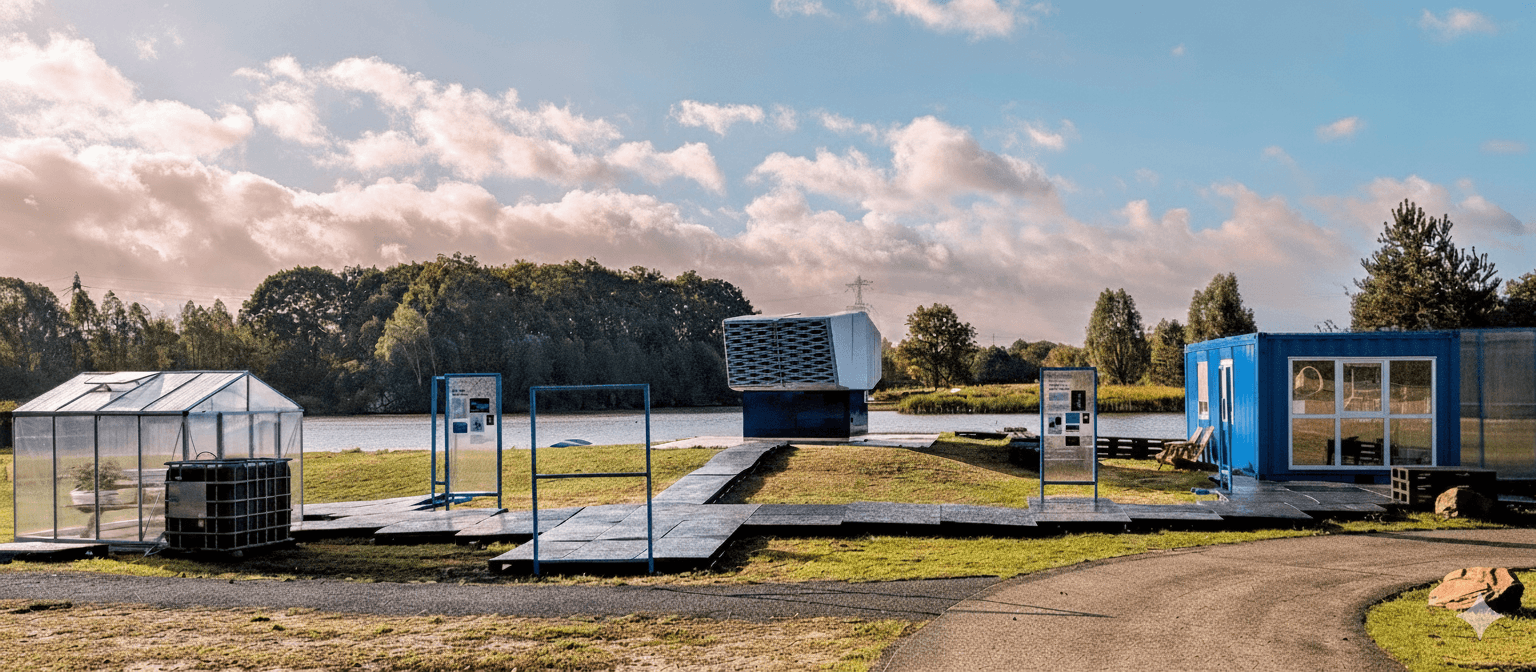
Carbyon Go at High Tech Campus Eindhoven
Bart, co-founder of Media52 and Professor of Journalism oversees IO+, events, and Laio. A journalist at heart, he keeps writing as many stories as possible.
When people talk about Brainport Eindhoven, energy is rarely the first domain that comes to mind. Semiconductors, photonics, precision engineering and medical technology tend to dominate the story. Yet a new snapshot of the region’s startup and scaleup landscape suggests that energy has become a serious deep-tech field in its own right.
The data, compiled from Dealroom-based ecosystem information by the Gerard & Anton Community and Braventure, identifies 26 active private energy startups and scaleups founded since 2010. Together, they have raised €231 million through 52 equity, grant and debt rounds. That represents 19 per cent of the wider Brainport population of funded companies founded since 2010.
The companies operate across a broad set of domains: industrial heat, carbon capture, batteries and storage, hydrogen, solar, smart charging and grid management. More importantly, they show a distinctly Brainport approach to the energy transition. These are not primarily consumer-facing climate solutions. They are technologies designed for factories, electricity networks, construction sites, heavy industry, and the infrastructure that supports everyday life.
In other words: the region’s energy story is increasingly about turning complex engineering into systems that can work outside the lab.
RIFT shows what industrial scale can look like
The clearest example is RIFT, the Eindhoven company developing iron powder as a circular fuel for industrial heat. Founded in 2020, RIFT has raised €127 million, making it by far the best-funded energy company in the snapshot.
Its proposition addresses a stubborn part of the climate challenge. Steam and process heat account for a large share of industrial emissions, while many companies still rely on natural gas because full electrification is difficult and green hydrogen remains limited and expensive.
RIFT’s approach is strikingly physical. Iron powder is burned to generate high temperatures without CO₂ emissions. The remaining rust can then be regenerated into iron using green electricity, creating what the company describes as a transportable and circular energy carrier.
That image captures why the company matters for Brainport. RIFT is not selling a distant vision of future decarbonisation. Its first commercial installation at Swinkels, the company behind Bavaria beer, has already been producing steam. The technology is aimed at existing boilers in breweries, food production sites and other industrial environments where the energy transition is often hardest to achieve.
RIFT also illustrates the strength of the local innovation chain. The company emerged from TU/e student team Team SOLID, which started working on iron powder as fuel in 2014. Six years later, RIFT was founded. Today, the startup has become one of the most visible examples of how a student experiment can evolve into a capital-intensive industrial venture. And by the way, a next-generation Team SOLID is also active at the moment.
A portfolio of difficult energy problems
RIFT is the largest company in the picture, but the broader ecosystem is far more diverse.
Carbyon, a TNO spin-off founded in 2019, works on direct air capture: technology designed to remove CO₂ directly from the atmosphere. It develops ultra-fast carbon-capture systems based on activated carbon films and aims to bring the cost of carbon removal below $100 per tonne. The company has raised €35 million and was a finalist in the XPRIZE Carbon Removal competition.
LionVolt, another Eindhoven deep-tech venture, focuses on batteries. The TNO and Holst Centre spin-off develops a 3D solid-state battery with thin-film lithium-metal anodes. The goal is to combine higher energy density with faster charging, initially for wearables and IoT applications, and eventually for electric mobility. LionVolt has raised €20 million.
DENS takes a different route. The company, which emerged from TU/e student team FAST, uses formic acid as a liquid hydrogen carrier alongside more traditional battery packs. Its Hydrozine systems can provide emission-free electricity for construction sites, events and off-grid backup. The technology has already been demonstrated at Lowlands and in cooperation with Dutch Railways. DENS has raised €12 million. Today, it mainly supports the energy for remote building and road construction projects.
Taylor, also founded out of TU/e, works on improving the output of solar panels through smart panel electronics. More than 45,000 panels using the company’s technology have been installed across the Netherlands.
Taken together, these companies show that Brainport’s energy ecosystem is not concentrated around a single breakthrough. It spans carbon removal, new fuels, electricity storage, solar optimisation and industrial energy systems. The common thread is engineering depth: technologies that must survive demanding real-world conditions before they can become commercially relevant.
© Gerard & Anton Foundation / Braventure / Matthijs Bulsink
A new generation is already forming
The next layer of companies suggests that the pipeline is still growing.
Tibo Energy, founded in 2022, develops smart charging and energy management systems for commercial fleets and small and medium-sized businesses. Its software combines dynamic electricity tariffs, local renewable generation and information about grid congestion.
Integer Technologies, based in Helmond, develops energy-efficient power electronics. The company raised a €1 million seed round in 2025 from BOM, LUMO Labs and VP Capital.
Spark-nano works on Atomic Layer Deposition equipment for high-efficiency solar cells and next-generation battery electrodes. Its ambition is to move advanced nanocoatings from research environments into industrial production.
Then there is Perovion, a TNO spin-out launched in March 2026. The company commercialises perovskite solar technology and is based at High Tech Campus Eindhoven, where it can draw on Solliance’s roll-to-roll pilot lines for tandem and building-integrated photovoltaic modules.
The youth of the ecosystem is one of its most striking features. 21 of the 26 active companies in the snapshot were founded after 2017. Several came directly from TU/e student teams or university spin-outs. That creates a pattern familiar in Eindhoven: students and researchers start with a difficult technical challenge, build a prototype, gather an industrial network around it, and gradually turn it into a company.
More than a startup ecosystem
The Brainport energy story also reaches beyond companies founded locally. The region is increasingly becoming a place where energy technology developed elsewhere can be tested, industrialised and connected to manufacturing expertise.
Solliance, the joint R&D programme involving TNO, imec, TU/e and Holst Centre, provides shared facilities for thin-film and perovskite solar development at High Tech Campus Eindhoven. Its pilot lines are already being used by Perovion and other companies working on scalable solar coatings.
LeydenJar, a TNO spin-off headquartered in Leiden, chose Strijp-T in Eindhoven for PlantOne, its first factory for 100 per cent silicon-anode batteries. The site is intended to demonstrate batteries with higher energy density, faster charging and a lower CO₂ footprint than conventional graphite-anode cells.
At High Tech Campus Eindhoven, Thorizon is developing a molten-salt reactor programme together with VDL and DEMCON, bringing nuclear technology together with Brainport’s manufacturing and systems-engineering capabilities. Meanwhile, TU/e’s Eindhoven Institute for Renewable Energy Systems, EIRES, brings together more than 150 researchers working on hydrogen, batteries, heat storage and electrification.
That infrastructure matters. Energy companies need more than early-stage capital and a good laboratory result. They need pilot lines, industrial suppliers, test facilities, manufacturing partners, grid connections and customers willing to deploy new technology in critical environments.
© Gerard & Anton Foundation / Braventure / Matthijs Bulsink
The foundation is there
The snapshot does not suggest that Brainport has already solved the energy transition. Its companies still face the difficult path from first installation to repeated deployment, from technical promise to competitive production, and from individual projects to systems that can operate at scale.
But the foundations are becoming visible.
Brainport now has 26 active energy startups and scaleups, €231 million in capital raised, a growing stream of student teams and research spin-outs, and a network of facilities where technologies can be developed, tested, and manufactured. The most promising companies are not trying to make energy slightly more efficient at the margins. They are addressing industrial heat, carbon removal, grid congestion, energy storage and new forms of solar generation.
That is a serious portfolio for a region built on engineering.
The next question is whether Brainport can turn these individual breakthroughs into a durable energy economy: one in which new technologies do not remain impressive demonstrations, but become part of the industrial infrastructure Europe will need in the decades ahead.
Data note: the snapshot covers private energy startups and scaleups founded since 2010 that are still operating. Funding includes equity, grants and debt, and excludes exits and post-IPO rounds. The dataset was compiled from information from Gerard & Anton Community, Dealroom, and Braventure, with a May 2026 snapshot date.