
Brainport explores hydrogen network to help industry decarbonize
Feasibility study identifies four promising clusters for hydrogen production and distribution, High Tech Campus as the most viable option.
Published on March 8, 2026
Bart, co-founder of Media52 and Professor of Journalism oversees IO+, events, and Laio. A journalist at heart, he keeps writing as many stories as possible.
Demand for hydrogen in the Brainport region is growing rapidly, while connection to the national hydrogen backbone may still take several years. To provide companies with a perspective on decarbonizing their energy supply, Brainport Development, the municipality of Eindhoven and grid operator Enexis commissioned a study into the feasibility of a local hydrogen network.
The feasibility study shows that four industrial clusters in and around Eindhoven offer opportunities to produce or import hydrogen locally and distribute it through a regional network. This could allow companies to take steps toward a hydrogen-based economy even before the national infrastructure is in place.
Local solution while waiting for the backbone
The study, conducted by Antea Group, examined how local hydrogen production and supply could help meet the region’s growing demand. It assessed factors such as energy infrastructure, financial feasibility, safety, permitting requirements, and long-term viability.
Based on this analysis, four clusters were identified where a local hydrogen network could be viable. For each cluster, the expected hydrogen demand toward 2030 was mapped out and the available electrical capacity for hydrogen production via electrolysis was evaluated.
High Tech Campus is the most promising location
The most promising cluster is located around the High Tech Campus Eindhoven (HTCE). In this cluster, with companies such as Sonac, KWS, and Dutch Bakery, an electrolyser with a capacity of around 7 megawatts could be installed.
Such a facility could almost fully meet the campus's hydrogen demand while also supplying hydrogen to other companies in the cluster. The indicative cost price is around €12 per kilogram, comparable to current market prices for green hydrogen.
An important advantage is that the site could eventually be connected to the Delta Rhine Corridor, the planned international hydrogen pipeline linking the Netherlands with Germany and other industrial regions.
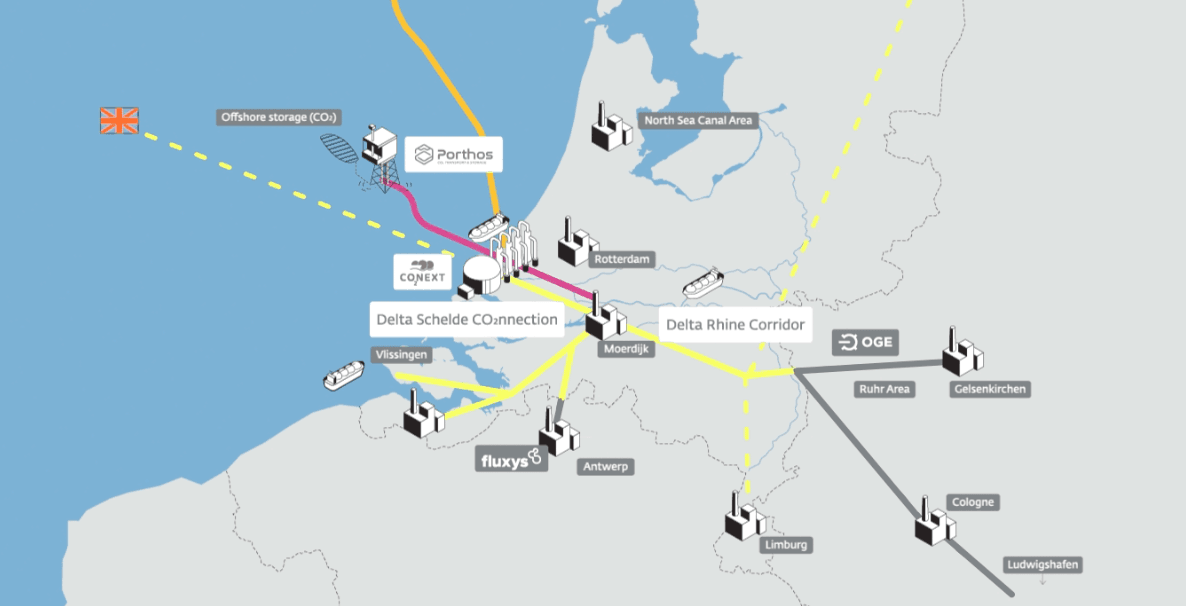
Delta Rhine Corridor © Gasunie
Large demand from DAF requires a different approach
A second cluster around DAF, Eindhoven University of Technology and the High Tech Automotive Campus in Helmond also shows potential, but faces a major challenge: DAF’s hydrogen demand is so large that local production is currently not feasible within the available electricity capacity.
For now, a supply point—where hydrogen is delivered from external sources—appears to be the most realistic option. However, the logistical consequences and societal impact still need to be examined, for instance, regarding transport flows and nitrogen emissions.
Opportunities around Helmond’s Automotive Campus
There are also opportunities around TNO and the Automotive Campus in Helmond. An existing hydrogen supply point is already in place there, and options are being explored to expand this with local production.
One challenge is that there is insufficient space on the TNO site itself for an electrolyser. The Automotive Campus could therefore serve as an alternative location, especially since several potential hydrogen users are already present there.
Limited but useful option near Van Rooi Meat
The fourth cluster—featuring companies such as Van Rooi Meat, Den Ouden Grow Solutions, and Canpack—is technically feasible but has limitations. An electrolyser of about 4 megawatts would only cover part of the hydrogen demand.
Still, such a facility could contribute to the regional hydrogen supply and later connect to the national backbone. In addition, the residual oxygen from the production process could be used locally, for example, at a planned water treatment installation.
No investment decision yet
The study does not yet lead to an immediate investment decision. Instead, the researchers recommend that the next phase should further examine the actual hydrogen demand in each cluster, the willingness of companies to participate, and the technical and financial feasibility.
They also advise investigating the role that temporary supply points could play until connection to the national hydrogen infrastructure becomes possible. In addition, discussions with grid operator Enexis are recommended to explore flexible contract models and the potential role of electrolysers in reducing grid congestion.
If the next steps prove positive, a local hydrogen network in Brainport could become an important stepping stone toward a regional hydrogen economy—well before the major national pipelines are completed.