
Brabant-grown yeast will form the basis of our protein shakes
The Protein Brewery turns mycelium into a fiber- and protein-rich ingredient for sports nutrition.
Published on October 21, 2026
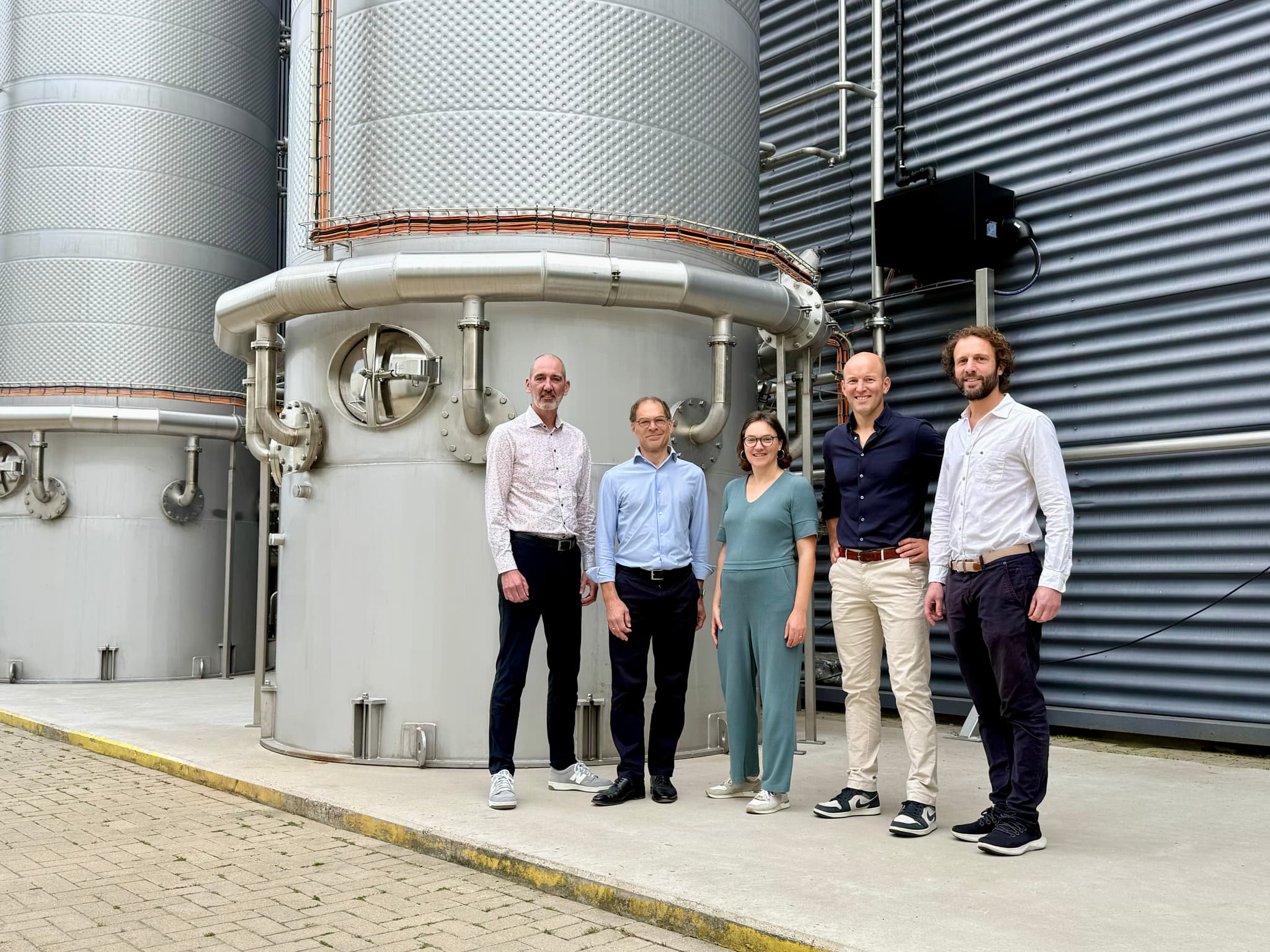
The Protein Brewery's team at the plant

Our DATA+ expert and Editor-in-Chief, Elcke Vels, explores AI, cyber security, and Dutch innovation. Her "What if..." column imagines bold scenarios beyond the norm.
Amid the fields of Brabant filled with wheat and other traditional crops, The Protein Brewery in Breda is working on a futuristic food source. There, mycelium is processed into a protein- and fiber-rich powder for use in sports nutrition. The company recently received approval to enter the European market. Reporter Elcke Vels took a look inside the factory in Breda.
When most people think of fungi, they might think of mushrooms or the blue spots on stale bread. At The Protein Brewery, they form the basis for a valuable ingredient: Fermotein®. “Here, we cultivate a selected fungus in fermenters and process it into a special ingredient,” explains CEO Thijs Bosch. In Breda, Bosch and his colleagues give us a warm welcome. On the table are various products that incorporate the mycelium-based ingredient. This immediately demonstrates just how versatile the ingredient can be.
The ingredient, containing 50% protein and 30% fiber, can be incorporated into a wide range of foods, such as protein shakes and bars. Of course, we’re already familiar with whey-based products like these. Mycelium offers a nutritious, plant-based alternative.
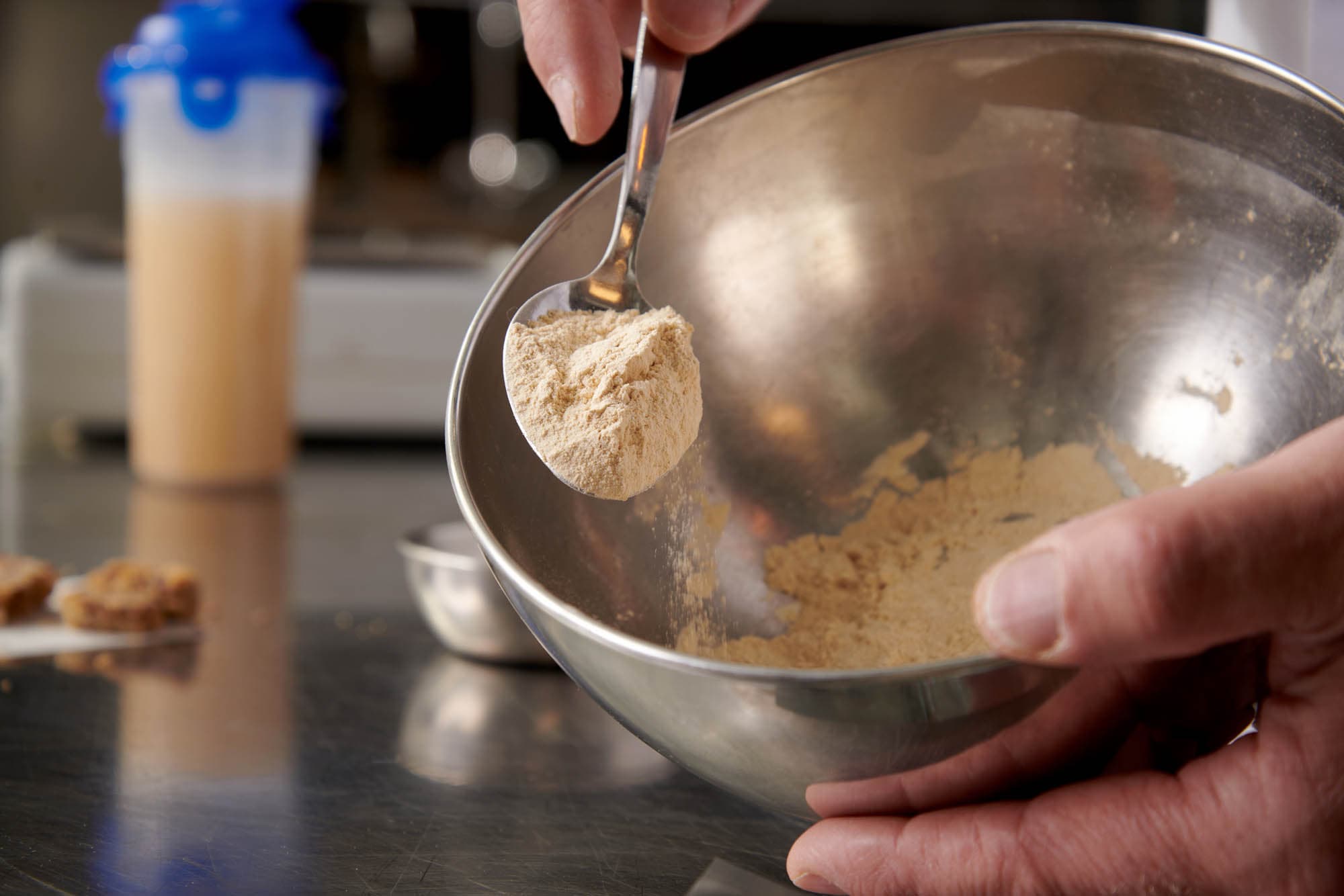
Fermotein®
Put on your helmet, put on your shoes
At the factory in Breda, it’s not just talk. Put on your helmet, put on your special shoes, and off we go. What strikes me most as we walk across the factory floor are the large fermentation tanks in which the mycelium is grown. We walk over to them and learn all about them. Oxygen and sugar are fed into the tanks through tubes. The mycelium is tapped from the bottom. We’re told that cultivation happens at a rapid pace. It takes about eight to twelve hours for an 85,000-liter fermentation tank to fill with mycelium.
During the tour, we learn that The Protein Brewery plans to scale up significantly. Two production units are currently operational in Breda. Eventually, the company aims to deploy six fermenters. This scaling up is urgently needed. The company has already been authorized to sell Fermotein® in the United States and Singapore, and recently received approval for the European market as well.
Thousands of microorganisms studied
The foundation for the product was laid as early as 2017, three years before The Protein Brewery was founded by Wim de Laat, Bosch explains. “We selected this strain from more than 100,000 different types. We chose this strain because it has the most neutral taste, is the most soluble, and is relatively easy to produce and process.”
Lately, we’ve been hearing a lot in the news about how AI can help analyze DNA, cells, viruses, and fungi—and even discover new variants. So I decide to ask him whether AI played a role in selecting such microorganisms. “All of this happened before the rise of AI. The fungal strain was selected in 2017. With AI, you could, of course, have carried out this kind of research much faster today.”
The benefits at a glance
Fermotein® combines a high protein and fiber content with a relatively low environmental impact. Its production requires little farmland, utilizes a byproduct from sugar production, and consumes little water—which, moreover, can be reused. According to initial results, CO₂ emissions are slightly lower than those of plant-based proteins and significantly lower than those of animal-based proteins. The ingredient may also offer health benefits. In one study, worms fed a fermented fraction lived 22 percent longer. Further research is needed to determine whether this effect also occurs in humans.
Scaling up: the challenges ahead
Expansion of the production facility, entry into the European market: things are moving in the right direction for The Protein Brewery. However, Bosch admits that the production process itself still faces some challenges. One example is the dehydration of the mycelium. “In the tank, the mixture consists of 98% water and 2% mycelium. So we have to remove virtually all of the water. That process isn’t as simple or efficient as we’d like. If we were to build this again, we’d approach it very differently.” Purchasing a new fermenter isn’t enough, after all. The software, the piping, and the rest of the system must also be compatible with one another.
Shutting down the current plant completely to redesign everything from scratch is not an option. The protein company therefore wants to retain the existing location in Breda for both production and further development of the process. Engineers will be able to develop and test new methods there in the future. For further upscaling, the company is looking into a larger production site. “That should make it possible to produce larger volumes more efficiently and profitably,” said the CEO.
Brabant’s protein ambitions
It’s no coincidence that The Protein Brewery is located in Brabant. The province aims to play a pioneering role in the development of new protein sources. The Brabant Development Agency (BOM) helps innovative food companies grow and sees the protein transition as an opportunity to make food production more sustainable. Thijs Taminiau, Senior Project Manager for International Business at BOM: “The world is moving toward more sustainable food systems. Protein is part of that. We need to bring food production into better balance, with slightly less animal protein and slightly more plant-based protein. We believe Brabant can play an important role in this.”
This transition to innovative protein sources also offers Brabant economic opportunities, Taminiau notes. “Brabant has a strong agricultural base, with crops such as potatoes and sugar beets. But to remain internationally competitive, we need to look beyond traditional uses. Other countries can often produce these crops more cheaply. Our strength lies precisely in making smarter use of these raw materials and adding higher value to them. Through innovation, we can turn them into new ingredients, proteins, and other high-value products. In this way, we create more added value for growers, processors, and the Brabant economy.”
The BOM is investing heavily in companies that are accelerating the protein transition. For example, the development agency has invested in The Protein Brewery and Revyve.
No shortage of ambition
The Protein Brewery’s agenda is packed for the coming years. A third fermenter is scheduled to be installed in Breda in early 2027. At the same time, the company is searching for a location for a larger factory and aims to conquer the European market. There’s no shortage of ambition. The company has already raised a total of 70 million euros.
After my visit to Breda, one thing became clear to me: the story of The Protein Brewery has only just begun.