
Biocomputing, neurocomputing: the future of computing
In the Tech Trends 2026 report, experts outline a number of new ways of computing.
Published on December 30, 2025
.png&w=2048&q=75)

Our DATA+ expert and Editor-in-Chief, Elcke Vels, explores AI, cyber security, and Dutch innovation. Her "What if..." column imagines bold scenarios beyond the norm.
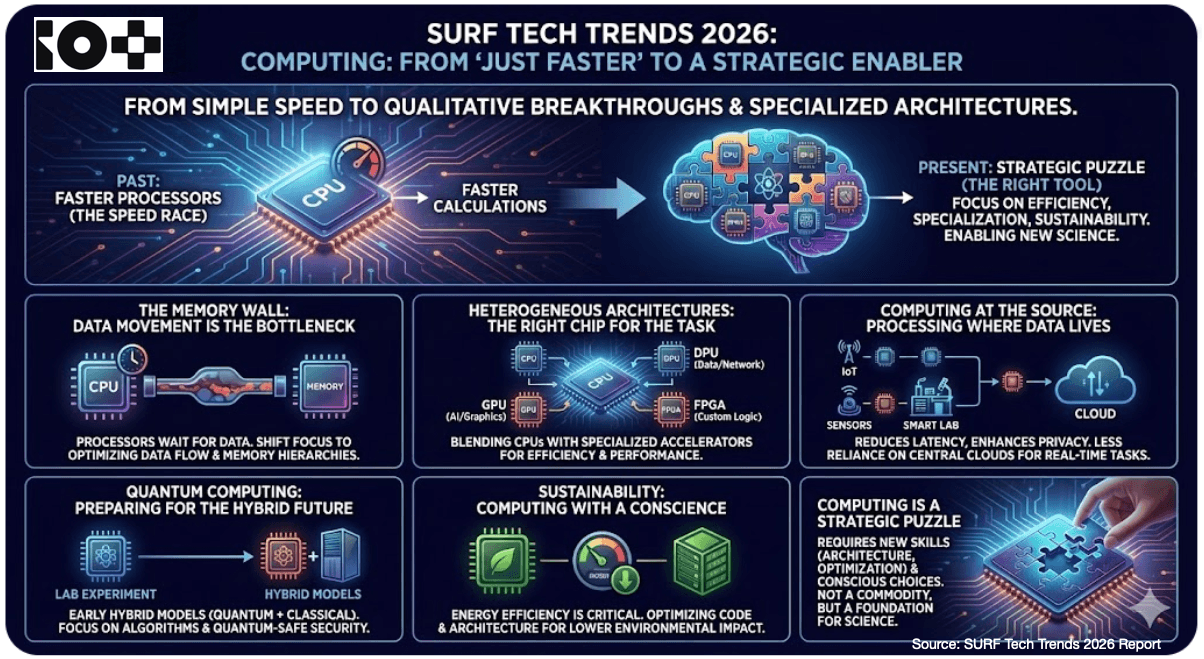
Our society is using increasingly advanced computing power. We need it, for example, to develop personalized medicines or to predict the consequences of climate change. Above all, we need more and more computing power because of the rise of AI. This is a major challenge because traditional computers are reaching their limits. That is why we need innovation in computing. With the help of new technologies such as biocomputing, photonics, and neuromorphic computing, we will be able to compute much more efficiently in the future. In the Tech Trends 2026 report, experts outline a number of new ways of computing. We highlight three of them.
Tech Trends 2026
The Tech Trends Report 2026 is a biannual publication based on international trend studies and market reports, enriched with insights from experts from and around the SURF cooperative. In ten episodes, IO+ and SURF look ahead to the most important technological developments of the coming year.
Neuromorphic computing
Neuromorphic computing is an innovative way of computing that is inspired by the human brain. Instead of traditional digital circuits, these systems mimic neurons and their connections, enabling them to perform certain tasks much more efficiently. This can save energy, especially for AI applications: studies show that consumption can be 10 to 1000 times lower than with conventional computers.
In 2024, neuromorphic supercomputers such as Spinnaker 2 (Germany), Intel's Halapoint (US), DeepSouth (Australia), and Darwin Monkey (China) demonstrated what is possible: they contain more than a billion artificial neurons. Education in this field is growing in the Netherlands; universities are expanding programs to train new experts in neuromorphic computing and engineering. In addition, companies such as SpiNNcloud, Synthara, Axelera AI, and Innatera are making it clear that this technology is slowly shifting from academia to industry, where it is finding applications in AI and in-memory computing.
The future of biocomputing
Biocomputing is a new way of computing that uses living cells instead of traditional computer chips. Biocomputing uses biological elements such as DNA, proteins, and cells to process information at the molecular level, resulting in parallel processing and higher energy efficiency.
The idea is still in its infancy, but researchers see great potential in it. Consider, for example, modified bacteria, such as E. coli, that can perform simple calculations. Biocomputing can help speed up the discovery of new medicines, improve our understanding and detection of diseases, and study complex ecosystems.
For example, researchers at MIT programmed E. coli bacteria to display the numbers 0–9 with fluorescent light. This shows how living cells can process information as mini biocomputers.
Photonics in computing
In addition to biocomputing, photonics is also gaining ground as an alternative to traditional computer technology. In photonic computing, information is processed using light rather than electrical signals. This makes it possible to move and process data much faster, with less energy loss and hardly any delay.
An important advantage of photonics is that light can be easily split. This allows many calculations to take place simultaneously. Patty Stabile of Eindhoven University of Technology points out that each light beam in a photonic system can be seen as a separate calculation. This makes photonic chips particularly suitable for heavy computing tasks, such as AI and data processing, where speed and energy efficiency are becoming increasingly important.