
Beyond the chatbot: Real world is the ultimate physical AI test
Bringing AI out of the digital realm and into the physical world is not only possible, but the essential next frontier.
Published on April 18, 2026
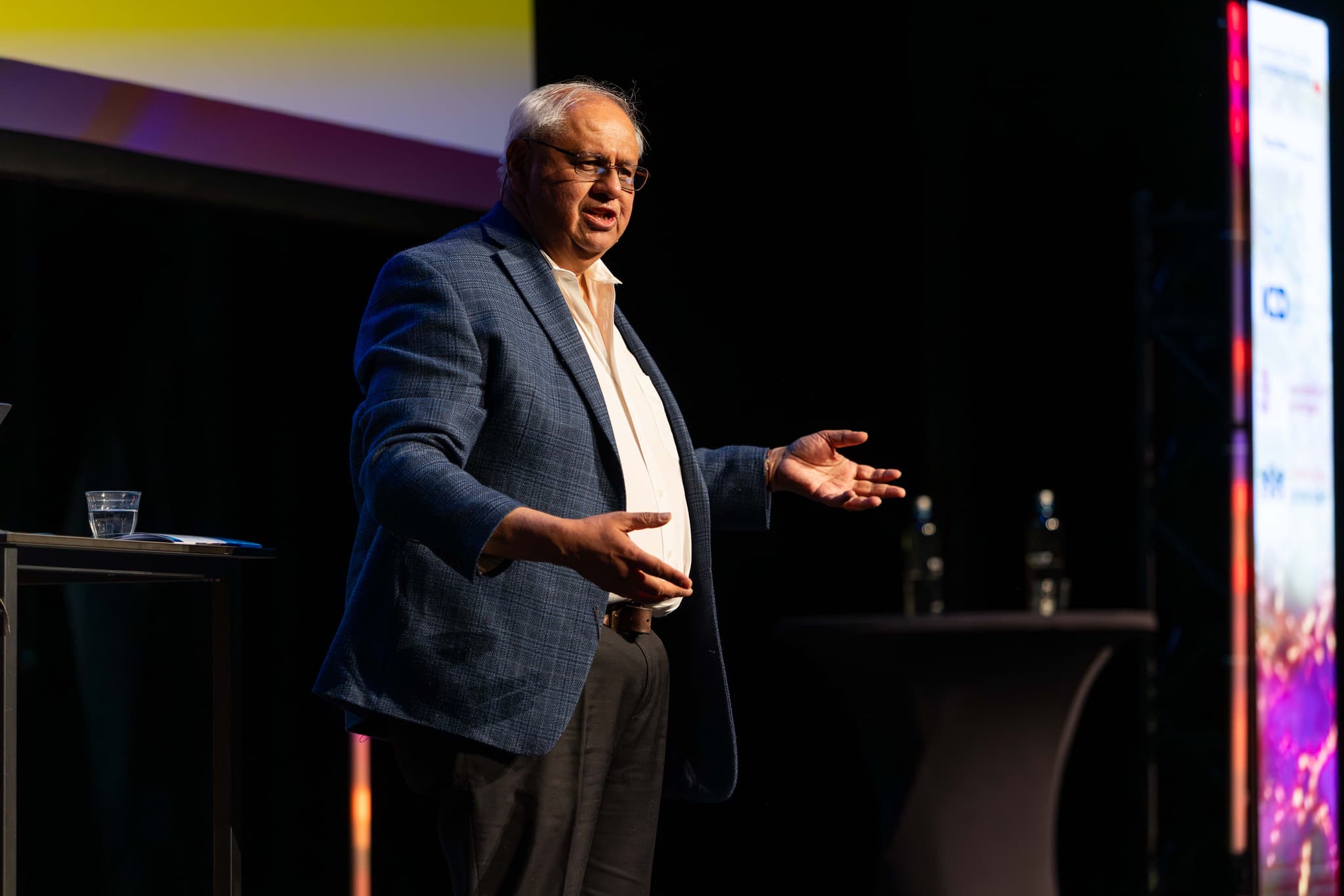
Professor Shankar Sastry, UC Berkeley, NCAS 2026 © NCAS

Bart, co-founder of Media52 and Professor of Journalism oversees IO+, events, and Laio. A journalist at heart, he keeps writing as many stories as possible.
At the Nationaal Congres Autonomous Systems (NCAS’26) in Drachten, Professor Shankar Sastry from UC Berkeley delivered a keynote on building trustworthy autonomous systems. As a globally recognized pioneer in cyber-physical systems and control engineering, Sastry’s message cut through the current generative AI hype: making AI work in physical environments is fundamentally different, and significantly harder, than generating text on a screen.
The unforgiving physical world and Moravec's paradox
Sastry starkly reminded the audience that "the physical world is much more unforgiving than a chatbot". If a large language model hallucinates, a user can simply hit refresh, but if a physical robot makes an error, it can destroy highly expensive hardware, cause critical operational failures, or even cost lives.
He illustrated this challenge through Moravec's paradox, the observation that high-level reasoning requires very little computation, but low-level sensorimotor skills require enormous computational resources. We can teach a robot to do a backflip or a kung-fu kick, but programming a humanoid robot to reliably execute a "simple" task like opening an unfamiliar door or grasping an everyday object remains one of the hardest problems in engineering.
The 40-Watt brain: "The mind exists to control the body"
To emphasize why grasping and physical interaction are so complex, Sastry invoked the ancient Greek philosopher Anaxagoras, who stated in 500 BC that "the mind exists to control the body". He pointed out that in human beings, a disproportionate 40% of the brain's motor cortex is dedicated exclusively to the hands and face. The brain’s most intense computational tasks revolve around physical manipulation, yet the human brain accomplishes all this while consuming a mere 25 to 40 watts of power: a stark contrast to the massive, energy-hungry GPU clusters required to train modern AI.
Pushing the limits: autonomous racing and disaster relief
To solve these real-world challenges, Sastry’s research involves pushing AI algorithms to their absolute limits. One high-octane example is his team's participation in the Indy Autonomous Challenge. Here, fully autonomous 500-horsepower race cars, packed with LiDAR, radar, and cameras, race against each other at speeds up to 150 mph. The hardware for every team is identical; the competition is purely a battle of AI software algorithms reacting in real-time.
Sastry also demonstrated how competitive multi-agent game theory, originally designed for "hide and seek" drone swarms, is being adapted for Humanitarian Assistance and Disaster Relief (HADR). During events like the Los Angeles wildfires, autonomous drones can be deployed to locate victims and guide them safely out of danger. Crucially, Sastry’s models factor in the unpredictable behavioral dynamics of human panic, ensuring the drones can effectively lead evacuees who might not act rationally.
Neurosymbolic reasoning: The path to trust
For these systems to operate safely alongside humans, they require strict certification and trust. Sastry advocates for a hybrid approach called "neurosymbolic reasoning". By combining traditional, provable control theory (which provides rigid safety boundaries and guarantees) with deep reinforcement learning (which handles unpredictable, non-linear environments), engineers can create physical AI that is both highly adaptable and inherently safe.
This blend of rigorous control and dynamic learning is what allowed Sastry's team to successfully train humanoid robots to adapt to random domains, open doors, and even beat Google DeepMind's robots in an autonomous game of table tennis.
Unlocking the economy
Sastry concluded with a compelling economic reality check. Currently, purely software-based AI is only addressing a fraction of the tasks available in the global economy. Without advancements in "Physical AI" - the ability to put intelligence directly into autonomous systems and machines - the economic impact of AI will hit a rigid ceiling. Sastry's work at UC Berkeley proves that bringing AI out of the digital realm and into the physical world is not only possible, but the essential next frontier.