
Belgium’s largest battery park officially opens in Navagne
150 MW battery storage facility in Wallonia strengthens grid stability and supports renewable energy.
Published on September 5, 2026
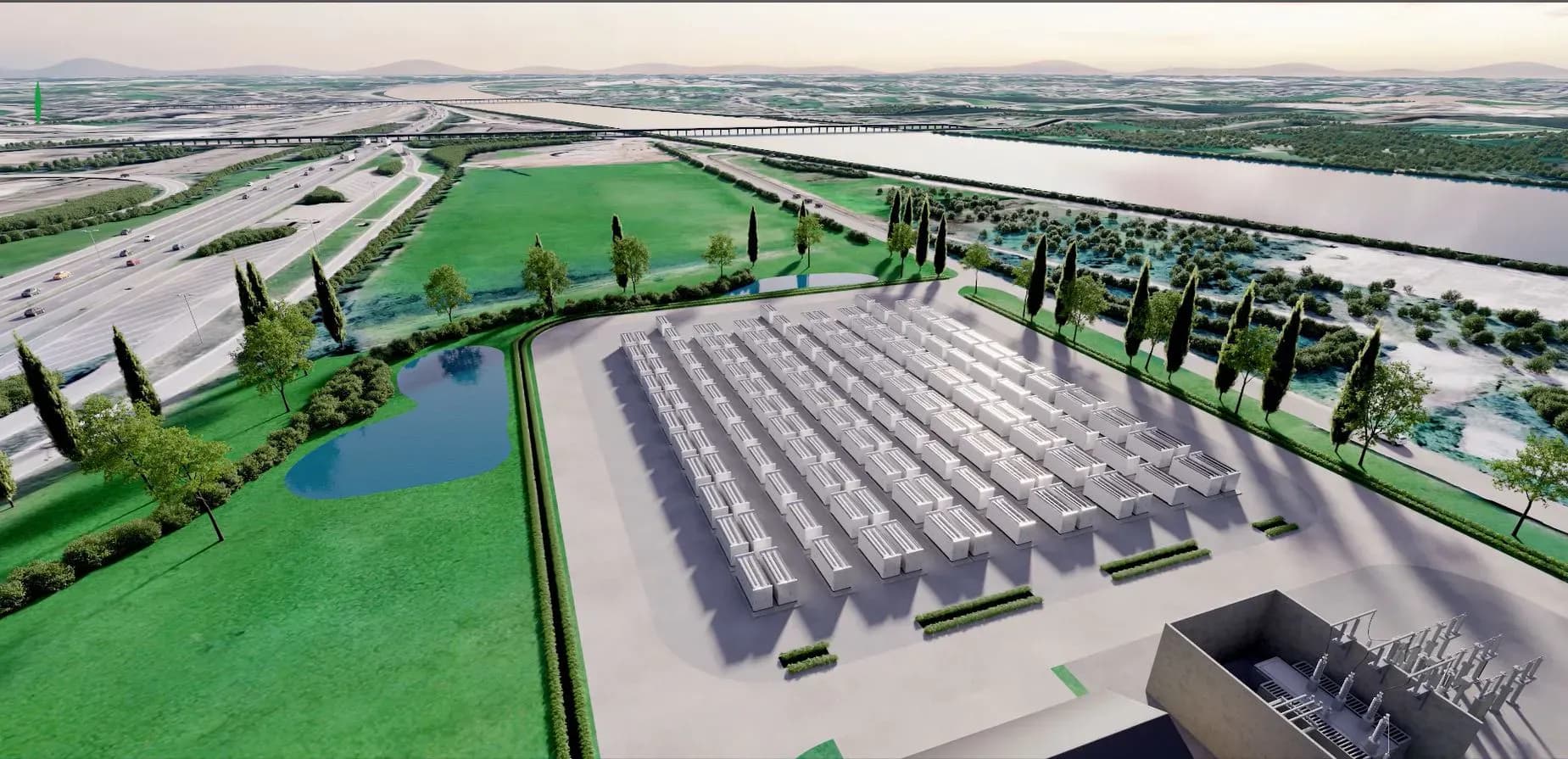
BESS © Luminus

Team IO+ selects and features the most important news stories on innovation and technology, carefully curated by our editors.
Belgium’s largest battery storage facility was officially commissioned this week in Navagne, near Visé in Wallonia. The 150 MW/600 MWh Navagne Battery Energy Storage System (BESS), a collaboration between Luminus and the Belgian Infrastructure Fund (I4B), marks a milestone in the energy transition. Representing an investment of €160 million, the project is intended to improve grid stability and accelerate the integration of renewable energy.
Record investment in Wallonia
Developed by Luminus, a subsidiary of the EDF Group, and financed by I4B, the Navagne BESS facility is the largest battery park in Wallonia, with a capacity of 150 MW and storage capacity of 600 MWh. The installation can supply electricity at full power for four hours, equivalent to the annual consumption of 87,600 households. Its 132 battery containers, transported from China by ship, are directly connected to the high-voltage network operated by Belgian grid operator Elia. Newelec, a Luminus subsidiary, is responsible for the electrical installations and medium-voltage distribution system at 33 kV.
Key role in the energy transition
Renewable energy covered 31% of Belgium’s total electricity demand in 2024, a share that Elia expects to rise to 48% by 2036. The rapid growth of wind and solar power makes large-scale battery storage essential for absorbing surpluses and stabilizing grid frequency. The Navagne project will play a crucial role by storing peak renewable-energy production, helping to prevent grid congestion and price volatility. Federal Energy Minister Mathieu Bihet emphasized that the facility strengthens the flexibility and resilience of Belgium’s electricity system.
I4B’s strategic portfolio
Navagne is the first of four BESS projects financed by I4B. Together, these projects represent 620 MW of power and 2.1 GWh of storage capacity, accounting for approximately 25% of Belgium’s total BESS capacity by the end of 2027. The portfolio represents a total investment of around €600 million, including €160 million for Navagne. I4B acted as Navagne’s sole shareholder and played a central role in structuring the financing. I4B CEO André Autrand said the strategy had gained considerable momentum in less than a year, driven partly by the urgent need for greater grid stability.
Impact on Belgium’s energy independence
The Navagne project contributes to Belgium’s energy security by helping to reduce its dependence on fossil fuels, which currently still account for 80% of the country’s energy consumption. Walloon Energy Minister Cécile Neven described the facility as “excellent news for our energy system,” as it improves the integration of renewable energy and strengthens grid resilience. Grégoire Dallemagne, CEO of Luminus, emphasized that flexibility is central to the company’s #Electrify2030 strategy. Battery storage makes it possible to use renewable energy more efficiently and reduce CO₂ emissions.
Financing and future plans
Backed by leading Belgian institutional investors, I4B has already invested more than €2.5 billion through Fund I in over ten infrastructure projects, including €1 billion in Ghent’s R4WO ring-road project. Fund II, which has a target size of €500 million, reached a first close of €275 million in February 2026 and is now working toward a second close to meet growing demand for infrastructure investment. I4B CIO Samuel de Lhoneux said the funds are focusing on larger projects, potentially in partnership with international investors.
Comparison with other Belgian BESS projects
In addition to Navagne, I4B is working on three other BESS projects that will collectively account for 25% of Belgium’s battery storage capacity. ENGIE, meanwhile, is developing projects in Vilvoorde (200 MW/800 MWh), Kallo (100 MW/400 MWh), and Drogenbos (80 MW/320 MWh). Storm is building two major projects in Ruien (200 MW/800 MWh) and Langerlo (100 MW/400 MWh), representing a combined investment of €330 million. These projects demonstrate that Belgium is one of Europe’s most advanced energy-storage markets, offering opportunities in energy trading, ancillary services, and the capacity market.