
BarionX locates threats with drones, neutron beams, spectral AI
Eindhoven startup unveils its bold detection concept at the Blue Magic Netherlands event.
Published on December 5, 2025
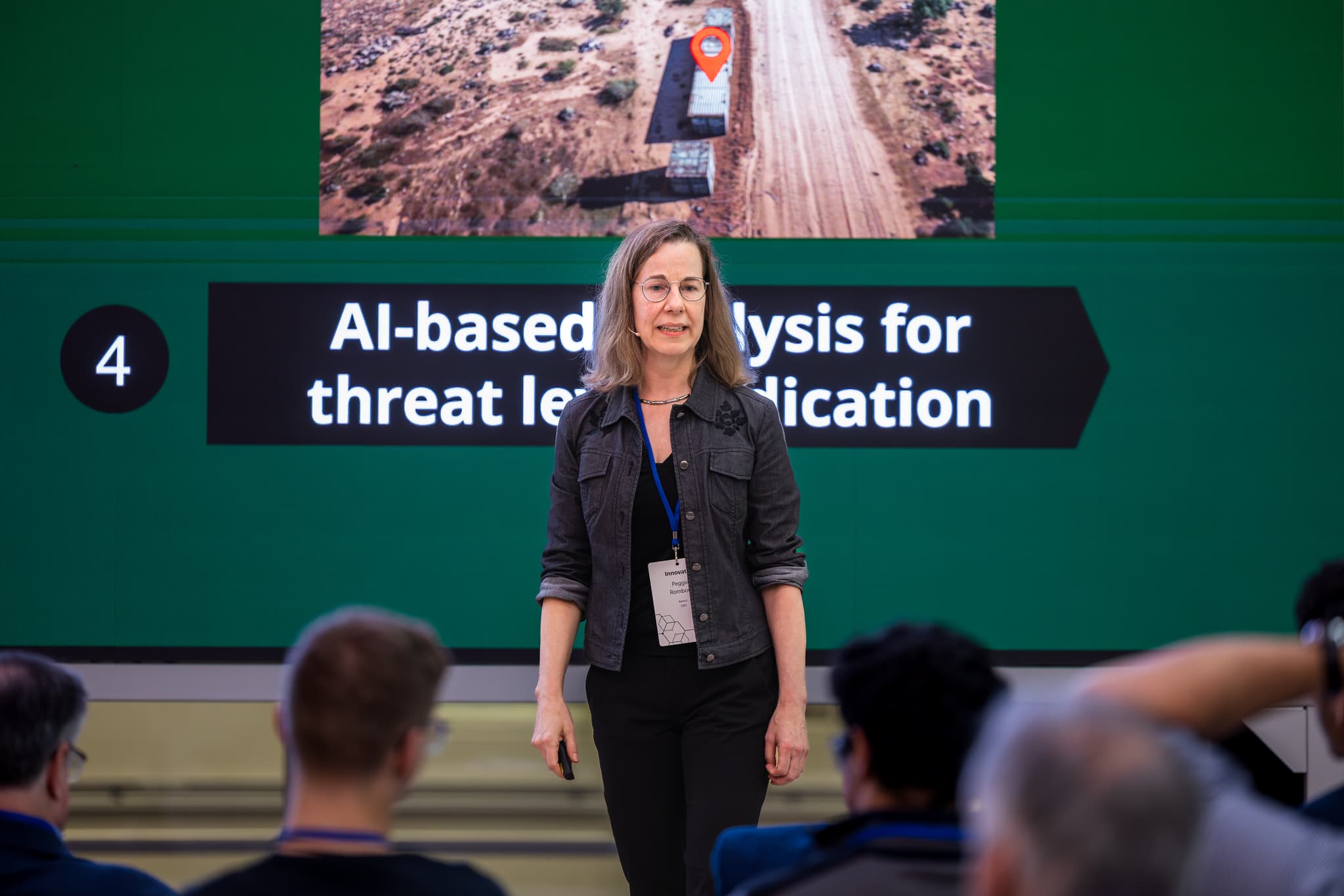
Peggie Rombouts, BarionX © Nadia ten Wolde

Bart, co-founder of Media52 and Professor of Journalism oversees IO+, events, and Laio. A journalist at heart, he keeps writing as many stories as possible.
At the Blue Magic Netherlands event, the crowd had already seen its fair share of ambitious defence-tech pitches. But when Peggie Rombout from BarionX stepped on stage at Melt at Avular in Eindhoven and calmly started talking about drones firing directional neutron beams, the room leaned in.
“Our purpose is simple,” she opened. “Finding the real threats so communities can live in peace.” But the way BarionX wants to get there is anything but simple.
The problem: more threats, fewer ways to see them
Rombouts outlined four headaches that military and security services face today. The demand for surveillance is growing fast, especially along the 4,000-kilometre eastern NATO border. Hostile actors are using decoys and misinformation. And worst of all: current sensors simply can’t look inside closed, metallic objects.
“You see a shipping container,” she said, pointing at the slide. “But what does it contain? We don’t know. LiDAR and radar can’t see through steel.”
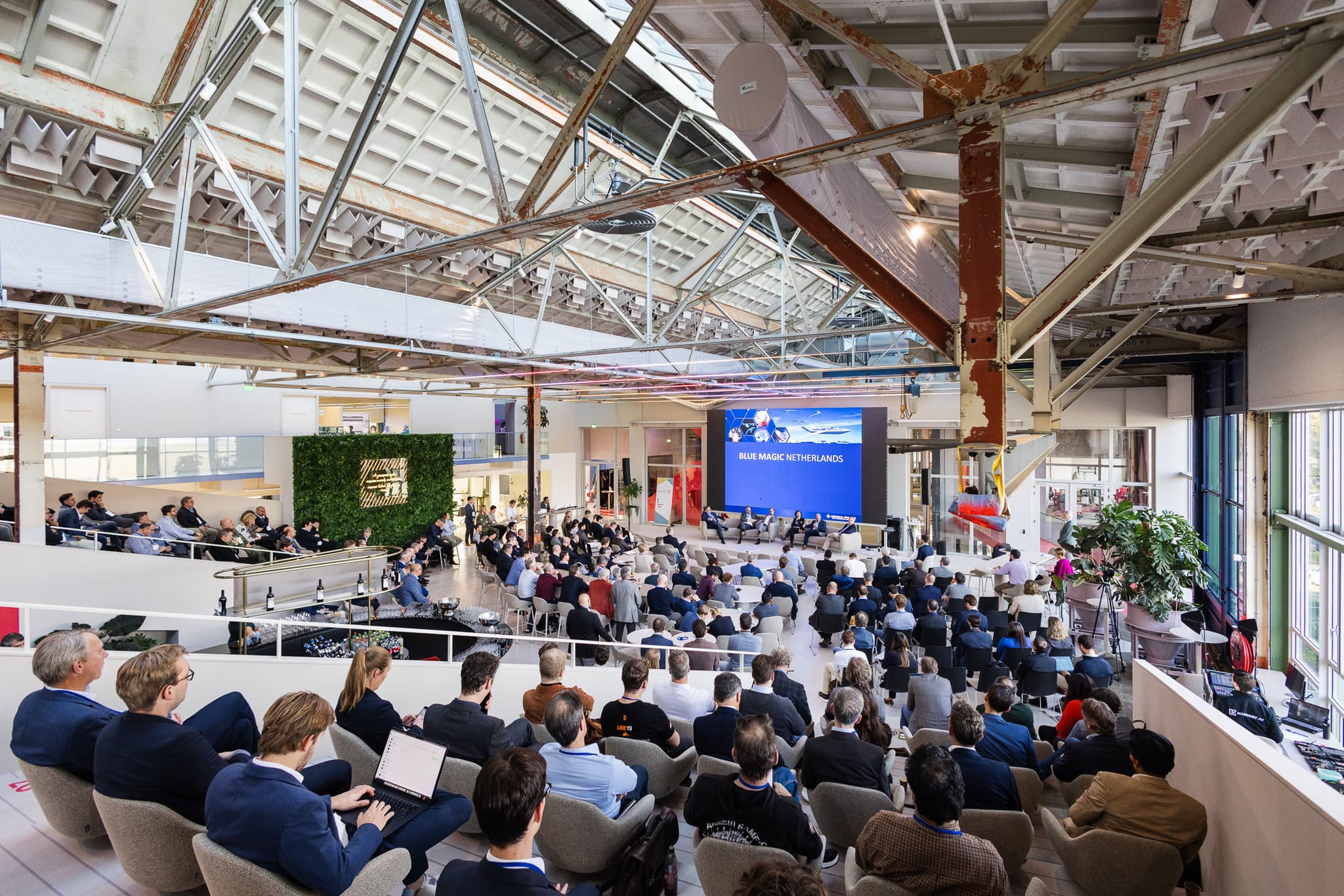
Blue Magic Netherlands
Read our stories about the Blue Magic Netherlands event, focused on innovation in the defense industry.
The idea: scanning containers from the sky
BarionX’ solution sounds like science fiction, but is grounded in real nuclear physics. The concept uses two drones: one equipped with a compact neutron source, the other with a gamma-ray detector.
The source drone fires a directional neutron beam at an object, for example, a container near a border crossing. When neutrons hit material, they trigger material-specific gamma emissions. The second drone picks up those gamma rays and performs AI-driven spectral analysis.
“Spectral analysis gives an indication of the threat level,” Rombout explained. “Does this container hold explosives or weapons? Or is it harmless?”
And they’re not starting from zero. A tech partner has already built a compact 2-meter, 100-kg neutron generator, “basically my size,” Rombout joked, and a stationary TRL4 prototype has successfully identified explosives.
From physics to a flying demonstrator
Turning this into a deployable system will take several steps:
- Proof of principle (approx. €100k) to validate the use case
- Proof of concept (approx. €400k) to build a functioning lab setup
- Demonstrator (approx. €4M) with an operational detector drone
- Minimum viable product (approx. €8M) ready for real-world deployment
“This is where the real investment comes in,” Rombout said. “But also partnerships. We are not drone builders. We deliver the detection system.”
The need for collaboration came up repeatedly during the lively Q&A. Someone asked about drone coordination, another about operation from trucks or maritime vessels. Rombout confirmed: “A vehicle-based version is easier. But today we’re talking about aviation.”
Physics, safety, and practical limits
When questions turned technical, BarionX cofounder Cor Datema joined her on stage. Could the beam reach kilometres instead of hundreds of meters? “In theory, neutrons can travel great distances,” he said. “But in practice, scattering in the air makes long-range use extremely challenging.”
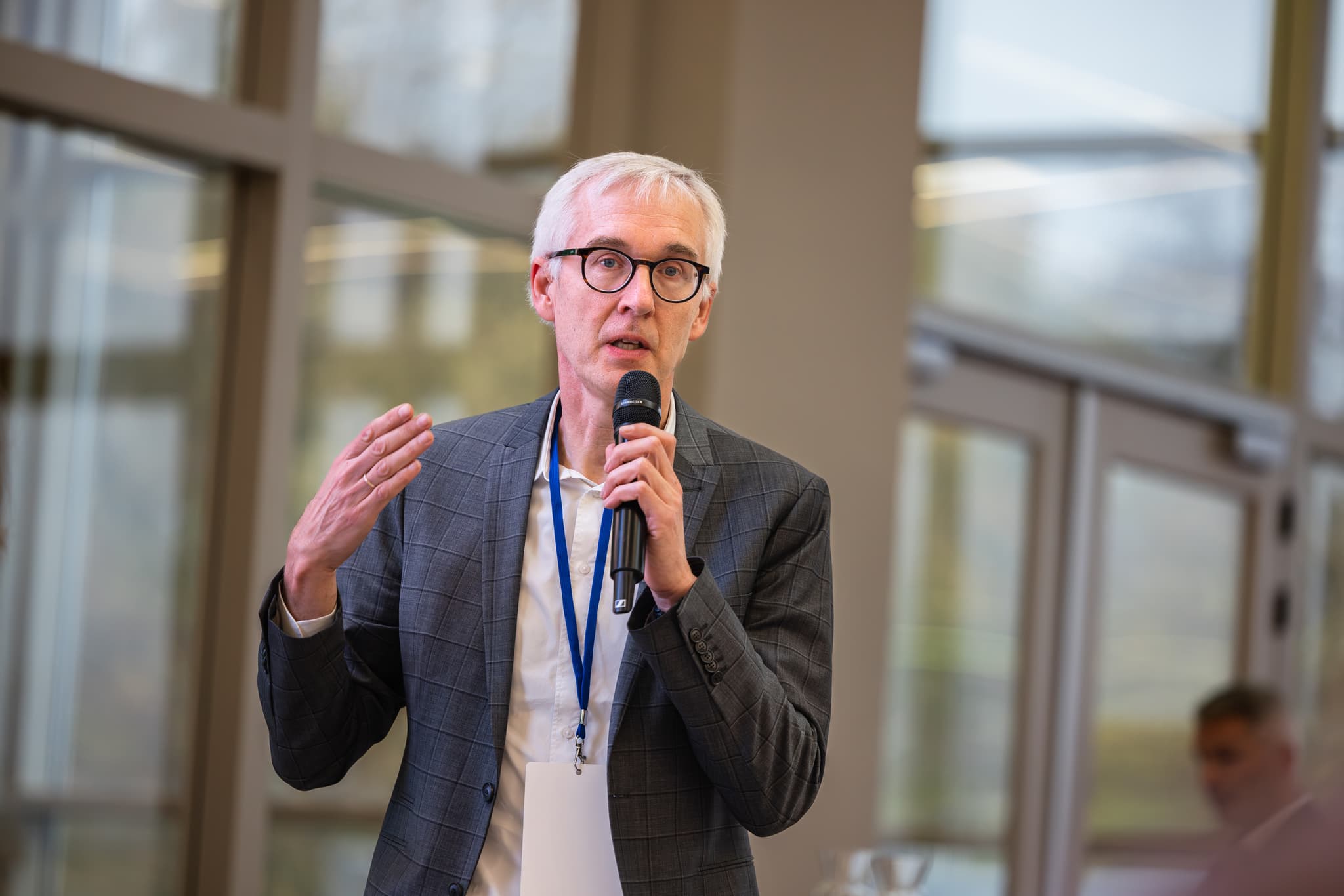
Cor Datema, BarionX © Nadia ten Wolde
What about safety? “Repeated exposure isn’t healthy,” Datema noted. “But a one-off scan at 100 meters is not dangerous. It requires case-by-case risk analysis.”
The system’s neutron beam has a narrow, 10-degree spread, specific to this application. Detecting the beam itself is difficult: “You need a specialized device. Normally, nobody could measure it.”
A heavy-tech team taking a bold step
BarionX is still early-stage, but far from inexperienced. “We’re a tech-heavy team,” Peggie Rombout said. “We bring knowledge of nuclear and particle physics, engineering, and successful venture-building. We’re not starting from scratch.”
Their ambition reaches beyond containers: airborne threats, space applications, even detecting drug boats at sea; “There’s a signature there,” Datema remarked.
But the core mission remains razor-sharp: “There’s no silver bullet,” Rombout said. “But by integrating detection systems - ours included - we can help you find the real threats.”
At Blue Magic Netherlands, BarionX made one thing clear: Eindhoven’s defence-tech ecosystem isn’t afraid to tackle the hardest physics problems if it means making the world a bit safer.