
Aviation in transition: towards a sustainable future
From ambitious goals to technological breakthroughs: the LiT Conference 2026 explores the future of sustainable aviation.
Published on October 14, 2026
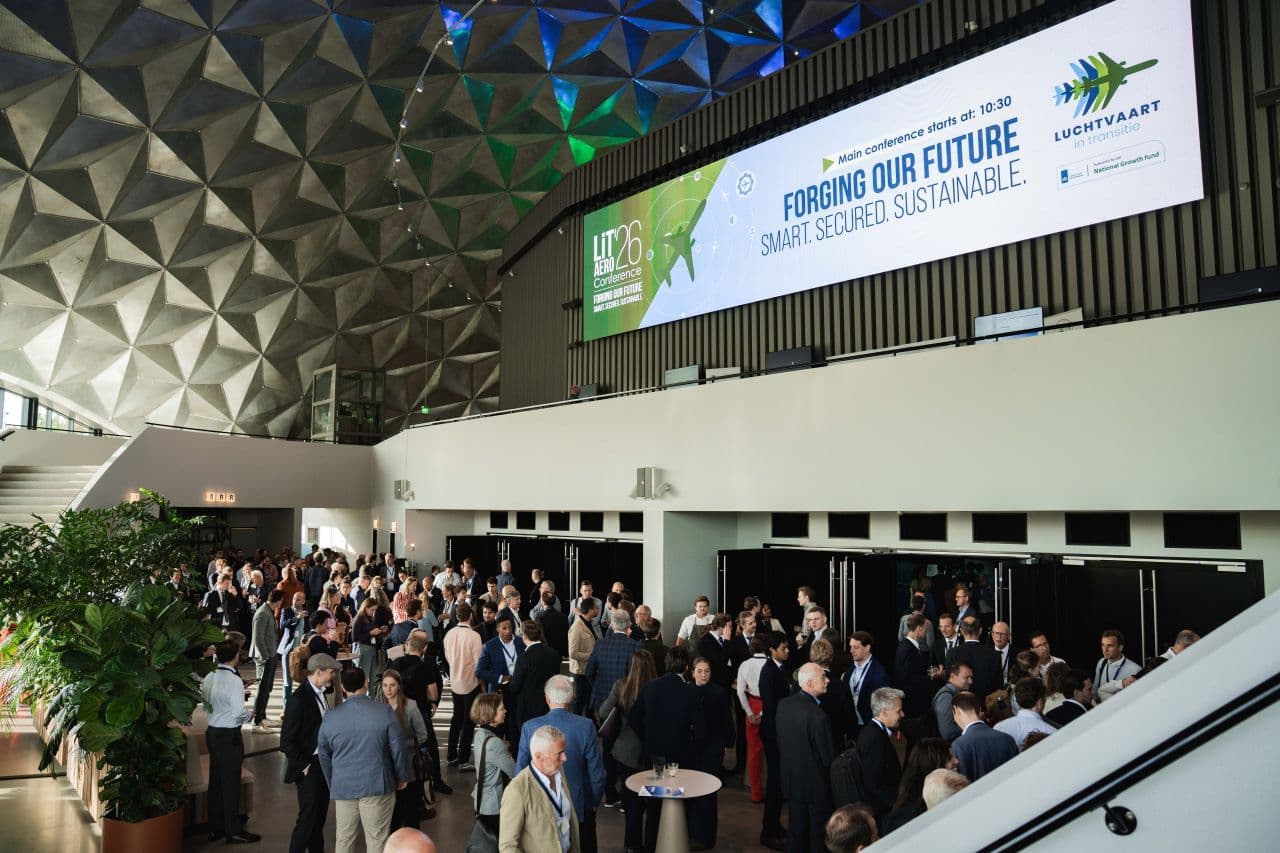
That was the central question at the 2026 edition of the Luchtvaart in Transitie (LiT) Conference. Ron van Manen, managing director of LiT, opened the event in front of more than 500 attendees with a clear long-term goal: a fully emissions-free and geopolitically independent European aviation sector within fifty years.
This ambition set the tone for the researchers, entrepreneurs and industry representatives in attendance. The collective conclusion was clear: technological breakthroughs are crucial, but bringing cleaner aircraft to market requires capital, strategic choices and close collaboration.
“Shoot for the moon”
Diederik Samson, the former Head of Cabinet for the executive vice-president of the European Commission, was the first speaker of the day. He opened the program by sharing his reflections on sustainability in an increasingly complex and geopolitically uncertain world.
Samson identified three major developments that will shape the coming decades: the existential threat of climate change, the unprecedented pace of innovation in green technologies, and the end of European naivety. He called for substantial investment in Europe's own industry and warned companies not to wait passively for new regulations. “Regulation is for the losers,” he stated bluntly. Rather than pursuing marginal gains, as he argued the supermarket sector does, the aviation industry should dare to think big: “Don't look for profit within the limits. Shoot for the moon.”
The valley of death
However, these moonshots come with significant financial and organisational challenges, as a panel discussion on ‘aviation's next unicorn’ made clear. A unicorn is a privately held startup valued at over $1 billion. Many startups fail in what is known as the valley of death: the phase in which development requires substantial funding while revenues have yet to materialise.
Marloes van Put, venture manager at Netherlands Organisation for Applied Scientific Research (TNO), argued that startups must prepare for this challenge from the outset: “You have to build a company from day one that is prepared for the valley of death. That means your team needs more than just engineers; you need to bring together people with a range of different areas of expertise.”
Daniel Rosen Jacobson, co-founder and CEO at Elysian Aircraft, a Dutch aerospace and technology company, highlighted the funding challenge. Investors often expect results within a relatively short timeframe, whereas aviation development involves lengthy processes. Public-private partnerships and early orders from industry are therefore vital. As the panel summarised: “Ultimately, the best way to finance a company is to generate revenue”, Rosen Jacobson.
Better alignment
To ensure that these innovations are deployed strategically, Paul Eijsen spoke on behalf of the recently merged AeroNL. The Dutch industry association brings together companies and organisations in the aerospace sector to promote collaboration and innovation. Eijsen stressed that the Dutch aerospace industry needs to align more closely with Europe's ambitions: “Now is the time to act.”
According to Eijsen, making the greatest possible environmental impact while achieving economic returns requires clear strategic choices. He pointed to a specific technological direction, focusing on single-aisle aircraft, alongside greater emphasis on dual-use technologies that can serve both civilian and military purposes.
The national LiT programme is already demonstrating the value of this strategic focus. Eijsen cited a recent agreement with Airbus: “If we succeed in getting this particular technology onto the next aircraft, we're talking about €3 billion,” he explained, outlining the enormous potential for the Dutch knowledge economy.
To provide the sector with a more consistent strategic direction, AeroNL announced that it will present a national aviation strategy in 2027, firmly grounded in the principle that “we must focus on the areas where we can make the greatest impact.”
The ‘quad helix’
Vince Sidwell of US industrial giant RTX echoed the international recognition of the Dutch approach, noting that the company has significantly expanded its presence in the Netherlands in recent years. RTX invests in the country partly because of strong government support for R&D and the proximity of institutions such as Delft University of Technology.
In his presentation, Sidwell advocated a more advanced model of collaboration known as the quadruple helix.
“I've added an extra helix. The distinction lies in the OEMs and SMEs,” he explained. In this model, large industrial companies, or original equipment manufacturers (OEMs), take on an explicit mentoring role for small and medium enterprises (SMEs). “OEMs need to act as integrators for startups and SMEs, guiding them, bringing them along and helping them actually get their products to market.”
A world-class achievement on a student budget
The enormous potential of local talent was perhaps best demonstrated during the closing presentation by student team AeroDelft. Student team AeroDelft’s closing presentation was a clear example of young talent’s potential. Students Isha Moharir and Louise Guisset spoke passionately about Project Phoenix, their mission to demonstrate the viability of liquid-hydrogen-powered flight and actively promote its adoption.
Although the team's membership changes completely every academic year, they successfully taxied an aircraft along the runway using gaseous hydrogen in May 2026, becoming the first student team in the world to achieve this milestone.
They emphasised the scale of this achievement given their extremely limited student budget. “We accomplished all of this with less than a fraction of an industrial budget, but with a thousand per cent enthusiasm, motivation and dedication, without taking a single shortcut in how we worked through all these procedures,” they said proudly.
The LiT Conference thus demonstrated unequivocally that, although the sector still faces substantial financial and infrastructure hurdles, the Netherlands' extraordinary drive for innovation is bringing genuinely clean aviation closer at an accelerating pace.