
ASML sees AI influencing every stage: chip design to fabrication
The semiconductor industry is entering what ASML’s CEO describes as a “major race” creating an unprecedented dynamic across the sector.
Published on June 8, 2026

Our DATA+ expert and Editor-in-Chief, Elcke Vels, explores AI, cyber security, and Dutch innovation. Her "What if..." column imagines bold scenarios beyond the norm.
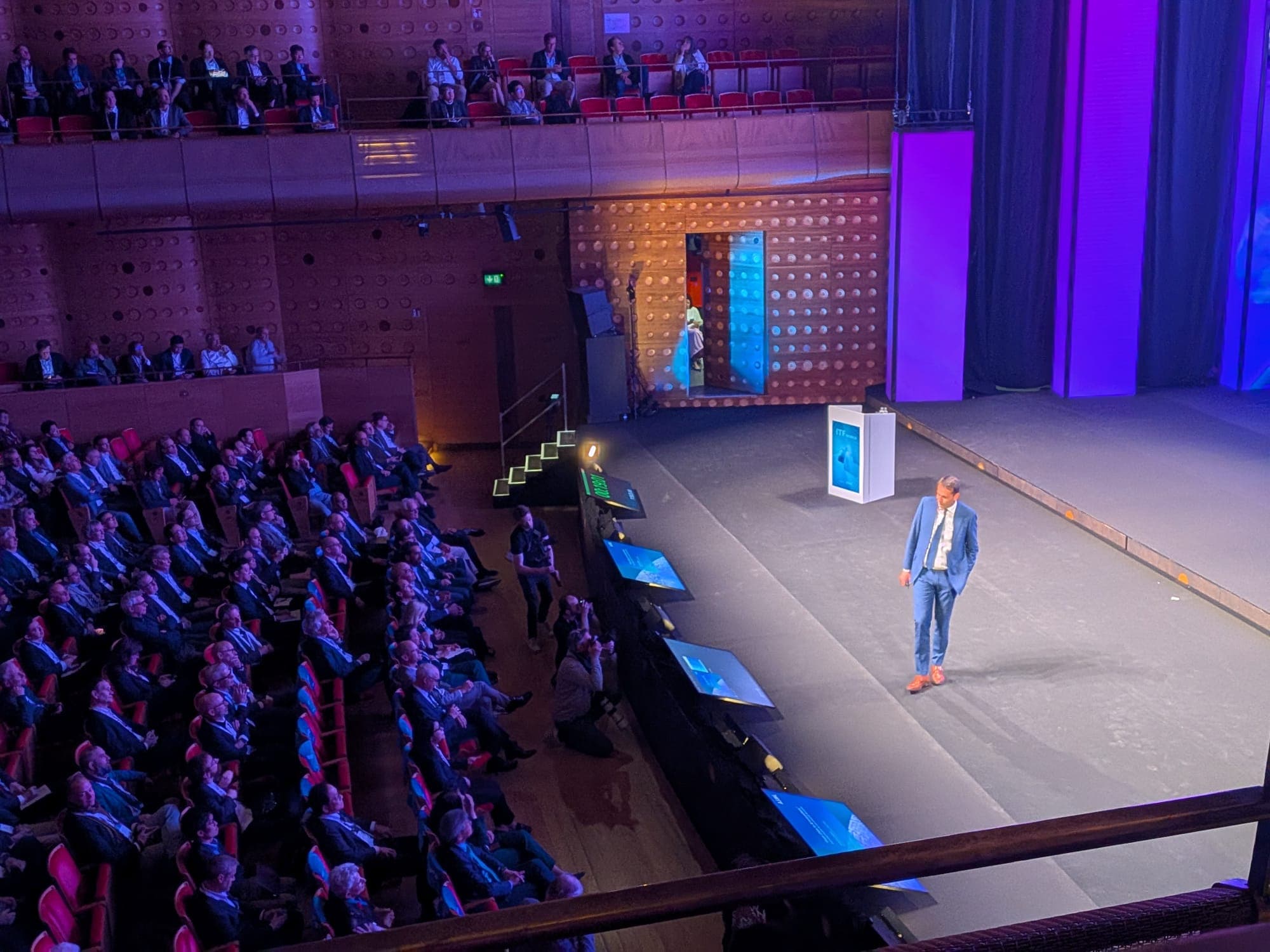
The semiconductor industry is entering what ASML’s CEO describes as a “major race creating an unprecedented dynamic across the entire industry.” At the center of this shift is artificial intelligence. At imec’s ITF World in Antwerp, President and CEO of ASML, Christophe Fouquet, outlined how the company is increasingly applying AI to improve efficiency across its entire value chain — from chip design and engineering to manufacturing operations. He also highlighted the strategic importance of ASML’s partnership with Mistral AI.
AI is reshaping our time more than any other technology. Every major company, and even entire nations, are accelerating investment in AI infrastructure. The scale is unprecedented: trillions of dollars are expected to flow into data centers, compute systems, and advanced chip technologies over the next few years.
Demand for chips is extremely high
But this boom comes with a hard constraint: hardware. The demand for chips — especially for data centers, AI accelerators, and advanced wafers — is high. Fouquet: “We are currently facing demand that is clearly outpacing supply in this industry.” Growth rates that once hovered around 7% per year in the semiconductor industry are now being driven beyond 20% by AI alone. Within just a few years, demand in key segments is expected to at least double.
“So the question becomes: will ASML be the bottleneck?”, Fouquet asks on stage. “And the honest answer is: there is a bottleneck. Because building capacity at this scale, at this speed, has never been done before.” The entire supply chain — from equipment to energy — is under pressure.
Chip design: more and more complex
And in this system, ASML sits at a critical point. The company’s EUV lithography machines are essential for producing the most advanced chips. As chip designs become more complex, EUV usage is accelerating.
A key theme in the CEO’s presentation is that traditional scaling laws — like Moore’s Law — are no longer sufficient on their own. Historically, progress came from making individual transistors smaller and cheaper. But AI has changed the rules. Modern AI chips no longer scale through single-die improvements alone. Instead, they require system-level scaling: multiple chips working together, advanced packaging, and 3D integration. Chips like NVIDIA’s Blackwell already require dozens of lithography exposures per unit, and future generations may require hundreds.
ASML: AI across several key areas
So, “it is essential that the industry succeeds in providing the right capacity, with the right technology, at the right time”, Fouquet continues. AI might be driving demand. But another important shift, he explains, is internal: “ASML is now actively using AI across its own operations”. The technology is set to significantly improve the company’s operational efficiency, with ASML applying AI across several key areas:
- Design and development: AI helps optimize complex lithography system designs and predict performance outcomes earlier in the development cycle.
- Manufacturing: AI is used to detect process variations and anomalies in real time, improving yield and reducing errors.
- Customer fabs: At customer sites, AI systems analyze production data to improve chip quality and efficiency.
- Inspection and defect detection: AI enhances the ability to identify optical, electrical, and surface defects that are too small or complex for traditional methods.
Another major strategic step in this transformation is ASML’s collaboration with Mistral AI. By working with the AI company, ASML aims to build systems that can interpret and optimize its enormous data streams in real time. The goal is to move beyond traditional rule-based engineering and toward adaptive, learning-based systems that continuously improve manufacturing performance. This includes optimizing thousands of machine parameters dynamically, improving throughput, and increasing the precision of lithography and inspection systems.
Economic logic must hold
In the end, Fouquet adds that despite the enormous technological progress happening across ASML, every innovation ultimately comes with a cost. Even in a world defined by extreme complexity and rapid scaling, economic reality cannot be ignored. “Cost remains a key focus. All technologies are designed with cost reduction in mind. No process is designed to become more expensive over time,” he says.
Worlds are intertwined
The overall conclusion of Fouquet’s presentation is crystal clear. In this new era, AI and semiconductor manufacturing are no longer two separate worlds.