
AI-designed smart materials break physics limits
Researchers developed a new class of materials that break the limit of physics, paving the way for new technology applications.
Published on March 9, 2026

© Unsplash

Mauro swapped Sardinia for Eindhoven and has been an IO+ editor for 3 years. As a GREEN+ expert, he covers the energy transition with data-driven stories.
Audio speakers, medical imaging devices, and kitchen lighters, what do they have in common? They all contain so-called piezoelectric materials, a class of materials that can sense pressure and convert it into electricity, or do the opposite, converting electric signals into movement.
For instance, when checking for kidney stones, an electric field is applied to the device's piezoelectric material. As a response, the material generates an inaudible sound wave that then bounces back when it hits a dense object—as a kidney stone, indeed. The bounced-back echo is then absorbed by the same piezoelectric material, helping to create a scan of that patient’s kidney. These materials are instrumental in all of the applications they are used for, yet they are limited.
“Most piezoelectric materials contain lead, a toxic and not environmentally-friendly choice. Moreover, most of these materials are limited by design, meaning that they can only expand, rotate, or twist in a few fixed ways,” underscores Saurav Sharma, a postdoctoral researcher at the Delft University of Technology (TU Delft).
Sharma is the lead researcher on a study aimed at breaking the constraints of these materials, designing better versions that behave in ways previously unattainable. For instance, they can expand and contract in different directions, paving the way for new devices in many fields.
A new approach
Delft scientists' mission was, to this end, twofold: to find more sustainable alternatives and to develop structures easier to customize. Theoretically, piezoelectric materials can work in 18 different ways, yet most of them are restricted to five, with fixed directions. By nature, most of them are brittle ceramics. Accordingly, their very inner structures constrain their movement dynamics in response to a mechanical stimulus.
So the researchers took on a radically different approach: reimagining their architecture from the ground up. Using computational design and AI, they explored millions of possible 3D structures—complex, repeating geometric patterns fine-tuned to exhibit a certain behaviour.
Manufacturing them was the next step. “We created our 3D printing method, developing a material that combines the features of ceramics and the flexibility of polymers—a class of synthetic plastics, ed.---and being both soft and durable. When we printed and tested the structures we previously designed, they turned out to work as predicted,” explains the researcher.
“We’re not just making better piezoelectrics,” Sharma says. “We’re showing that materials can be engineered to do things they’ve never done before.”
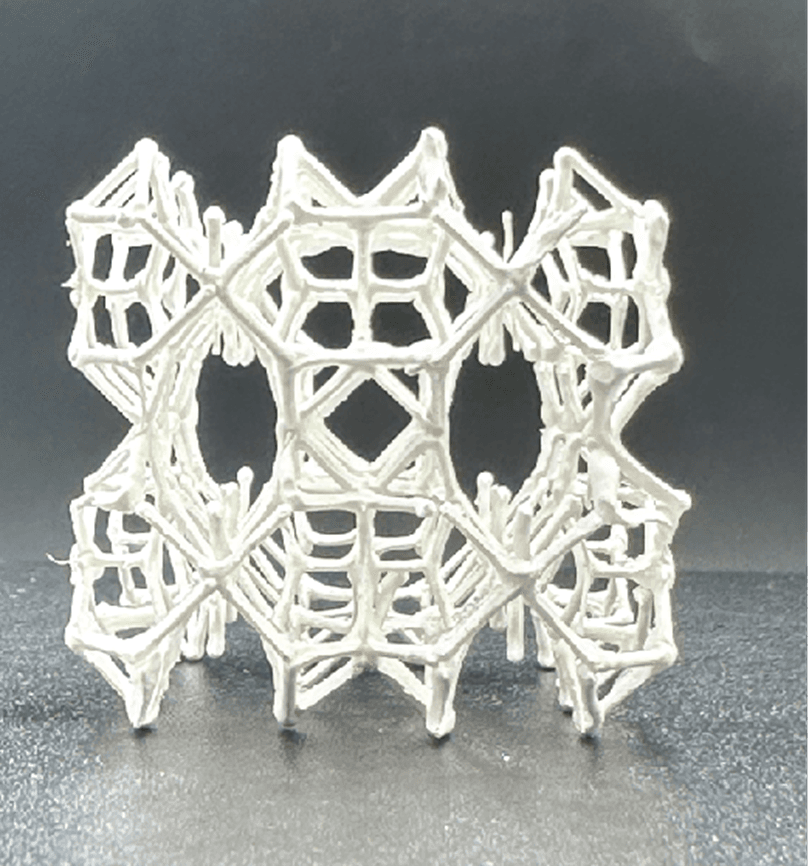
A sample of one of the piezoelectric material - © TU Delft
The advantages
Unlike traditional piezoelectric materials, Delft’s new materials can activate all 18 piezoelectric coefficients, meaning they can convert mechanical stress into electrical signals (and vice versa) in ways that were previously impossible.
For example, they can expand uniformly when stimulated—a rare property called auxetic behavior—or filter out noise by responding to forces in one direction while ignoring others. They also boast 48% higher energy-harvesting efficiency under hydrostatic pressure compared to standard materials like PZT (Lead zirconate titanate), making them ideal for applications where every bit of energy counts. And because they’re lead-free and biocompatible, they open the door to safer medical devices and environmentally friendly technologies.

Saurav Sharma
Postdoctoral researcher at the Delft University of Technology
He is the lead researcher of the study on piezoelectric materials.
Powering technology that doesn’t exist yet
The versatility of these materials means their impact could be felt across industries. In medicine, they could revolutionize non-invasive neuromodulation, enabling precise brain stimulation for conditions such as Parkinson’s disease or Alzheimer’s disease without the need for risky surgeries. The new implants would have properties that better detect brain electrical signals and respond accordingly.
For underwater sensing, their ability to isolate signals and operate efficiently under pressure could lead to smarter hydrophones, more accurate sonar systems, and even self-powered ocean-monitoring devices. By interacting with the forces around them, they could open up to new use cases.
In aerospace, their lightweight yet high-performance nature makes them perfect for self-sensing aircraft components—structures that can detect stress or damage in real time, improving safety and efficiency. And because they’re tunable, engineers can customize their properties for almost any application. “In a way, we are unlocking the path for developing entirely new technologies,” adds Sharma.
Breaking the materials' limits
Now, the scientists' focus will shift towards designing devices embedded with the new materials to understand how they will behave in different scenarios. The researcher doesn’t point to any specific device, as he underscores that all efforts are focused on developing materials that can be customized for real-life dynamic conditions.
Motivations don’t lack. “To me, the most fascinating aspect of piezoelectric materials is their untapped potential. Despite their widespread use, they are hardly tunable. Challenge this assumption, breaking the limits, and designing better materials, keeps driving me every day in my work,” he concludes.