
AI can make everyone work faster. What happens to the team?
At the AI Summit Brainport, Josette Gevers warned that private chats with AI can crowd out the conversations that help teams coordinate.
Published on November 13, 2026
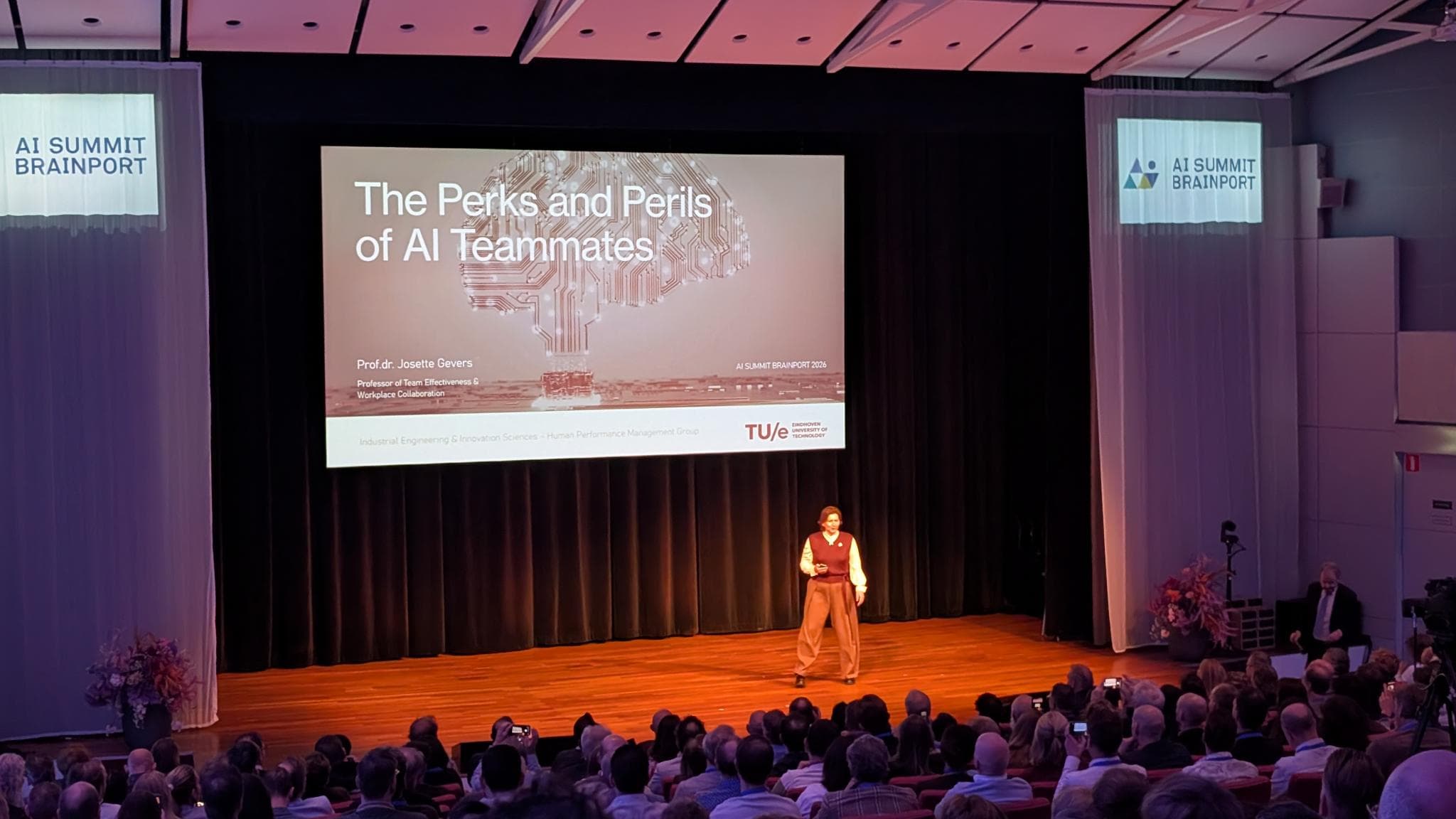
Josette Gevers at AI Summit Brainport

Bart, co-founder of Media52 and Professor of Journalism oversees IO+, events, and Laio. A journalist at heart, he keeps writing as many stories as possible.
Josette Gevers asked for a show of hands at the Evoluon on Thursday. Who was already using AI at work? The response prompted a joke. “End of summit. Let’s go.” Then the Eindhoven University of Technology professor turned to the second half of the summit’s theme, “AI at work. Use it or lose it?” “Lose what exactly?” she asked.
In her AI Summit Brainport keynote, Gevers made the question concrete with two fictional software developers, Bob and Inge. When Bob gets stuck, he would usually ask Inge for help. This time, he asks AI. Inge does the same when she runs into trouble. Each gets a sensible answer and finishes faster. Then they try to combine their work and discover the two solutions are incompatible.
The exchange they skipped would have given them a chance to spot the mismatch early. It’s the kind of conversation that rarely shows up in a productivity measure, even though it can save a team from having to do the work twice. Over time, Gevers argued, asking colleagues for help also builds the trust people need to challenge each other’s thinking.
How do juniors become experts?
Gevers, a professor of team effectiveness and workplace collaboration, sees a similar risk for people just starting out. A junior employee can get a plausible answer from AI in seconds. Developing the judgment to tell whether that answer fits the situation takes longer. It comes from wrestling with a problem, making mistakes and talking to people who have handled it before. A conversation with a senior colleague about what a client values can teach a junior something they’ll need for the next assignment, too.
The third thing Gevers worries about is what teams can figure out together. She used the image of people examining different parts of an elephant. Each can describe the part in front of them. Seeing the whole animal requires comparing what each person has found. Complex problems at work are similar. People in different roles may disagree about the solution because they see different parts of the problem. Working through those differences takes time, and it can change what the team thinks the problem is in the first place.
Without those exchanges, Gevers warned, colleagues can end up on “AI islands,” each with a convincing answer and little idea what everyone else is working with.
Put the chatbot in the team meeting
Gevers pointed to a field experiment at Procter & Gamble in which roughly 800 professionals tackled real product innovation challenges. They worked alone or in pairs, with or without generative AI. On those tasks, individuals with AI performed about as well as pairs working without it. AI also helped people draw on perspectives outside their own specialties. An engineer, for instance, could ask the model to look at a proposal from a marketing perspective. The results Gevers singled out were at the top end of the quality rankings, where pairs using AI had the highest estimated chance of producing a top-rated idea.
Her suggestions for teams start with a practical change. "Write the prompt together. Give everyone a chance to say what context matters, ask questions and refine the request." The discussion about what to ask can reveal that colleagues are working from different assumptions before the model has produced a single line.
Then give AI a role that helps the group think. Ask it to play a competitor, a skeptical reviewer or the devil’s advocate. "Once it responds, review the output together. Each person brings a different kind of expertise to that check. One may spot an unsupported claim. Another may see that a proposal makes sense on paper and would be hard to put into practice. Finally, decide together what to do next. You keep being in charge of the outcome.”
For Bob and Inge, that could start with a conversation about what their two pieces of software need from each other, followed by a shared prompt that makes those requirements explicit. They can still use AI to get to a solution faster. They also get to find out, while they’re both looking at it, whether the solution will work for both of them. In short: with AI as a full team member, the rest of the team can benefit as well. "But keep acting as a real team."