
AI as a travel agency: a good or bad idea?
The series ‘AI as a travel agency: a good or bad idea?’ explores how an AI tool can be used to plan your next holiday.
Published on February 4, 2026

Masterstudente journalistiek aan de RUG, stagiair bij IO+, schrijft graag over de integratie van AI in het dagelijks leven
Everyone sees it on social media during the winter: attractive videos and pictures of warm golden beaches, clear, fresh blue water, delicious-looking local food accompanied by music in a language you don't know. It certainly makes you want to book a nice holiday. Yet for many, this is a major challenge. Where should you go? Which airline should you fly with, or should you drive? Should you stay in a hotel or rent a house? AI tools such as ChatGPT, Gemini, and Copilot can provide answers to these questions, but how useful are they really as travel advisors?
According to research by the ANWB holiday monitor, half (50%) of 18- to 29-year-olds in the Netherlands use AI as a tool to help plan their holidays, compared to one in seven (14%) of those aged 65 and over. For this story, I, Amber van Kempen from IO+, turned to ChatGPT, Gemini, and Copilot to plan a week's holiday in the Netherlands.
Different chatbots generate the same lists
A comparison between ChatGPT, Gemini, and Copilot shows that when the following Dutch query was asked, ‘benoem dingen te doen in Europa’, all three language models provided a handful of suggestions. Gemini and ChatGPT divide their suggestions between topics such as “Classics”, “Nature & Adventure”, “Culture & History”, “Gastronomy”, “Unique Events”, and “Beaches & Relaxation”. Copilot, on the other hand, takes a country-by-country approach and provides suggestions on what to do in certain cities. Copilot, however, mentions only 10 of the 44 UN countries in Europe, including 2 duplicates and 1 unrecognised country. Travellers who rely on Copilot's list could therefore miss out on 77% of the other European countries if they do not do any further research. It is also noteworthy that the three chatbots' suggestions are very similar. For example, the Swiss Alps, the Norwegian fjords, Iceland, the Louvre in Paris, the beaches of the Algarve in Portugal, and Neuschwanstein Castle in Germany are suggested by all three.
Because ChatGPT, Gemini, and Copilot are trained in multiple languages, there is a chance that asking the question in English instead of Dutch will yield different results. With the following statement, ‘Give me things to do in Europe,’ ChatGPT gives the same list as in Dutch; Gemini does not understand the question; and Copilot produces practically the same list and adds three other countries, but it provides less information about the suggested places.
How chatbots generate an itinerary
All three chatbots were asked to make a plan for a week's holiday in the Netherlands and came up with almost exactly the same plan. Without specifying any personal interests, budget or travel preferences, the plans look as follows.
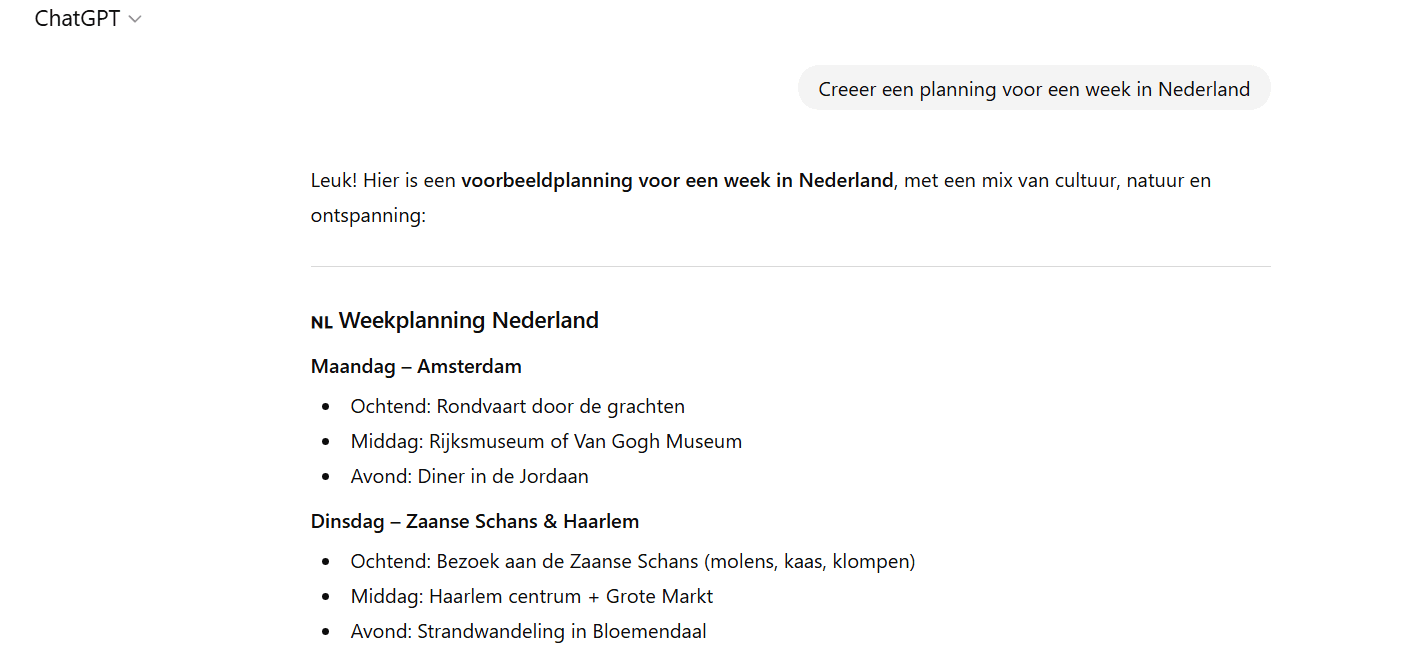
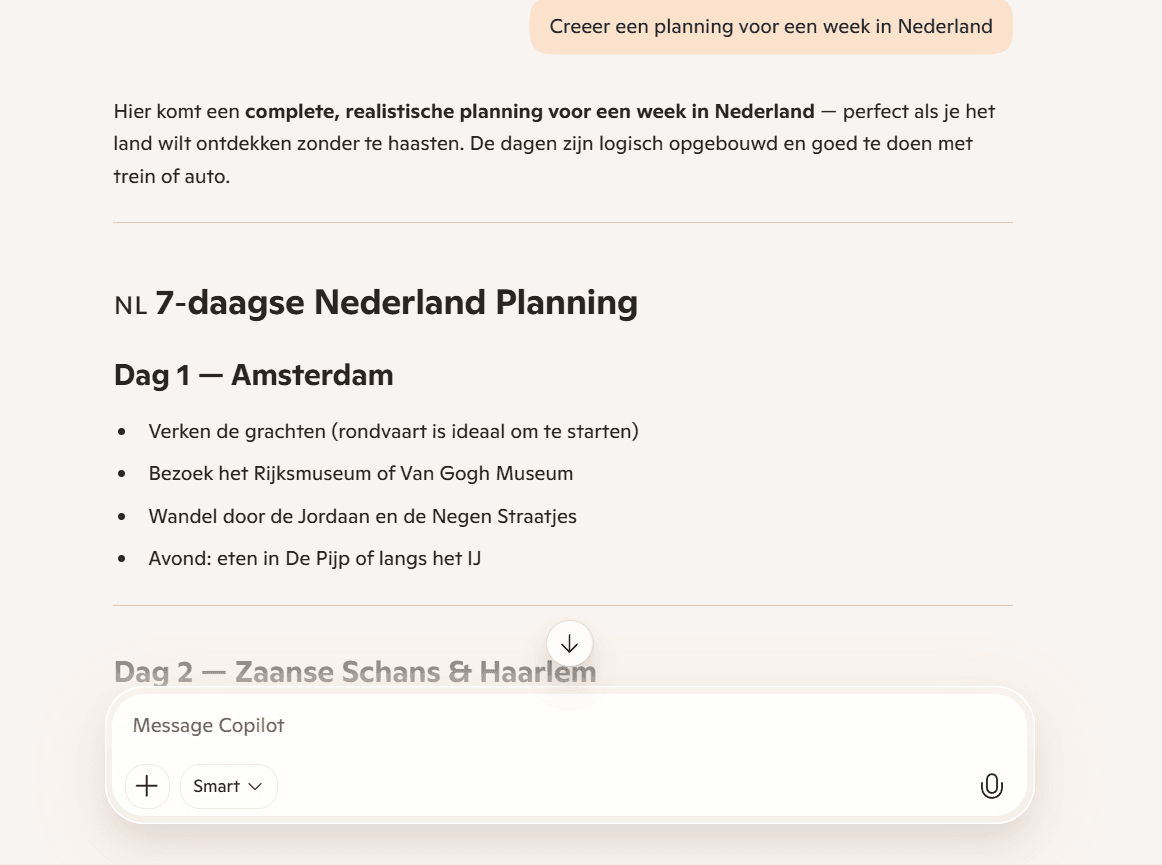
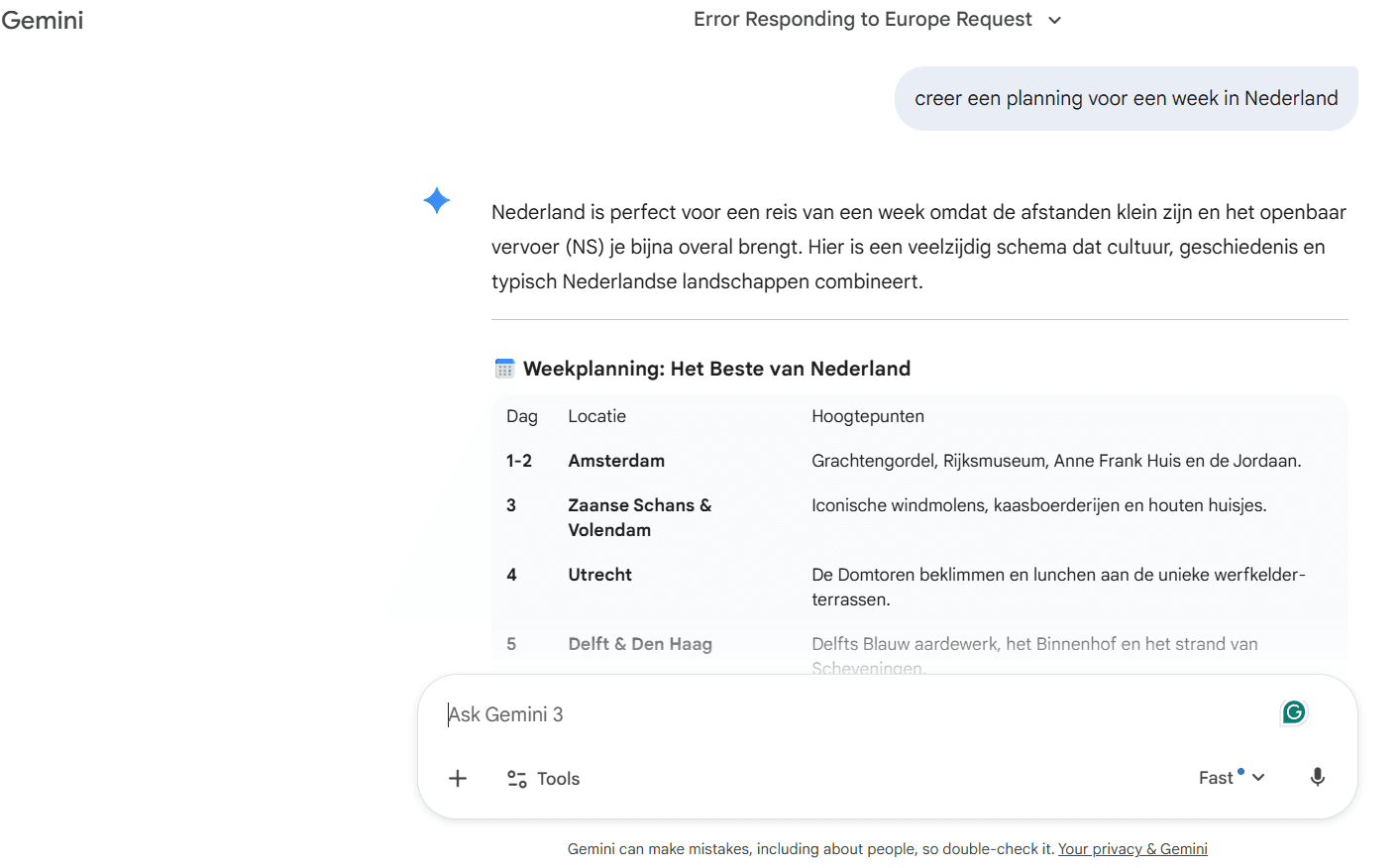
On day 1, Amsterdam is explored by means of a canal cruise, strolling around Dam Square, the Jordaan and the 9 streets. Though, no reason is given as to why these areas have been suggested. Next, there is a visit to the Anne Frank House. Here, the importance of booking in advance is pointed out. The day ends with dinner in the Jordaan or De Pijp.
On day 2, the plan is to visit the Rijksmuseum and the Van Gogh Museum. This is followed by relaxation in the Vondelpark and an evening on Leidseplein or Rembrandtplein. However, it is not mentioned whether there is anything to do on these squares.
For Day 3, the suggestion is to go to the Zaanse Schans in the morning for windmills and cheese. Then on to Haarlem for the Grote Markt and the Frans Hals Museum. The day ends at the beach in Zandvoort or Bloemendaal.
Day 4 takes you to the canals of Utrecht and the Dom Tower. You will also visit Kasteel de Haar and have dinner on the canals.
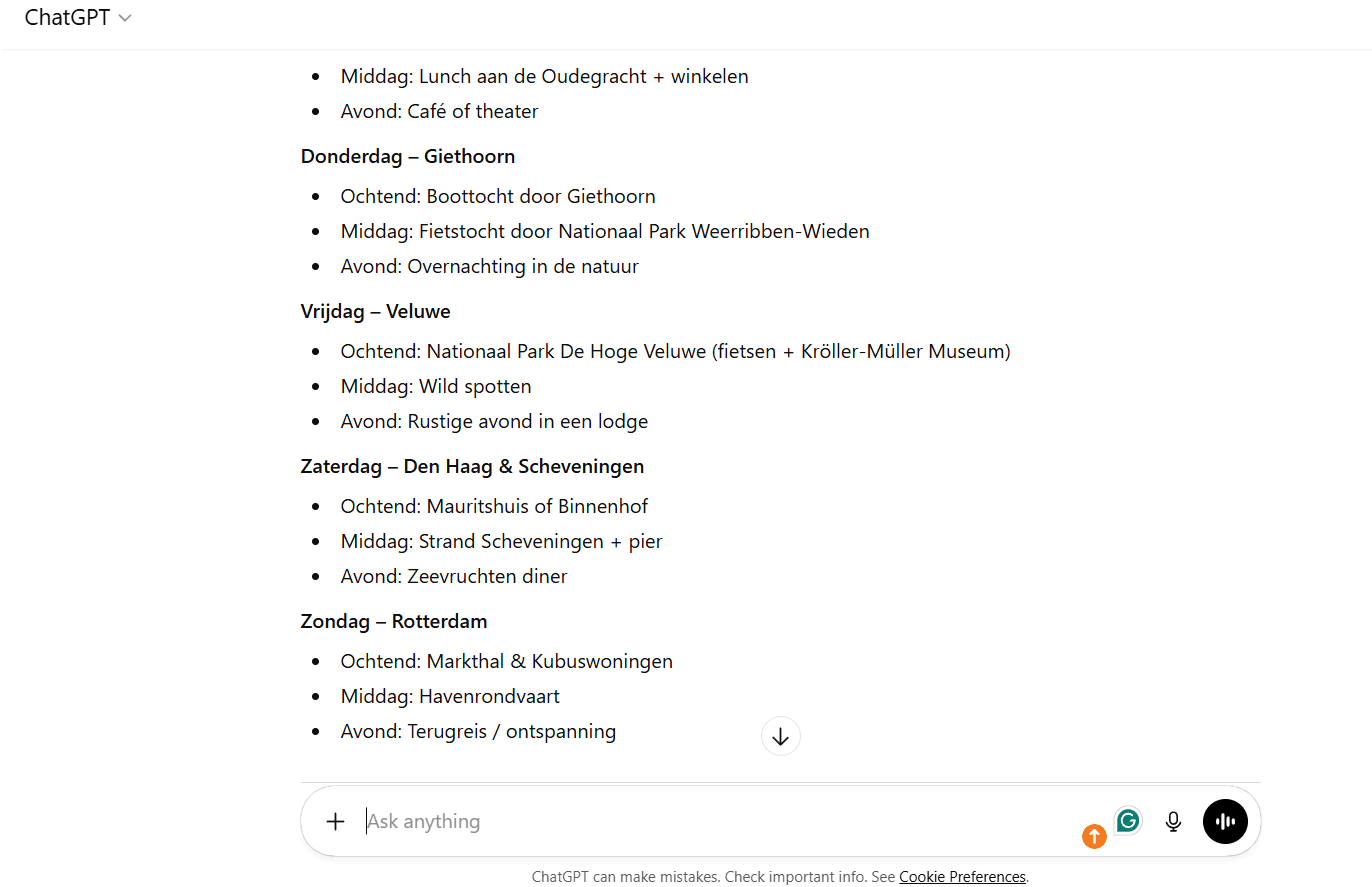
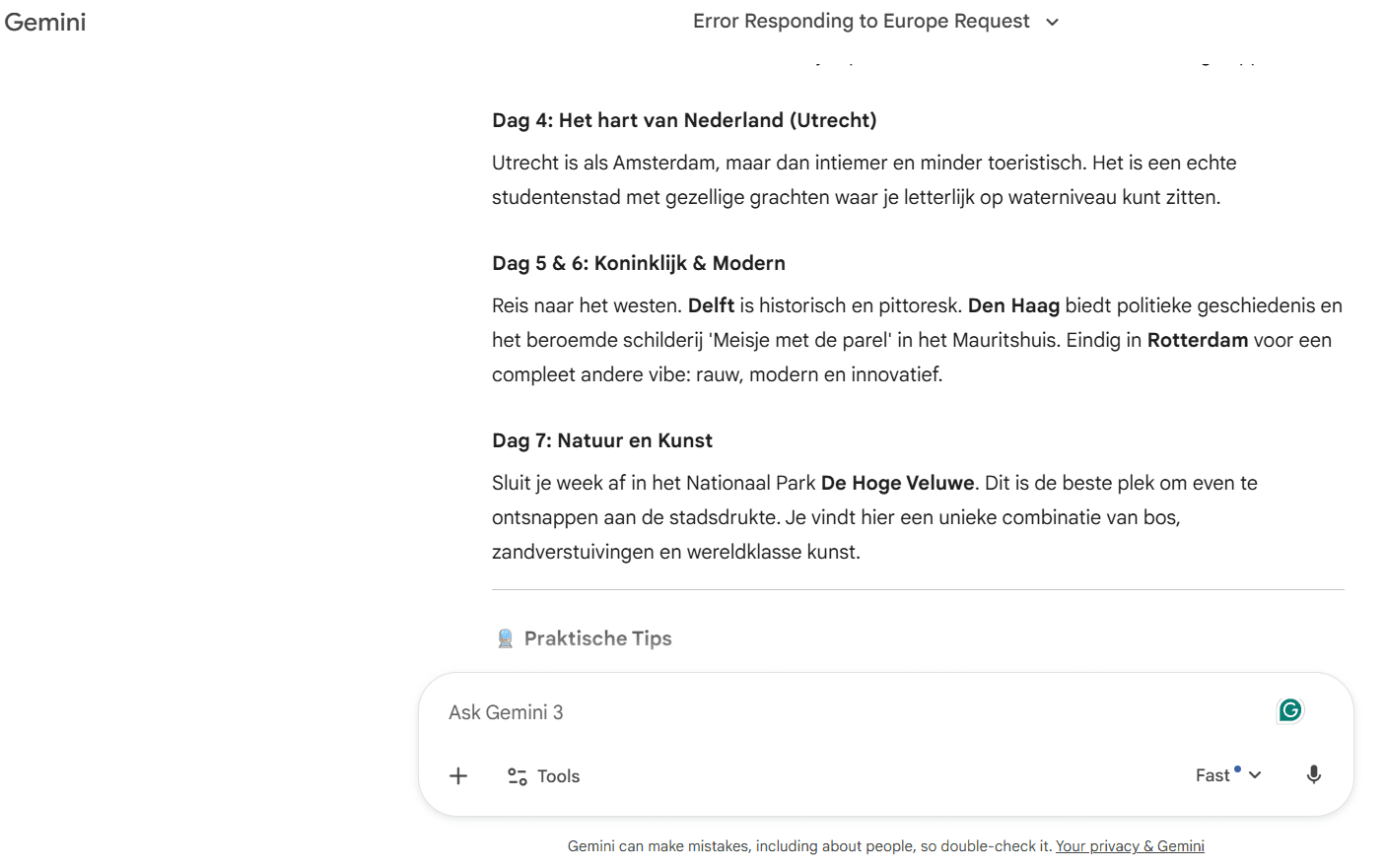
Day 5 takes you to Rotterdam to admire the architecture, have lunch in the Markthal, and then visit a few windmills in Kinderdijk.
On day 6, you can choose between a boat trip in Giethoorn or a visit to De Hoge Veluwe National Park and the Kröller-Müller Museum to view the next Van Gogh collection.
On the last day, a morning in Delft is planned to view the Delft canals and pottery. The afternoon will be spent in The Hague, visiting the Mauritshuis museum or Scheveningen beach. The day ends with a final dinner.
Popular hotspots
As the itinerary shows, without indicating interests, a holiday week in the Netherlands will be based on popular sights, easily accessible places and a balance between themes and interests that people may have. This will quickly lead you to the Amsterdam area. ChatGPT also makes it clear that travelling by train is easy and fast and that the suggested places offer culture, history, nature, the hustle and bustle of the city and opportunity for relaxation.
My conclusion
My conclusion: What the chatbots suggest when they do not have to take specified interests into account is logical. However, it does not entirely match my personal interests, and the Netherlands is more than just the Randstad. I would like to see more variety in activities and places that are not similar to each other. Valkenburg, for example, is a very nice village with elevation differences, caves and everything else that is not easy to find in the rest of the Netherlands. Or, take the city centre of Groningen, for example. There are many restaurants there that serve food from all over the world. It is also a great place to shop.
Personally, I would only use an AI travel planner or ChatGPT when I lack inspiration but still feel the urge to go on holiday. For a solo trip, I would also use it as a kind of sparring partner to discover what else I could do on days that are not yet filled in. In other words, for the time being, I would only use an AI travel planner when I lack inspiration.
No matter how good the generated planning or explanation sounds, ChatGPT, Gemini and Copilot remain language models. They do not search for information but use their training models to answer questions.