
AI as a friend: a helpful tool or a bad influence?
Child-friendly AI offers opportunities for learning and stimulating curiosity, but it also comes with risks.
Published on November 5, 2026
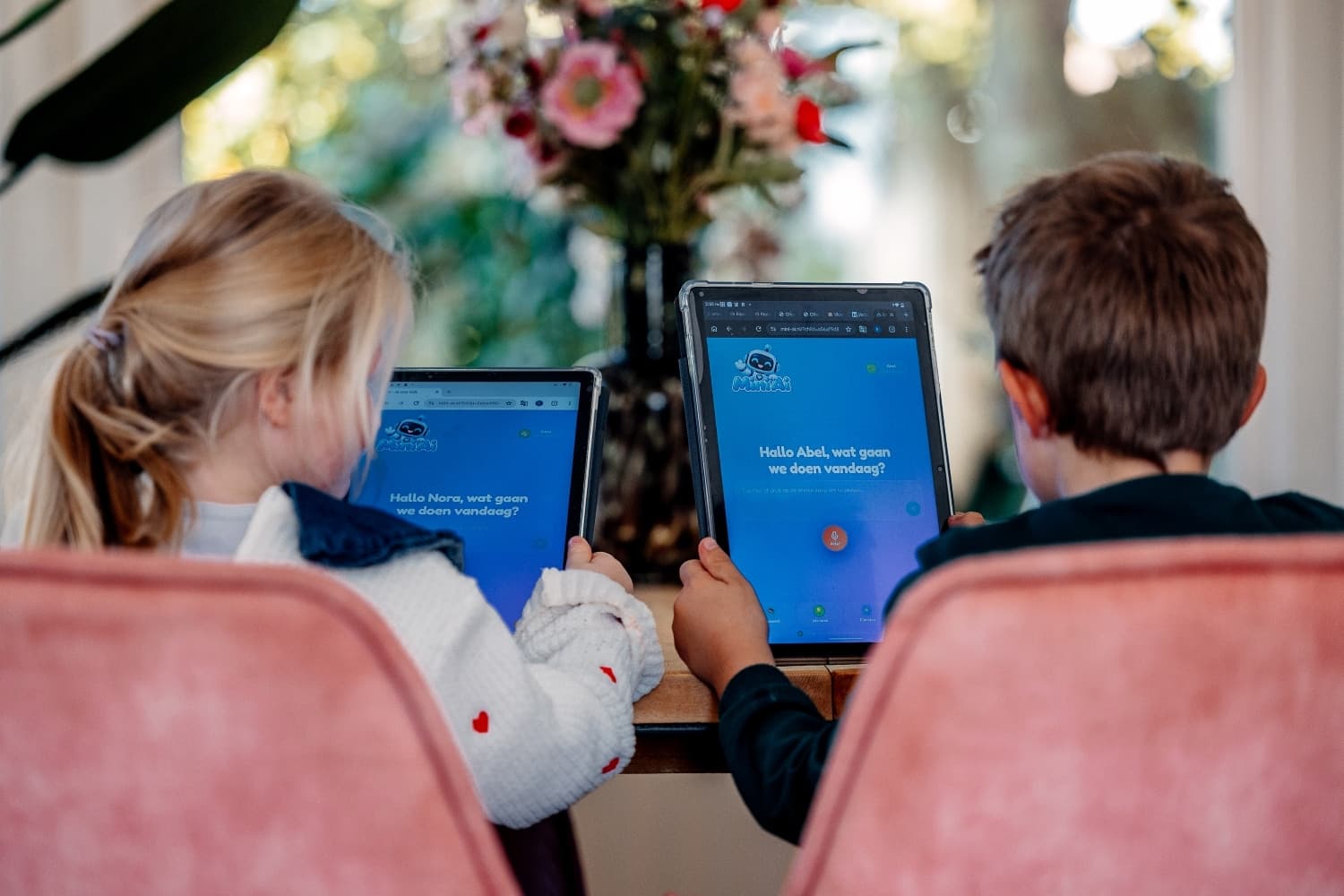
Children see their parents using ChatGPT and want to ask AI questions themselves. However, regular chatbots are not always suitable for young users. For example, they do not necessarily take a child's age into account and may provide answers that are inappropriate for their world of experience.
A few years ago, Dutch developer Nick Hoogveldt noticed that his own children enjoyed talking to AI, but he also saw its limitations. “An AI doesn't know how old a child is and sometimes says strange things,” he explains. That is why he developed MiniAI, a chatbot specifically designed for young users.
AI as a learning tool
MiniAI was developed to introduce children to AI in an accessible way. The application also helps them learn and do their homework. Rather than providing the answer straight away, the chatbot tries to guide children towards a solution themselves through explanations and examples.
Children can type their questions or simply ask them out loud. The AI then responds using a voice. This makes the application more accessible to children. “You should also be able to understand it without being able to read and type very well,” Hoogveldt says.
During testing, he discovered how important a simple interface is. For example, his own daughter would keep calling out to the screen when the AI did not respond as she expected. “That is why we extensively tested the interface and adapted it to the way children interact with technology.”
Parents can also view their children's conversations. When children ask personal questions, MiniAI refers them to their parents, as not every question is suitable for a chatbot to answer. These may include questions about sexual orientation, for example.
Inequality
According to Eliane Segers, professor of Learning & Technology at Radboud University and one of the programme leaders of the pedagogical and educational track at the National Education Lab AI (NOLAI), AI offers children opportunities to develop new skills.
Children are increasingly encountering the technology, not only online but also in everyday devices such as smart refrigerators. “Precisely because society is changing so quickly, it is important for children to learn how to use it.” If children only become familiar with AI at home, this could increase inequality between pupils. Children whose parents know a lot about AI can learn to work with it at home, while others may miss out on that opportunity and fall behind.
That does not mean AI should replace teachers. “You cannot let a computer or AI take over the classroom. That is complete nonsense. Teachers are indispensable by definition.” For example, a teacher can demonstrate how AI works on a digital whiteboard and deliberately show examples of the technology making mistakes. According to Segers, AI can help tailor education to individual pupils, for example in classrooms with different language levels and learning needs. The technology offers opportunities to support education, but its added value must be clear for each application.
Thinking skills
According to Segers, the impact of AI on children's thinking skills depends on how they use the technology. To explain this, she refers to the PISA study. “The study shows that pupils who say they use AI to do their work for them score lower than those who use AI to support their learning. And when someone else does my thinking for me, my abilities deteriorate. It's like going to the gym with a robot that lifts the weights for me.” When AI takes over the entire thinking process, children have fewer opportunities to practise thinking for themselves and solving problems.
Segers also warns that children can easily accept a chatbot's answers as the truth. AI can sound convincing even when the information is incorrect. This is particularly challenging for children, who often have less prior knowledge to recognise such mistakes. “If you have never seen grass before, it is difficult to argue with an AI that confidently tells you grass is blue.”
Chatbots that behave like a friend who always agrees with you also pose a risk, according to Segers. This is not limited to AI designed for children: regular chatbots, such as ChatGPT, can also reinforce users' beliefs, even when those beliefs are incorrect. “It is not healthy to surround yourself with people who always agree with you.”
AI as a real friend
Hoogveldt also noticed that children can start to see AI as a real friend. According to him, an earlier version of MiniAI's voice sounded so friendly that his daughter began to regard the chatbot as an actual friend. He therefore made the voice less emotional. Segers also warns about so-called emotional companions: children who start to see chatbots as their best friends. “At some point, a child may no longer be able to distinguish between what is real and what is fake.”
That is why children need to learn to assess answers critically and understand that AI can make mistakes. Parents and teachers play an important role in this. “You need to stay involved and show them how it works. Above all, show them when something goes wrong, so children understand that AI can say something stupid. They really need that awareness,” Segers explains.