
After the oliebol: How biotech and AI are redefining odor control
It may seem like a mundane post-holiday problem, but the battle against unwanted smells has become a technological arms race.
Published on January 1, 2026

Merien co-founded E52 in 2015 and envisioned AI in journalism, leading to Laio. He writes bold columns on hydrogen and mobility—often with a sharp edge.
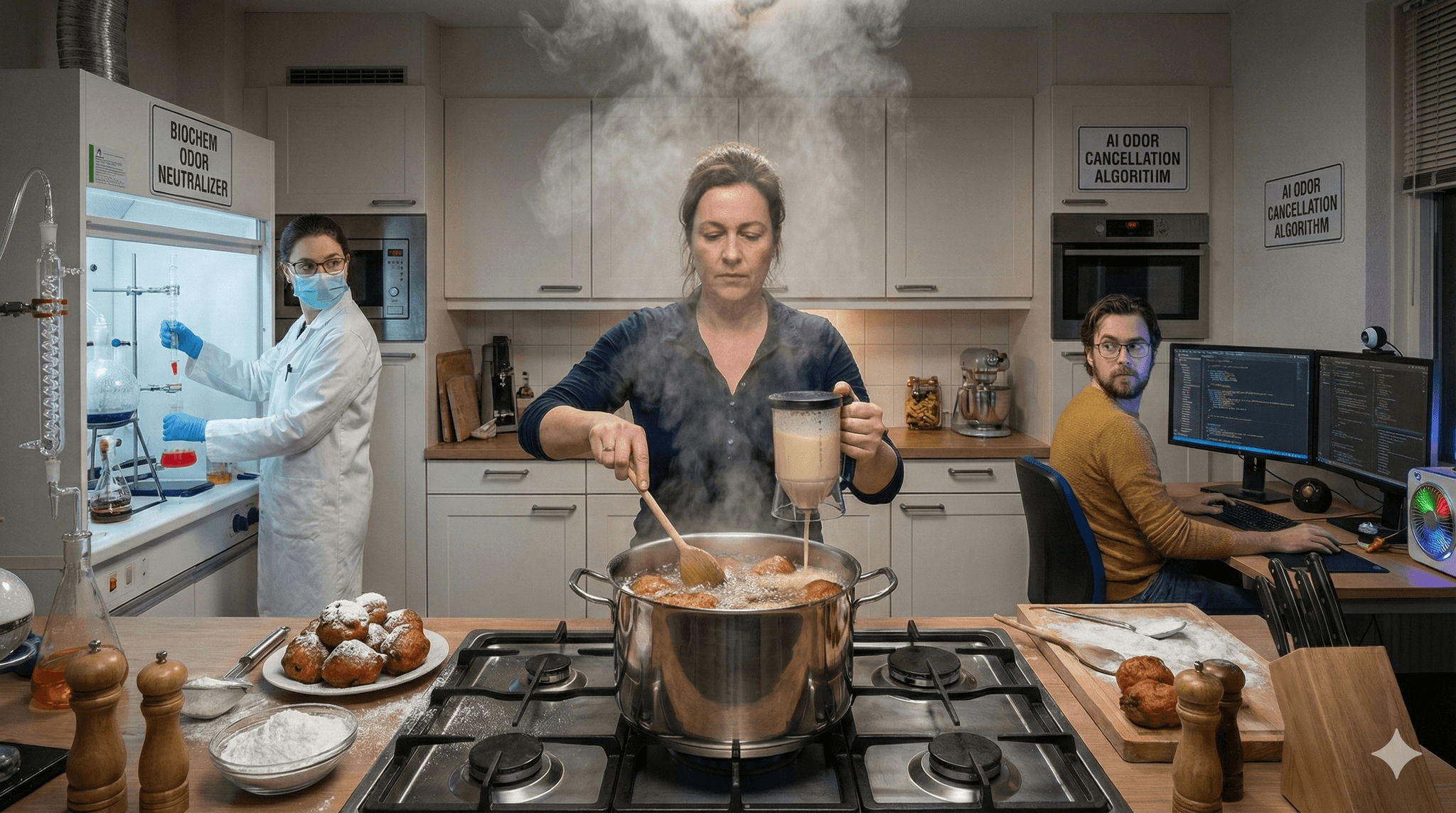
The pungent odor of gourmet grills and oliebollen that lingers in many living rooms and clothes after the New Year may feel like a trivial nuisance. Yet this annual “olfactory hangover” has become a litmus test for an industry worth billions worldwide. While consumers simply long for a fresh start to the year, chemical giants and tech companies see market validation for advanced molecular technologies. The days when odor control meant little more than masking smells with heavy perfumes are long gone. We are in the midst of a transition in which the sector is shifting from traditional petrochemical solutions to biotechnological innovations and AI-driven molecular design. The race to create the perfect, sustainable, and safe odor molecule is no longer just an aesthetic quest—it is a hard economic battle being fought in laboratories across the globe.
The chemistry of neutralization: beyond household remedies
The stubborn nature of the “gourmet smell”—a complex mix of fatty acids and combustion by-products—illustrates why traditional remedies often fall short. Fat molecules bind deeply to textile fibers, especially wool and synthetics. Experts warn that household solutions such as vinegar or vodka do little to counter these greasy compounds: they may work against bacterial odors, but fail against the chemical structure of cooking fumes.
The industry responded with supramolecular chemistry, marked by Procter & Gamble’s introduction of Febreze in 1996. Its core technology is beta-cyclodextrin, a ring-shaped carbohydrate molecule derived from corn starch. This molecule functions as a molecular trap: the hydrophobic cavity of the “donut” captures volatile odor molecules, while the hydrophilic exterior promotes water solubility. Innovation has not stood still. Modern formulations now include polymers such as “Duo PSB,” specifically engineered as odor magnets for hard-to-wash fabrics. This is no simple cleaning trick, but advanced chemical engineering designed to prevent odors from re-emerging before they are fully removed.
Pressure on the chemical industry to become more sustainable is forcing a fundamental rethink of production processes. While cyclodextrins still rely on relatively straightforward enzymatic conversions, the cutting edge is shifting toward advanced biotechnology. Industry experts, including Frances Shoemack of Abel Fragrance, compare this shift to the impact of electric vehicles on the automotive sector: an irreversible technological leap. Through precision fermentation, microorganisms such as bacteria and yeasts are used as microbial factories to convert sugars into specific fragrance molecules or to produce odor-neutralizing enzymes.
The rise of algorithms: AI as a “digital nose”
Alongside biotechnology, artificial intelligence is the second major disruptor of the fragrance industry. Traditionally, developing a new scent or deodorizing agent has been a slow and costly process, with raw material costs reaching up to €44,000 per kilogram and development cycles stretching over years. Major players such as Unilever are therefore investing heavily—most recently £85 million—in AI-driven R&D units.
These algorithms analyze vast datasets of molecular structures to predict scent profiles and performance before a single drop is mixed. Validation then takes place through advanced techniques such as gas chromatography–mass spectrometry (GC-MS) and double-blind sensory panels, testing whether AI-generated formulas truly stand out and meet specific olfactory descriptors. The Dutch initiative Algorithmic Perfumery (Moooi x EveryHuman) demonstrates how this technology can even enable hyper-personalization, with algorithms creating unique fragrance profiles based on questionnaires. This marks a shift from artisanal trial-and-error to a data-driven precision industry—essential to sustaining the projected annual market growth of 3.31% through 2030.
Regulation and strategic autonomy
This technological acceleration does not occur in a vacuum. It is shaped by Europe’s stringent regulatory environment, including the REACH regulation (Registration, Evaluation, Authorisation and Restriction of Chemicals) and the CLP regulation (Classification, Labelling and Packaging). The EU also requires the disclosure of 82 specific fragrance allergens, significantly narrowing the scope of discretion for perfumers and chemists.
While often seen as a bureaucratic burden, these rules in practice act as a catalyst for innovation. As traditional molecules come under scrutiny or are banned, companies are forced to develop safe biotechnological alternatives or use AI to design compliant formulas. This is strategically important for Europe: by maintaining the world’s highest safety and environmental standards—and the technologies to meet them—the continent turns regulation into an exportable form of expertise and high-value chemistry. It compels companies to be transparent throughout their supply chains, from the corn used to make cyclodextrin to the synthetic musks in the final product.
What to do about the smell of oliebollen? Freeze it.
Until this bio-technological revolution is fully realized, you don’t need a neuroscience breakthrough to deal with post-holiday odors at home. If you lack access to advanced biotechnology, thermodynamics still works just fine in your backyard. Simply hang that oliebollen-scented sweater outside overnight in freezing temperatures. This works not by magic but by physics: low temperatures drastically reduce the vapor pressure of volatile organic compounds, while the combination of convection and dry winter air facilitates desorption of odor molecules from textile fibers.
Sometimes, a crisp winter breeze and a basic understanding of phase transitions remain the most accessible way to start the new year fresh.
Happy New Year!