
A robot that 'makes' time: Ambyon brings calm to hospital chaos
With smart logistics robots, Ambyon aims to give healthcare professionals up to two hours per day back – time that can be spent on patients.
Published on April 4, 2026

Bart, co-founder of Media52 and Professor of Journalism oversees IO+, events, and Laio. A journalist at heart, he keeps writing as many stories as possible.
What if a robot doesn’t take over care, but instead creates room for better care? That is exactly the promise of Ambyon. The Brabant-based company develops an autonomous logistics robot that helps hospitals tackle their biggest bottleneck: lack of time. Not by automating medical procedures, but by taking over all the “side tasks.”
From personal experience to mission
The story of Ambyon does not start in a lab, but at a hospital bed. For CEO Willem-Jan Lamers, the trigger was painfully personal. “After the birth of our daughter, we unexpectedly ended up in the hospital,” he says. “The procedure went well, fortunately, but in the aftercare a lot went wrong. That had to do with a shortage of staff.”
That experience stayed with him. And twelve years later, their own research showed that the problem is not only a lack of people, but also how their time is spent. “Healthcare professionals spend up to two hours per day fetching medication, lab samples, and other supplies. That is pure waste.” That is where the mission was born: to use technology to allow healthcare workers to do what they are trained for: caring.
External Content
This content is from youtube. To protect your privacy, it'ts not loaded until you accept.
The hidden inefficiency in hospitals
In discussions about healthcare, the focus is often on staff shortages. Less visible, but at least as important, is logistical inefficiency within hospitals. Nurses walking back and forth endlessly. Doctors waiting for materials. Departments dependent on manual transport flows.
They are seemingly small tasks, but together they form a massive drain on time. “If we don’t act now,” says Lamers, “we will no longer be able to rely on the care we need in the future.”
Ambyon’s solution targets exactly this invisible problem: the movement of goods within the hospital.
Navigating through chaos
That sounds simpler than it is. Because a hospital is not a structured factory, but a dynamic, unpredictable environment. “A robot thrives on structure. And a hospital is extremely chaotic,” Lamers explains. “It’s like a busy intersection where everyone moves crisscross and ignores traffic rules.”
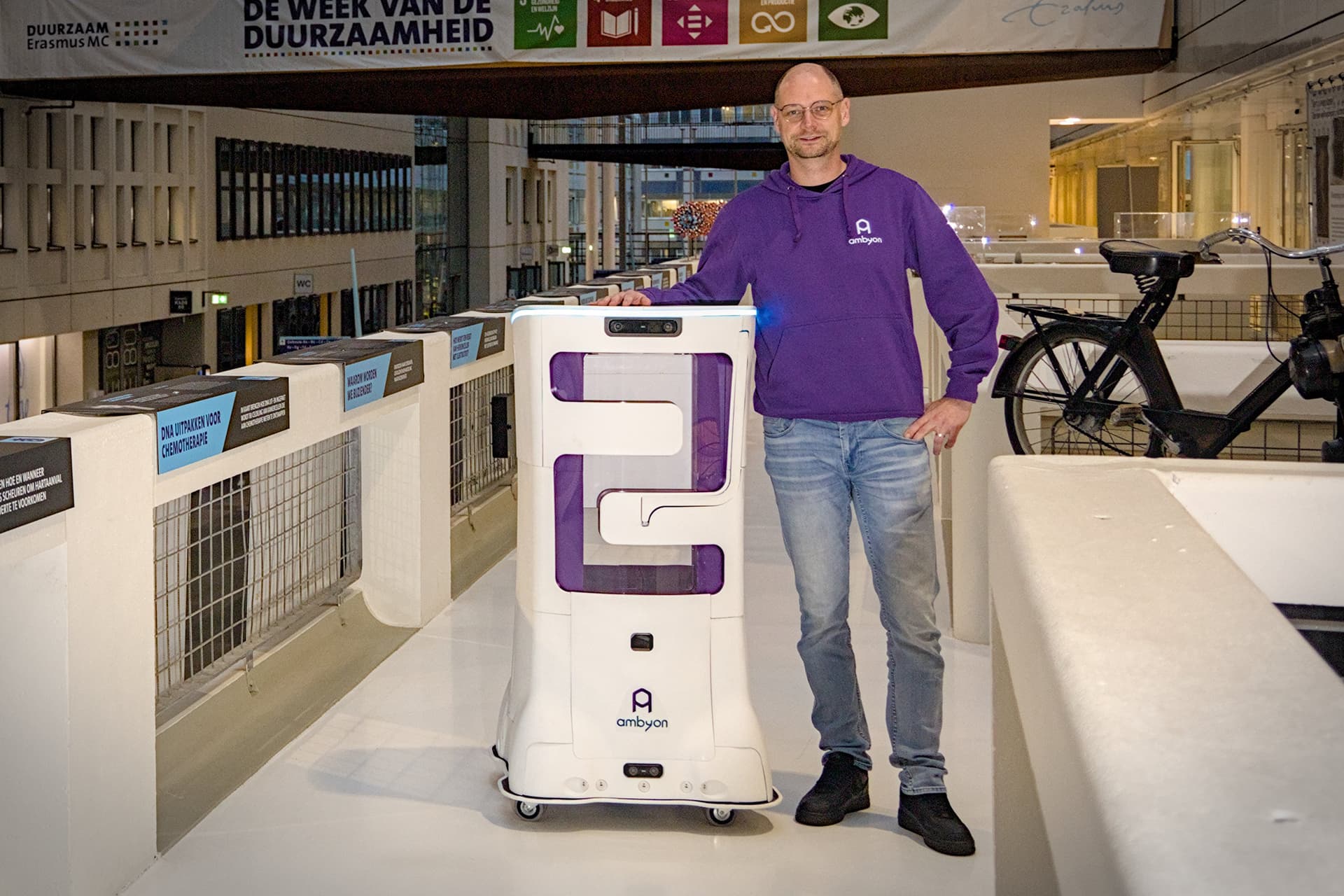
Where traditional robots struggle with that complexity, Ambyon takes a different approach. Their robot, the Ambyon One, does not try to structure everything in advance, but instead learns to deal with that chaos. “What humans do is anticipate. We use our eyes and our brains to predict situations. And that is exactly what our robot does as well.”
The power of anticipation
The technology behind Ambyon revolves around interpretation and prediction. The robot does not only look at what is happening, but also at what is likely to happen.
A door that opens? Then the chance is high that someone with a bed or wheelchair will come through. A group of people moving? Then the route changes. “Our robot sees objects, understands what they mean, and anticipates them,” says Lamers. “That prevents it from, for example, standing still in the middle of a doorway, something you still see with other systems.”
This “human” way of navigating turns out to be crucial for acceptance on the work floor. Because in a hospital, technology must not get in the way, literally and figuratively.
From pilot to practice
By now, the Ambyon One is already active in several hospitals. Four institutions are using the robot, and a fifth will follow soon. The impact is concrete and measurable: more than one hour of time saved per healthcare professional per day. "That is time that goes directly back to the patient,” says Lamers. “And that is what we do it for.”
It is not only about efficiency, but also about workload. Fewer logistical tasks means less stress and more focus on quality of care.
Technology as a silent force
Notably, Ambyon deliberately does not position itself as a “care robot” in the traditional sense. The robot does not perform medical actions and does not replace staff. On the contrary: it supports.
That positioning touches a sensitive nerve in a sector where technology is sometimes seen as a threat. Ambyon deliberately chooses a complementary role. The robot fetches medication, transports samples, and delivers materials. Tasks that are essential, but do not add direct patient value when performed by healthcare professionals.
National recognition?
Ambyon’s approach has not gone unnoticed. The company has been nominated for the Nationale Zorginnovatieprijs 2026, an important recognition within the sector.
Lamers also uses that nomination to tell the broader story. “With your vote, you help us gain national visibility,” he says. “So that we can bring our robots to even more hospitals and reduce the workload for healthcare staff.”